

Here's how to get started with connected and predictive maintenance.
Would you like to automate your business processes and boost customer satisfaction? Then let’s work together to develop AI agents that are precisely tailored to your processes—without unnecessary technological overhead, but with maximum value for your business.
While artificial intelligence dominates the IT agenda, its impact is mixed—using AI without a fundamental strategy and clearly defined goals does not automatically solve problems, but rather amplifies existing inefficiencies and drastically increases the volume of digital waste. (MaibornWolff Study on Technology Efficiency, p. 21)
At the same time, the pressure is mounting: 61% of companies report that the use of AI tools has increased by 2025. (MaibornWolff Study on Technology Efficiency, p. 21)
MaibornWolff supports you with an interdisciplinary team of experts through every phase: from a clear strategy to technical development and seamless integration into your existing systems. Alwaystailored to your needs, efficient, and focused on your goals—in line with our guiding principle: Less Technology. Better Business.
Our AI specialists combine expertise from three fields: artificial intelligence, cloud technologies, and software development. This results in solutions that are not only technically impressive but also prove their worth in practice: robust, scalable, and future-proof.
The following applies: Those who view AI merely as a panacea will be disappointed—but those who see it as a specialized tool will reap significant benefits. (MaibornWolff Study on Technology Efficiency, p. 23)
This is because 19% of respondents currently do not see any tangible business value in AI. (MaibornWolff Study on Technology Efficiency, p. 23)
There is also room for improvement when it comes to KPIs: Only 48% of companies have defined KPIs to systematically measure the actual benefits of their software solutions. (MaibornWolff Study on Technology Efficiency, p. 13)
The good news is that those who approach it the right way reap the benefits: 42% of respondents already see increased efficiency in their processes as the primary benefit. (MaibornWolff Study on Technology Efficiency, p. 23)
Our agents are tailored to your processes. They meet the highest standards of data protection, scalability and interoperability - and deliver reliable performance day after day, without breaks or after-hours.
We integrate your AI agents directly into existing systems. Your workflows continue to run as usual, only faster, smarter and less stressful. And without having to rebuild familiar processes.
We make success visible: KPIs show where you can save time, costs and nerves and still retain your customers for your brand. Our AI agents achieve different levels of autonomy - tailored to your needs.
We rely on scalable architectures and modern, interchangeable language models. This ensures that our AI agents remain fit even as requirements grow: today, tomorrow and the day after tomorrow. As reliable as on day one.
With the individual agent system, we can carry out our security updates with 100% accuracy - and our team has time to concentrate on the actual patches. Not a single engineer has to be distracted from their actual work.
We have been taking AI from buzzword to practice for over ten years. More than 70 successful projects later, we know: It's not just the technology itself that matters, but what your agents do in their day-to-day work and what benefits they bring to your business.
The focus is on agentic AI scenarios: In other words, AI agents that can interact independently, automate and make well-founded decisions.
After all, if AI is applied to inefficient processes, it will not result in greater efficiency, but merely in doing the wrong thing faster. (MaibornWolff Study on Technology Efficiency, p. 21)
We develop agents that communicate and act independently. Whether chatbot, voice assistant or complex system agent: our solutions think for themselves, interact in a context-sensitive manner and access external tools and data as required.
Our AI agents automate processes beyond individual steps. From capturing and processing requests to dynamic workflow control - the agents work proactively, in some cases continuously learning and fully integrated into your systems.
Well-founded decisions in real time: Our agents analyze current data, identify patterns and provide reliable forecasts, e.g. for maintenance, risk management or planning. Fully automated or as support for your team.
This is particularly true when it comes to modernization: By using AI agents, existing software landscapes and complex domains can be analyzed and modernized much more quickly. (MaibornWolff Study on Technology Efficiency, p. 23)
We use a reference architecture we have developed for AI agents, which consists of three central components, among other things. Your customized AI agents are created on this basis.
The Jevons Paradox strikes again: Since AI drastically reduces the cost and time required to create code and content, we are not producing less code in less time, but simply much more code overall—without proper governance, we risk an inflation of digital assets. (MaibornWolff Study on Technology Efficiency, p. 22)
59% of respondents fear that digital waste—specifically unused technical features, dead code, and redundant artifacts—will increase in the future as a result of AI. (MaibornWolff Study on Technology Efficiency, p. 22)
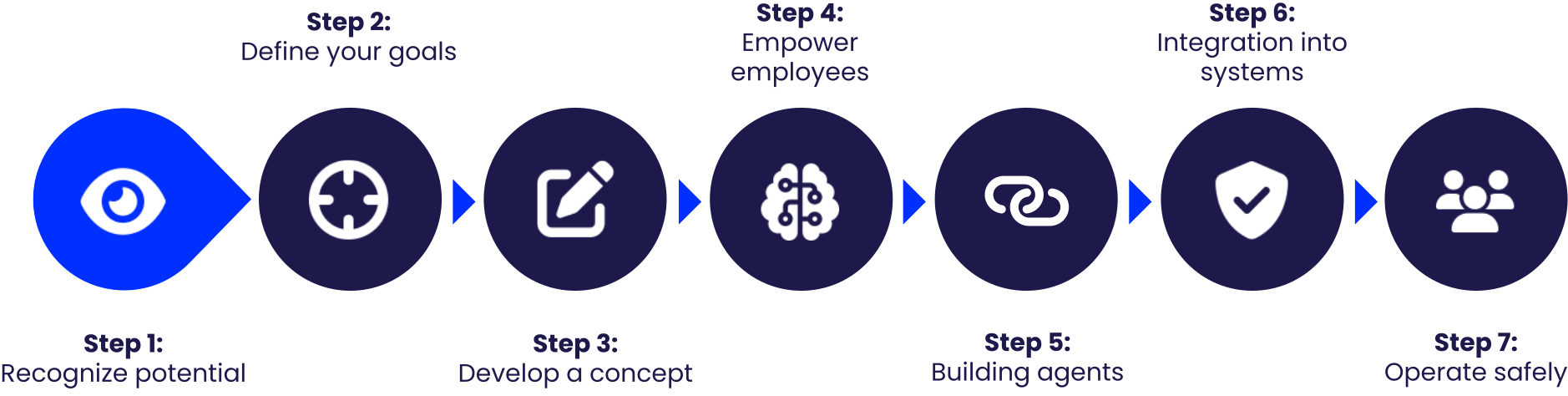
From the first flash of inspiration to the ready-to-use AI solution: we accompany you in seven clear steps: transparently, at eye level and with tangible results after each phase. So you always know where you stand, and we know together how to proceed.
This requires the right foundation: 68% call for a thorough requirements analysis before the project begins. (MaibornWolff Study on Technology Efficiency, p. 19)
And: 66% agree that documentation must be an integral part of the Definition of Done. (MaibornWolff Study on Technology Efficiency, p. 19)
We turn simple voice bots into real team players: AI agents that work together in an agentic AI system, make decisions independently and implement tasks. They make multi-stage decisions on what the next action is and which sources are to be used for this, drawing on their integrated memory if necessary. For solutions that not only sound smart, but also have an impact in everyday life.
Every company has its own challenges - and this is precisely where our strength lies. We do not develop off-the-shelf solutions, but design each AI project according to the individual goals and framework conditions. Our AI projects show how ideas become concrete results.
Aggregation of internal customer data & external data in a single web application
Data bundling & analysis with Amazon Bedrock
Intuitive user interface for sales, 88% reduced preparation time before customer visits
AI-supported service for orthopedic & sports medicine practices
Cloud-based web application for doctors for the automated, evidence-based creation of individually tailored patient training plans
New revenue source without fixed costs, higher patient retention, AI-supported & guideline-based
Customized assistance robots for people with physical disabilities in production
Integration of AI for automated adaptation of robots to people's capabilities
Effective empowerment of people with physical disabilities
Machine learning for time series forecasting
AutoML for automated adaptation of models to different data
Unified, scalable solution, optimized inventory costs, efficiency gains
Secure operation of AI in the European MS Azure cloud environment
Frontend & backend via MS Azure App, "Chat with your PDF" for TÜV employees
Quick implementation of new technologies (AI), strengthening knowledge management
Centralized planning of component manufacturing for cost- & resource-optimized production capacity worldwide
Conversion from local processing with fat clients to a client-server application, migration to the cloud
Data-based planning & calculation of different manufacturing scenarios & site-specific production costs
Centralized web-based IT system to replace individual isolated solutions
Event sourcing for planning & analytics, domain-driven design, cloud migration
Easy updates, expansion, maintenance, optimized security

AI agents have enormous potential - but in practice, similar obstacles keep cropping up. Companies are often faced with unclear objectives, have to deal with scattered data sources or must first build up the necessary understanding of AI internally. Regulatory requirements, non-scalable data architectures, unknown entry costs or the general question of how to get started also slow down many initiatives.
Our study paints a clear picture: German companies are drowning in complexity—investment in digitalization has been rising for years, yet operational productivity has stagnated in many areas. (MaibornWolff Study on Technology Efficiency, p. 2)
52% of respondents report that the use of inefficient software within their own companies has continued to increase over the past year. (MaibornWolff Study on Technology Efficiency, p. 5)
47% of IT managers and professionals feel overwhelmed by the sheer volume and frequency of new AI applications. (MaibornWolff Study on Technology Efficiency, p. 22)
This points to a classic SaaS sprawl scenario (unchecked proliferation of cloud applications), in which AI tools seep unchecked into business units as shadow IT without any central coordination. (MaibornWolff Study on Technology Efficiency, p. 22)
To ensure that innovative ideas do not fail in the face of reality, we support you wherever you need us: from the initial idea to the productive use of your agents.
Whether you’re a small or medium-sized business or a large corporation, our AI agents help you streamline processes, reduce costs, and make informed decisions more quickly. Once the obstacles are out of the way, you can get started with a pragmatic approach that delivers measurable benefits.
In this sense, the key to new competitiveness lies not in adding more tools, but in the ability to eliminate the unnecessary. (MaibornWolff Study on Technology Efficiency, p. 6)
Those who succeed in freeing up budgets from legacy system management create the financial capacity for innovation and a faster time-to-market. (MaibornWolff Study on Technology Efficiency, p. 6)
And this is what it looks like:
AI agents take over the pre-qualification of leads, automate quotation processes and prepare decisions based on data. This leaves your team more time for what no agent can replace: real customer relationships.
With agents who communicate around the clock, solve problems and connect relevant data sources, companies significantly increase service quality while simultaneously reducing costs. They have fewer tickets and more satisfied customers.
AI agents analyze documents, extract data, take over routine tasks such as invoice reconciliation or dunning runs and free up your specialists for their actual tasks.
Technical AI agents automatically prioritize tickets, suggest appropriate solutions, and perform simple tasks on their own. This reduces response times and gives your team more time for their core business.
After all, 56% report a noticeable loss of time due to a lack of integration and the resulting system disruptions. (MaibornWolff Study on Technology Efficiency, p. 10)
The core problem here often lies in the lack of interoperability between systems—when software solutions do not communicate seamlessly, humans must act as an interface. (MaibornWolff Study on Technology Efficiency, p. 10)
A significant portion of IT resources is not directed toward innovation, but rather toward managing unnecessary complexity. (MaibornWolff Study on Technology Efficiency, p. 8)
With access to machine data, AI agents analyze operating states, suggest maintenance measures and help to prevent breakdowns. As a result, everything runs more smoothly and expensive downtimes become the absolute exception.
AI agents compare offers, evaluate supplier performance and proactively identify risks in the supply chain - transparently and in real time. You sleep more soundly because risks are identified and mitigated at an early stage.
Whether it’s forecasts, scenario analyses, or business cases, AI agents process decision-relevant information and support management with well-founded insights. This allows them to make more informed decisions, relying less on gut instinct and more on clarity.
Only 25% of experts believe that the benefits of their current IT projects significantly outweigh the costs involved. (MaibornWolff Study on Technology Efficiency, p. 10)
Nearly half of the respondents do not see any tangible added value for their company in the software solutions currently in use. (MaibornWolff Study on Technology Efficiency, p. 13)
Here's how to get started with connected and predictive maintenance.
Was M2M bedeutet, wie es funktioniert und wo es in der Praxis eingesetzt wird.
Seize opportunities, manage risks—and make informed decisions.
AI governance allows you to establish a framework for the use of AI in your organization.
Successful AI implementation requires expertise and a clear roadmap.
Streamline processes, structure interfaces, and implement automation where it makes sense.
Stabilise processes, reduce complexity, make results measurable.
Simplify processes, identify potential, and use automation in a targeted manner.
Stabilize processes, reduce complexity, create measurable benefits.
How to bring your AI system into line with applicable laws and ethical standards.
How AI is making the automotive industry more efficient, smarter, and more competitive.
How AI works explained in simple terms—from data to models to benefits.
How data can help you make clear decisions.
AI is more than just hype: it is already being used today - in everyday life, in business, for society.
You automate, analyze, decide - and make your business fit for the future.
Understanding and using LLMs: What they can do, where they can help – and how to get started.
Use generative intelligence strategically, securely and with clear added value.
Descriptive analytics explained – definition, process, benefits and specific examples.
Predictive maintenance explained: making maintenance more predictable, efficient and smarter.
Using AI correctly: data, opportunities, challenges and concrete solutions.
Potential and areas of application for AI, tips and examples for sustainability.
Understanding artificial intelligence simply: applications, impact and future opportunities.
Whisper on the Pi? It works – but not everything. Practical insights from Marno Janetzky.
How AI is driving innovation, efficiency and new technologies in industry.
Better estimate customer demand: definition, methods and added value of demand forecasting.
How predictive quality helps increase customer satisfaction and reduce production costs.
AI in practice: use cases from sales to production, with opportunities and obstacles.
An autonomous AI agent plans, decides and executes tasks independently - without dedicated prompts. It uses tools, accesses data, remembers contexts and adapts dynamically. These capabilities make it possible to take on complex processes that go far beyond simple chatbots.
AI in controlling recognizes patterns in large amounts of data, creates forecasts, automates reports and detects anomalies. In this way, it provides a sound basis for decision-making, saves time and increases accuracy - especially when it comes to forecasts, scenario analyses and budget deviations.
AI agents are seen as a central component of the next wave of digitalization. They combine generative AI with automation, tool use and the ability to learn - enabling productive, interactive systems that control processes independently and bring real efficiency gains.
A prompt is an explicit prompt that is used to control classic language models. Autonomous AI agents work differently: they plan their next steps themselves - without needing a prompt for each step.
Which tools AI agents use depends heavily on the use case. For example, AI agents can access internal systems, control APIs, interact with databases or use external services such as calendars, email clients or Jira. The important thing is that they can use these tools independently and depending on the context.