
Demand Forecasting: How accurate forecasts strengthen your competitive advantage
Estimated reading time: 10 minutes

Do you already know today what your customers will want tomorrow? Demand Forecasting makes it possible! With precise demand forecasts, you can avoid bottlenecks, allocate resources more effectively, and respond more quickly to market changes. In this guide, you will learn what lies behind it and how you can successfully integrate Demand Forecasting into your company.
-
What exactly is Demand Forecasting? It refers to the data-driven prediction of future demand for products or services. While forecasting provides the analysis, Demand Planning implements these forecasts operationally in production and logistics.
-
Why is the effort worthwhile? Companies optimize their resource planning through precise forecasts and significantly reduce inventory costs. At the same time, customer satisfaction increases because bottlenecks are avoided and products are available exactly when customers want them.
-
Which methods lead to the goal? Approaches range from qualitative expert assessments for new markets to statistical models. Today, AI methods represent the gold standard, incorporating complex patterns and external factors such as weather or trends into the calculation.
-
How does AI change forecasts? Deep Learning and Foundation Models such as TimeGPT enable highly precise predictions without extensive manual training. These systems automatically detect subtle market changes and dynamically adapt to new data situations.
-
What matters when implementing it? Success requires excellent data quality and seamless integration into existing ERP systems. In addition, models must be protected against “Data Drift” through monitoring and regularly adapted to current market conditions.
What is Demand Forecasting? A definition
Demand Forecasting (German: demand or needs forecasting) refers to the data-driven prediction of future demand for products or services. As a core element of supply chain management, it uses historical sales data and external variables to proactively manage inventory.
While Demand Forecasting provides purely the analytical prediction, Demand Planning takes over the operational control. Planning uses the forecast data to align inventories and capacities across departments precisely with the expected demand.
Why is Demand Forecasting worthwhile for your company?
Whether in the automotive industry, retail, or hospitality: Demand Forecasting replaces gut feeling with data-driven precision. Modern tools already show you today what your customers will want tomorrow – often before they articulate it themselves.
This proactive approach makes it possible to manage resources more efficiently and respond flexibly to market changes. The following key advantages help secure your decisive competitive edge:
Efficient resource planning and inventory management
Demand Forecasting is the foundation for planning production, inventory, procurement, and personnel. With precise demand forecasts, companies ensure that materials and capacities are available exactly when the market requires them.
This minimizes costly overstock and significantly reduces storage costs. At the same time, production stoppages caused by missing components are prevented, as procurement is managed proactively based on the forecast data.
Optimizing the supply chain and inventory management
Demand Forecasting makes it possible to identify material requirements early and synchronize the entire supply chain. Manufacturers and distributors gain planning reliability, which stabilizes the flow of materials and makes coordination with suppliers significantly more efficient.
In the automotive industry, manufacturers know in advance how many variants of a model – for example with or without seat heating – customers will order. These forecasts ensure the exact quantity of materials and form the foundation for smooth timing in production.
Adaptive market management through Dynamic Pricing
Demand forecasts make it possible to identify demand fluctuations early and respond accordingly. They form the strategic foundation for Dynamic Pricing in order to actively balance supply and demand through pricing.
Especially in the airline industry or in the energy market, this makes it possible to maximize revenues. Companies adjust their prices in real time to market conditions, which both improves capacity utilization and strengthens competitiveness.
Higher customer satisfaction through reliable availability
Empty shelves or “out-of-stock” messages in the online shop frustrate customers and often lead to an immediate switch to competitors. Such negative experiences not only harm current sales but also weaken brand loyalty and trust in your company in the long term.
Demand Forecasting ensures that products or ingredients are available exactly when demand arises. By reliably meeting customer expectations and avoiding disappointment, you increase satisfaction and build long-term customer loyalty through maximum delivery reliability.
How Demand Forecasting works: 3 key methods
Demand Forecasting does not look the same in every company. Which method is right for you depends, among other things, on the data available to you. In practice, different methods are often combined in order to achieve the most accurate prediction possible.
1. Qualitative methods: expertise instead of history
Qualitative methods are based on subjective assessments rather than large volumes of hard data. They are primarily used when historical data is missing – for example when entering new markets or launching entirely new product categories.
In this case, customer opinions as well as the expertise of internal employees and external experts are used. While this method provides quick impulses, its forecasting accuracy usually remains behind data-driven approaches.
Established qualitative methods include:
-
Market research & Delphi method: Structured expert surveys conducted in several rounds.
-
Sales Force Composite: Forecasts based on the assessments of the sales team.
-
Visionary forecasts & panel consensus: Strategic judgments made by expert panels or management rounds.
2. Causal models: understanding cause and effect
Causal models analyze the relationship between different variables in order to make predictions. They assume that factors such as pricing or marketing activities directly influence demand.
-
Regression models: Here, a dependent variable (e.g., revenue) is calculated based on independent drivers (e.g., advertising spending). In addition to linear regression, neural networks, Random Forest, and Support Vector Machines (SVM) also fall into this category.
-
Time series analysis: This method uses historical data (sales figures, customer inquiries) to identify temporal patterns such as trends or seasonal fluctuations. Statistical models such as ARIMA or exponential smoothing help determine whether demand remains stable or changes.
3. AI and Deep Learning as a game changer
Modern AI methods are revolutionizing Demand Forecasting by complementing classical statistics with Machine Learning (ML). Deep learning models identify complex patterns in massive datasets that remain hidden to human planners.
A key advantage is the integration of external variables: whether weather data, market trends, or regional holidays – artificial intelligence (AI) automatically weighs these factors in order to continuously increase the precision of the forecast.

Then take a look at our article on AI use cases.
Technology & integration: forecasts in operational use
An effective demand forecast requires seamless integration into your existing system landscape. Only when forecast data flows automatically into ERP systems such as SAP or Microsoft Dynamics can it deliver its full impact for resource planning.
For the technical implementation, we rely on specialized analytics platforms and ML tools such as Azure Machine Learning or Amazon SageMaker. These enable the development of precise, tailored models that go far beyond standard statistical approaches.
The results are visualized in intuitive dashboards via BI tools such as Tableau or Power BI. This allows planners to identify trends and deviations at a glance and make proactive decisions based on reliable data.

Get individual advice and integrate smart technologies – for a future-proof orientation of your company.
Challenges in demand forecasting
The implementation of precise forecasting models involves specific pitfalls that go beyond purely technical aspects. To ensure that your Demand Forecasting delivers reliable results, the following factors must be taken into account:
The fuel question: Which data does your Demand Forecast need?
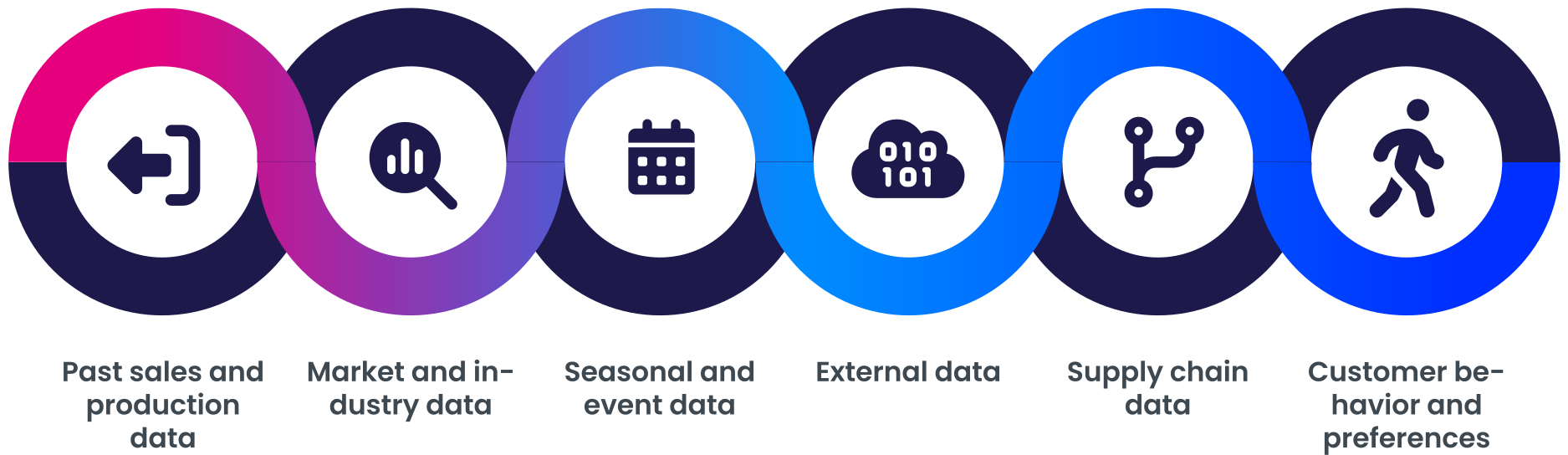
The precision of your forecasts stands and falls with the quality of the data base. For effective Demand Forecasting, you should integrate the following data streams:
- Historical performance: Past sales and production data as the core of any analysis.
- Market dynamics: Information about competitors and industry trends.
- Seasonality & events: Holidays, promotions, or external major events (trade fairs, sports events).
- External factors: Weather data for the hospitality sector or the energy market.
- Supply chain signals: Raw material availability and delivery times.
- Customer insights: Feedback and changing purchasing behavior.
Data understanding: the bridge between tech and business
Without a deep understanding of the data, even the best algorithms lead to misinterpretations. Developers must know the sources and logical relationships in detail in order to avoid spurious correlations and evaluate models on a solid basis.
A close symbiosis between technical development and business departments is essential for this. Only through this exchange can it be ensured that AI models correctly reflect real market dynamics and deliver results that are viable in practice.

This series explores technology, organization, and governance—so you can safely and scalably integrate AI into your business. Available in German language.
Creating acceptance through transparency
AI-supported forecasting often fails due to a lack of trust among users. Planners who have worked manually for years need transparent model logic instead of “black box” solutions in order to apply the new forecasts confidently in their daily work.
Success depends on awareness of data maintenance within operational teams. Only when the added value of automated precision becomes clear in everyday work does skepticism turn into productive use.
Ensuring quality and optimizing models
Reliable forecasts require continuous two-stage validation. While the technical evaluation keeps cloud costs and performance in view, the functional review ensures the logical plausibility of the results for real-world operations.
Because forecasting models quickly become outdated due to market changes, regular retraining based on current data is essential. For this purpose, we rely on modern monitoring tools that calculate so-called “drift scores”.
As soon as market data deviates too strongly from the original baseline (data drift), the system automatically triggers a new training cycle. This iterative optimization prevents incorrect forecasts and ensures the highest forecast quality in the long term.
Make a clear distinction between adaptation and forecasting cycles. While the model may only be retrained (updated) on a weekly basis, it can still generate new demand forecasts (forecasts) on an hourly basis based on the data currently coming in.

We develop tailor-made IIoT solutions for your company.
Best practice: AI-supported forecasting at Siemens
Together with Siemens, MaibornWolff developed an AI-based platform to optimize production planning. The goal of the project was to significantly reduce inventory costs through a machine learning system for precise time series forecasts.
With the help of Automated Machine Learning (AutoML), tailored models for over 100 products were created in record time. These shortened the testing phase to just a few weeks and made the system quickly ready for use.
Today, planners in the plants use the solution as a self-service tool. Thanks to the scalable architecture, the system is gradually being rolled out to additional locations and the entire product portfolio, which significantly increases global production efficiency.
The future of forecasting: your advantage with MaibornWolff
In dynamic markets, Demand Forecasting is the key to a resilient supply chain, reliably meeting customer demand while making your resource planning as efficient as possible.
MaibornWolff combines deep IT expertise with modern AI know-how. We support you from the initial data strategy through model development to the seamless integration of forecasts into your operational business processes. Together, we turn your data into real competitive advantages and prepare your company for the challenges of tomorrow.
Let’s work together to unlock your potential in demand forecasting and implement customized AI solutions. Our experts look forward to guiding your project to measurable success.
Frequently asked questions about Demand Forecasting
What is the difference between Demand Forecasting and Demand Planning?
Demand Forecasting provides the purely analytical prediction of future demand based on data. Demand Planning uses these forecasts for operational control. It aligns inventories and production capacities across departments. While the forecast estimates what will happen, planning ensures that the resources are available to fulfill it.Which forecasting methods deliver the most accurate results?
AI-supported deep learning methods and foundation models such as TimeGPT usually provide the highest accuracy. They identify complex patterns in massive datasets that classical statistics overlook. However, the choice depends on the data: when historical data is missing, qualitative expert assessments remain indispensable. In many cases, combining different methods delivers the most precise results.
Which tools are essential for modern demand forecasts?
Efficient forecasting requires specialized analytics platforms as its backbone. Business Intelligence tools such as Tableau visualize trends, while ML platforms such as Azure Machine Learning enable tailored forecasting models. For the real-time integration of large datasets, streaming software such as Apache Kafka is essential. The foundation is always clean data from ERP systems such as SAP.What role does IIoT play in Demand Forecasting?
The Industrial Internet of Things (IIoT) acts as a real-time data source for maximum precision. It feeds information from production and the supply chain directly into forecasting models. This allows companies to respond more quickly to changes and automate processes. The integration prevents isolated silo solutions and unlocks the full potential of demand forecasting.
Kyrill Schmid is Lead AI Engineer in the Data and AI division at MaibornWolff. The machine learning expert, who holds a doctorate, specialises in identifying, developing and harnessing the potential of artificial intelligence at the enterprise level. He guides and supports organisations in developing innovative AI solutions such as agent applications and RAG systems.