
IT Automation: Scale Processes Measurably
Estimated reading time: 10 minutes

Manual routine work, growing hybrid cloud complexity, a labor market that barely has any room left – IT departments have enough on their plate. IT automation addresses this: automating the right processes so that your operations become more stable, faster, and more cost-effective. This guide provides you with a concrete roadmap for automating your IT processes – from process understanding through maturity levels and typical mistakes to a measurable entry plan.
Key Takeaways
- What is IT automation? Executing recurring IT tasks – provisioning, configuration, monitoring, incident management – with appropriate tools as far as possible without manual intervention. The goal: an IT infrastructure that adapts reliably, quickly, and securely to changing requirements.
- Why now? Skills shortages, growing hybrid cloud complexity, increasing compliance requirements (GDPR, EU AI Act), and cost pressure are turning manually operated IT processes into a structural bottleneck.
- What is automated – and with what? IT automation is one of three domains alongside business process automation and production automation. AI, RPA, or Infrastructure as Code (IaC) are not domains – they are tools that can be used across all three.
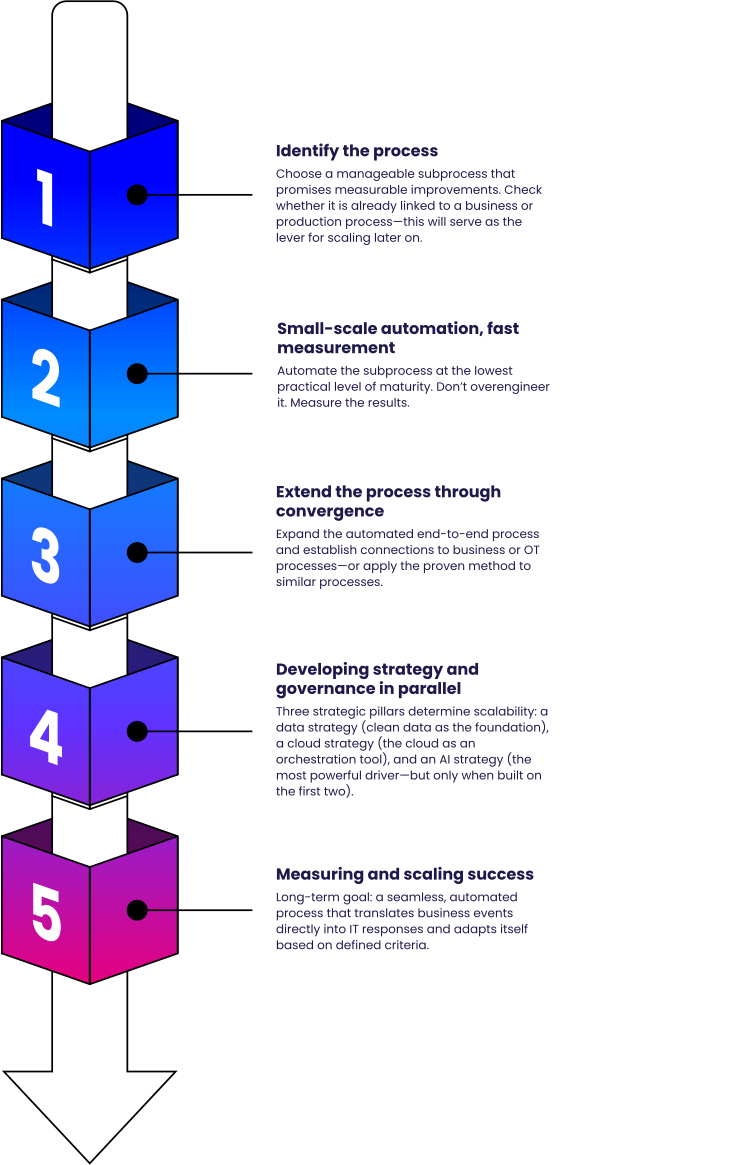
- How do you get started? Not by selecting a tool, but by choosing the right process. The pragmatic approach: identify a process, automate small, unlock convergence, build strategy & governance, measure success.
- What are the biggest risks? Automating bad processes, letting shadow automation grow unchecked, not monitoring the automation itself, and underestimating the human factor.
- How do I recognize success? Define KPIs before automation. Four dimensions: speed (MTTP, MTTF), quality & stability (MTTR, change failure rate), cost-effectiveness (ROI, cost per incident), and convergence progress. ROI typically unfolds over 6–8 months.
- Where is the trend heading? Autonomous AI agents complement rule-based automation. Self-healing becomes self-optimization. Convergence between IT, business, and production processes becomes a fundamental prerequisite. Those who invest in clean processes and open architectures today will help shape this evolution.
What is IT automation?
IT as a Process Domain
In IT automation, IT is understood as a domain – the "what." The technology is the "how." IT automation means redesigning IT processes so that recurring tasks are reduced to the desired degree. The tools can be shell scripts, cloud admin tools, RPA, AI, self-service tools, or custom software solutions and third-party software.
In this guide, by IT processes we mean those that provide infrastructure and IT services for business and production.
IT processes and their automation potential
Process focus | Examples |
|---|---|
| IT resources themselves | Provisioning of servers, networks & devices, monitoring & incident management, problem detection, configuration management |
| IT resource requirements | Provisioning of access rights, security & compliance policy checks, quality standards |
| Request management | Service processes (ITSM), ITIL (service design, transition, operation), governance |
A large portion of IT processes are bulk or recurring operations. The goal: fewer manual interventions, fewer errors, more speed.
The special role of IT: Domain and tool at the same time
IT holds a unique dual role in the automation landscape, because originally IT was not a separate process domain, but a tool for optimizing business and production processes:
- IT as a domain: IT processes are themselves an automation target. Provisioning, monitoring, and incident management can and should be automated.
- IT as a tool: At the same time, IT is the foundation of every other automation. Without IT, there is no process automation, no RPA, no AI automation, no production control.
The best first step? A conversation.
Why now?
Convergence of process domains
Through digitalization, the boundaries between business, production, and IT processes are disappearing. Financial companies are becoming FinTechs, car manufacturers are becoming software companies, energy suppliers are becoming SmartEnergy platforms. Because the three domains are increasingly merging, the leverage multiplies when companies automate their IT processes.
Increasing requirements
- Skills shortage: 109,000 unfilled IT positions in Germany (Bitkom, 2025) – the bottleneck is structural.
- Hybrid cloud complexity: Multi-cloud environments and distributed architectures can hardly be managed consistently by hand anymore.
- Increasing compliance requirements: GDPR, the EU AI Act, and industry-specific regulation require automated controls – manual audits don't scale.
- Cost pressure: Automated processes measurably reduce error costs and cycle times while freeing up capacity for strategic tasks.
Process automation in IT: How does it work and how do you get started pragmatically?
Automation makes a good process faster. A bad one it just makes bad faster.
IT automation doesn't start with tool selection, but with the process.
The process is the foundation
Anyone who wants to automate IT processes must first understand the process. How consistently is it modeled end-to-end, or does it exist as a patchwork of scripts and workarounds? And above all: Is this IT process already connected to a business or production process, or does it run in isolation?
The more consistently a process is modeled end-to-end, the higher the degree of automation. An isolated process always creates manual handovers at its boundaries. This is where the circle closes back to convergence: an onboarding process that automatically triggers account creation and device provisioning; a machine event that triggers a monitoring alert and incident ticket without a media break. Process mining makes visible where these connection points lie.
Methods and tools by IT process type
The architecture depends on the maturity level, IT landscape, and the processes to be automated:
| IT process | Automation approach | Example tools |
|---|---|---|
Infrastructure rollout | Infrastructure as Code with GitOps | Terraform, Ansible, Pulumi |
| Configuration management | Consistent system states across fleets | Ansible, Puppet, Chef |
| Infrastructure quality | Compliance as Code, IAM | Open Policy Agent, Checkov |
| Monitoring | AIOps | Dynatrace, Datadog, Prometheus, Grafana |
| Event-Driven Automation | Systems react to events instead of schedules | PagerDuty, Argo CD, Flux |
| Incident Management | Workflow automation + AI | PagerDuty + LLM, ServiceNow |
| Security & vulnerabilities | SOAR – automated detection and response | Splunk SOAR, Palo Alto XSOAR |
| Request Management | Self-service, self-provisioning | ServiceNow, Bots |
Event-driven automation is the decisive maturity leap: Instead of reacting to schedules, the system reacts to events in real time – MTTR (Mean Time to Repair) can be reduced by 50–70%.
Maturity levels of IT automation
Automation is not a switch, but a development path:
- Level 1 (Script): Shell scripts or cron jobs replace individual manual steps – purely IT-internal.
- Level 2 (Workflow): Ansible or GitHub Actions orchestrate multiple steps, also IT-internal.
- Level 3 (Platform): Processes are centrally managed and versioned (Terraform, ServiceNow), first business-IT connections emerge.
- Level 4 (Adaptive): AIOps and event-driven automation respond autonomously to events. IT, business, and production (OT, Operational Technology) are connected.
- Level 5 (Self-Healing): The system detects and resolves problems autonomously. All three domains must be converged.
Without convergence, levels 4 and 5 are practically unattainable. No company needs to start at level 5 right away, but you should know the path.
The pragmatic start in five steps
Typical mistakes and how to avoid them
...is the most common and most expensive mistake. What helps: Understand and clean up the process first, use process mining, explicitly model edge cases or exclude them from scope.
...arises when teams independently build scripts and pipelines – undocumented and with no one responsible. The solution is not prohibition, but channeling: a central platform as a single source of truth and lightweight governance.
Automated processes run silently in the background, even when the results are wrong. Every automation needs observability from the start: logs, alerts, health checks, and clear ownership.
IT infrastructure is an organically grown bundle of components; a change can have unexpected effects. What helps: Version IaC and test in staging, keep changes small, define rollback plans, have policy as code check every change.
...through proprietary platforms. Those who don't separate automation logic from the platform create dependency. Prefer open standards and evaluate exit costs when choosing tools.
...particularly affects highly digitalized companies: More time flows into maintaining the automation than into the product. The rule of thumb: Abstract everything that doesn't contribute to market differentiation or purchase it as a managed service.
When employees don't understand why automation is being introduced, resistance arises. Early involvement, transparent communication, and training are success factors. The mindset shift: Automation shifts work from routine to tasks where human judgment is needed.
Measuring success
The effort is immediately visible, the benefit only months later. That's why: Define KPIs before automation – not after.
IT automation has an impact on four levels:
- Speed (MTTP, Deployment Frequency)
- Quality and stability (MTTR, Change Failure Rate, Compliance Rate)
- Cost-effectiveness (ROI, Cost per Incident, Resource Utilization)
- Convergence progress (Share of automatically triggered IT processes, media breaks in the E2E process)
The ROI (Return on Investment) typically unfolds over 6–8 months. The fourth dimension is the most strategically important and the least frequently measured.
The simplest rule of thumb: before every project, define three things. What takes how long today (baseline), what should improve (target), when will it be measured again (time point).
Also read our guides on the following topics: Process Automation, AI Automation, Robotic Process Automation (RPA), Automation in Production.
Outlook: Where is IT automation heading?
From automaton to agent
Current IT automation is rule-based: an event occurs, a defined reaction follows. The next stage is autonomous AI agents that don't just execute IT processes but independently analyze and initiate actions. An agent detects a traffic spike, assesses it as an attack, isolates affected systems, and escalates to the security team in seconds.
Agentic AI will fundamentally change AIOps within the next three to five years; not replace it, but the boundary between "the system reacts" and "the system decides" will blur.
From automatSelf-optimizing instead of self-healingon to agent
Self-healing – infrastructure that autonomously detects and fixes errors – is already in use, but reactive. The next stage is self-optimization: the system continuously improves itself based on usage patterns, load forecasts, and quality criteria. Infrastructure that reconfigures itself before a bottleneck occurs; compliance systems that automatically incorporate new requirements.
The distinction between "operating infrastructure" and "optimizing infrastructure" will no longer exist in five years. The prerequisite: Convergence between business, production, and IT processes. Agents and self-optimization only work with access to complete, cross-domain processes.
What this means for your IT organization
- Process quality is the most important investment. Agentic AI and self-optimization can only be as good as the processes they build upon.
- Open architectures are not a nice-to-have. Proprietary platforms will become a bottleneck. Open standards and portable automation logic are strategic decisions.
- The maturity level determines the speed. Don't jump straight to level 5, but know the path and design each step so that it enables the next one.
The question is not whether IT automation is coming – it's already here. The question is whether your organization shapes it or gets overtaken by it.
IT Automation with MaibornWolff: Pragmatic, secure, measurable
IT automation doesn't end at the IT department boundary – and neither does our offering. MaibornWolff understands IT automation as part of a bigger picture: The requirements for IT infrastructure, IT services, and IT processes originate in business and production and are increasingly linked directly to them. Business-IT alignment and OT-IT convergence are not buzzwords for us, but the starting point of every automation project.
We only automate what creates measurable value. No over-engineering, no technology bloat, no vendor dependency. MaibornWolff accompanies you from use case identification through the MVP to scaling in live operations – through vendor-independent IT consulting and with compliance by design as a core principle.
You know which processes are slowing you down – we know how to fix them. Let's identify the first use case together.

Let's identify the first use case together.
Frequently asked questions about IT automation
Is IT automation a security risk?
On the contrary: Automated policy checks eliminate human errors, clean role models limit access rights, and complete logging creates transparency. The foundation is the least-privilege principle. Prerequisite: Think about security from the start – as policy as code, not as an afterthought audit.What organizational prerequisites does IT automation require?
Three factors are decisive: a sufficient IT maturity level (documented processes, stable base services), cross-functional teams (development, operations, and security working together instead of in silos), and leadership sponsorship (clear budgets and strategic backing). Without these foundations, automation projects remain piecemeal.
How quickly does IT automation pay for itself?
That depends on the scope. A clearly defined pilot project typically delivers measurable results within 3–6 months. The key is to define clear KPIs upfront – MTTF, MTTR, cycle time, error rate, and cost per transaction are good starting points.
As a consultant and software designer, Vadim actively shapes the solutions developed by the Pro-Code AI Solutions delivery unit. With a background in digital design and process usability, he focuses on measurably improving business and production processes. In customer projects, he ensures that new solutions can be easily and intuitively integrated into the existing corporate ecosystem without any friction losses.