


AI automation: How smart processes accelerate your business
Estimated reading time: 14 minutes

AI (artificial intelligence) is not an end in itself, but rather a turbocharger for processes that have been slowing down your business. AI automation unleashes its full power where rigid processes become too restrictive or unstructured mountains of data block day-to-day business. The key point is that it's not just about the technology, but about how these smart tools work within your existing processes. "In a recent study, 61% of companies report that the use of AI tools has increased by 2025." (MaibornWolff Technology Efficiency Study, 2026)
This trend is continuing: According to the 2026 Bitkom study, 41% of German companies are now actively using AI—double the figure from the previous year. At the same time, experts warn that without a clear strategy, AI risks merely amplifying existing inefficiencies. (Source: Bitkom, February 2026)
The most important information in brief
-
What distinguishes AI automation from traditional automation? While traditional systems process rigid if-then rules, AI learns from data patterns, handles unstructured data, and adapts independently to new situations.
-
Why is now the right time to implement it? AI automation is the smart solution to labor shortages and cost pressures, as it enables more stable processes, the highest quality, and data-driven decisions. Additionally, the main provisions of the EU AI Act will take effect on August 2, 2026—companies must ensure their AI systems are compliant by then.
-
What technologies form the foundation? The architecture is based on a combination of machine learning for pattern recognition, RPA tools for implementation, and generative AI for complex tasks. In 2026, AI agents (Agentic AI) will also come to the fore as autonomous process control—according to Gartner, the number one strategic technology trend for 2026.
-
Where does the greatest operational value lie? AI automation drastically reduces turnaround times, particularly in business processes and back-office operations. The focus here is clearly on intelligent software that frees up customer service and administrative teams from administrative hurdles.
What is AI automation in modern companies?
AI automation goes one step further than previous approaches: while digitization makes processes readable and optimization structures them more efficiently, AI automation actively takes over thinking and acting. We convert maintenance-intensive control systems into self-learning algorithms that sustainably reduce operational complexity.
Differentiation from traditional automation
-
Traditional automation excels where processes are highly structured and predictable. However, as soon as exceptions or unforeseen data formats arise, it reaches its limits. AI automation closes this gap with its flexibility:
-
Learning ability: The system draws conclusions from past data and improves during operation.
-
Processing of unstructured data: Information from emails, documents, or images is reliably recognized and assigned.
-
Pattern recognition: Anomalies and correlations are identified independently, reducing the need for manual monitoring.
-
Low maintenance: Adjustments are often made by training the models instead of time-consuming reprogramming.
Why intelligent automation pays off for you
The use of intelligent automation directly contributes to your business goals and avoids unnecessary technological overhead:
-
Accelerated processes
-
Reduced error costs
-
High adaptability
-
Future-proofing
“42% of respondents already see increased efficiency in their processes as the primary benefit.” (MaibornWolff Study on Technology Efficiency, 2026)
According to the McKinsey Global AI Survey, companies that use AI strategically achieve an average ROI of 5.8x within 14 months of going live. At the same time, 77% of German companies using AI report an improved competitive position (Bitkom, 2026).
Relevant fields of application: Where AI has your back
AI automation works best where processes are data-rich, repeatable, and business-critical. In other words, precisely in those areas where a lot of effort is currently required, from production and logistics to customer service and back office. Instead of introducing isolated individual solutions, successful companies rely on end-to-end automation along entire process chains.
The result: fewer manual routines, more stable processes, and more time for value-adding tasks. Basically, artificial intelligence filters out the digital background noise so you can focus on the tasks that require real human intuition and creativity. “However, when AI is applied to inefficient processes, it does not result in greater efficiency, but merely in doing the wrong thing faster.” (MaibornWolff Study on Technology Efficiency, 2026)
Precision on the assembly line: Relief in production and logistics
In manufacturing and logistics environments, AI process automation provides noticeable relief in day-to-day business. On the shop floor, AI becomes the “sixth sense” for your equipment: it detects deviations before they become problems and plans maintenance proactively. This ensures a smooth flow of materials and takes the pressure off supply chain planning.
-
Inventory management: AI forecasts demand more accurately and helps to significantly reduce inventory levels and costs.
-
Quality assurance: Image-based processes detect deviations and errors early on – reliably and around the clock.
-
Predictive maintenance: Maintenance is carried out proactively before failures occur.
-
Supply chain optimization: Dynamic planning improves routes, reduces transport costs, and increases responsiveness.
No wonder, then, that process automation is at the top of the investment list for many manufacturing companies. AI is increasingly being used directly at the plant and process level.
However, our latest study shows that “56% of respondents report a noticeable loss of time due to a lack of integration and the resulting system disconnects.” (MaibornWolff Study on Technology Efficiency, 2026)
In manufacturing in particular, the success of AI automation depends largely on how seamlessly the systems communicate with one another. Siloed solutions without an interface strategy increase complexity rather than reducing it.

How is artificial intelligence changing industrial value creation—and what does that mean in concrete terms for manufacturing companies? This guide shows how AI increases efficiency, enables new production approaches, and what conditions are crucial for its successful implementation.
Digital assistance: Streamlined processes in customer service and back office
AI automation has a particularly rapid impact in customer service and administrative areas:
-
Intelligent chatbots automatically answer the majority of standard inquiries, significantly reducing the workload for service teams.
-
Email classification: Messages are automatically prioritized and assigned, which significantly speeds up processing.
-
Document processing: Relevant information is reliably extracted from unstructured documents.
-
Ticketing systems: Requests are automatically forwarded and enriched with suggested solutions.
This results in leaner processes, shorter turnaround times, and a better service experience. For employees, this means finally getting away from the click marathon.
Current benchmarks confirm this trend: AI agents in customer service are already resolving 50–70% of support tickets without human intervention. In document processing, AI has reduced manual review time by 84%, with an error rate of less than 1%. (Sources: Salesforce AI Research, 2025; McKinsey, 2025)
The following graphic shows how AI agents take over the manual intermediate steps. The goal is not to replace humans, but to free them from routine tasks so that they have more time for the essentials – such as final quality assurance or complex decisions.
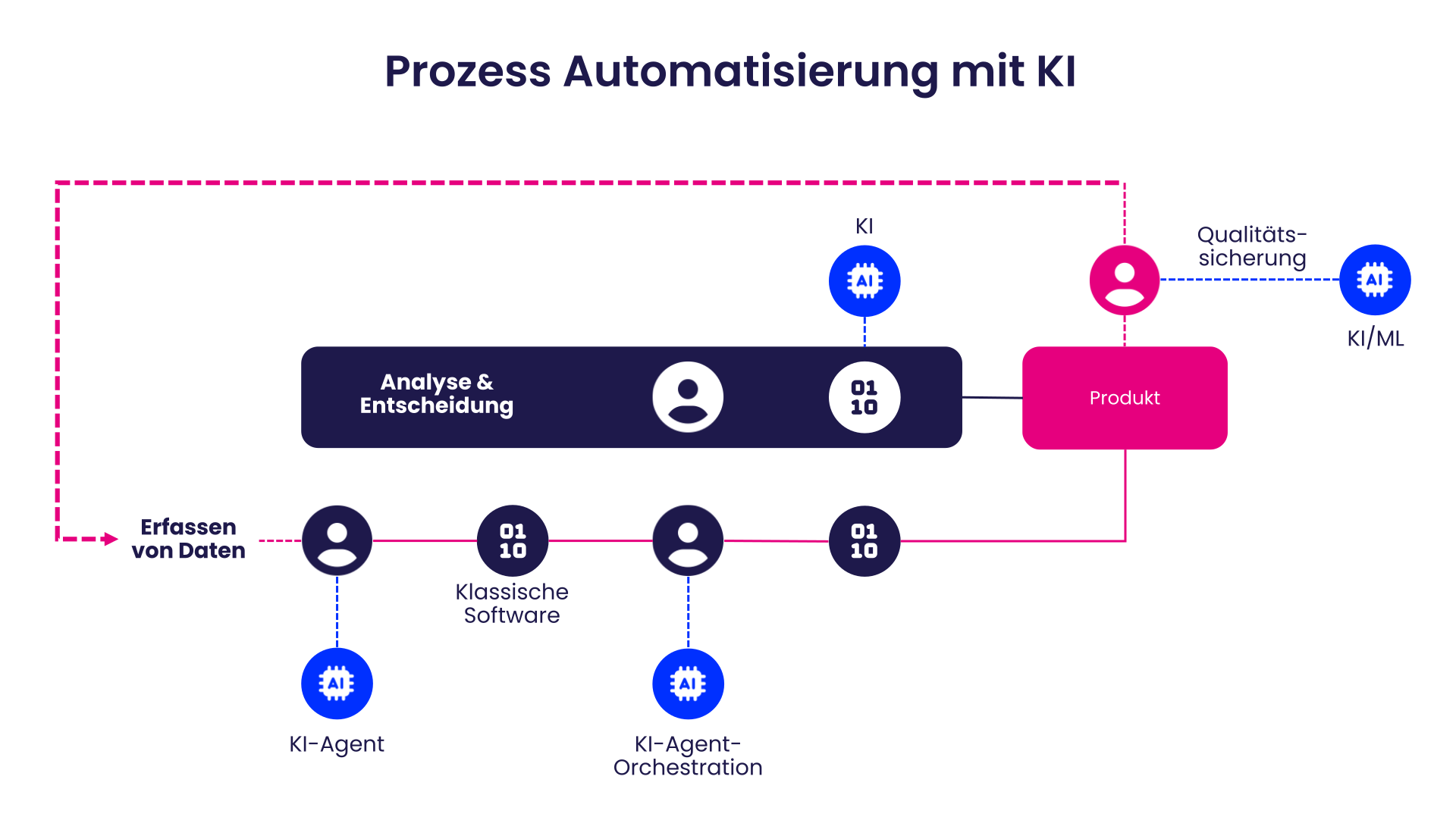
No, quite the opposite. We're not eliminating our colleagues in the graphic, just the copy-and-paste work that people previously had to do.
-
AI: Takes care of the data shuffling.
-
You: Coordinate the process—as a strategist who validates the results and makes decisions when things get tricky.
How does AI-supported automation work technically?
Technically, there is no single solution. The architecture depends on your processes and your IT infrastructure. We methodically distinguish between two approaches:
- The classic approach for existing systems (RPA & ML): In areas such as back office or document processing, the combination of RPA and machine learning is often the most efficient choice. While ML algorithms learn, RPA tools execute the actions in your existing systems – ideal for modernizing established IT landscapes without having to build new ones.
- The modern premier class (AI agents via APIs): Wherever possible, we rely on AI agents. They bypass the error-prone click level and communicate directly via interfaces (APIs, nodes, or connectors). The key advantage: Since many agents are already prepared for tools such as Outlook or low-code platforms, the solution is often ready to go in record time.
Gartner has named Agentic AI the No. 1 strategic technology trend for 2026. According to its forecast, 33% of enterprise software will include Agentic AI capabilities by 2028—up from less than 1% in 2024. At the same time, Forrester warns that fewer than 15% of companies will actually activate the agentic capabilities of their automation platforms by 2026. (Sources: Gartner Top Strategic Technology Trends 2026; Forrester Predictions 2026). And our study concludes: “The use of AI agents enables existing software landscapes and complex domains to be analyzed and modernized much more quickly.” (MaibornWolff Report on Technology Efficiency, 2026)
Intelligence meets action: Who takes on which role?
To provide methodological clarity, we divide AI automation into two areas of expertise:
-
RPA takes action: Here, we automate the work of the data collector. Wherever information is moved from A to B according to fixed rules, the bot replaces manual entry. This frees teams from monotonous clicking marathons.
-
ML takes over the decision-making: Here, we automate the preparatory work for managers and those responsible. ML algorithms recognize patterns in unstructured data and prepare complex decisions. The algorithm takes over the analysis work that would previously have taken hours of manual review.
This flexibility ensures that we are not building a technical flash in the pan, but a solution that grows organically with your requirements.
The perfect duo: How RPA and machine learning work together
In intelligent process automation, RPA often acts as the crucial interface between humans and technology. While RPA already reduces manual interaction, machine learning provides the next leap in efficiency: the application learns from every interaction. Over time, the system can answer more and more questions independently, further reducing interaction with humans.
| Focus area | RPA strengths | ML & Agent Strengths |
|---|---|---|
| Task | Rule-based process execution | Pattern recognition and classification |
| Database | Structured data fields | Processing unstructured data |
| Integration | Surface automation (UI) – works even without interfaces | AI agents (use APIs, nodes, or connectors) |
| Benefit | Quick relief for routine work | Continuous improvement and learning systems |
Next Level: Generative AI in Business Process Automation
Generative AI, such as GPT models, is revolutionizing AI business process automation by taking on tasks that were previously considered purely human—especially in creative or communicative roles:
-
Content analysis: Understanding complex documents, which was previously only possible through expert review.
-
Text generation: Automatic creation of reports or emails that used to take clerks hours to complete.
-
Creative problem solving: Generating suggestions for unforeseen situations
-
Intuitive control: Orchestrating processes simply via voice command or chat instead of complicated forms
Marketing and HR departments in particular benefit from this intelligent process automation, for example when creating product descriptions or job advertisements.
The adoption of generative AI is accelerating: According to Gartner, by 2026, over 80% of companies will have deployed generative AI models in production environments. In Germany, the 2026 Bitkom study shows that 45% of companies using AI have already significantly accelerated their internal processes. (Sources: Gartner, 2025; Bitkom, February 2026)
What challenges and risks need to be taken into account?
Despite all its advantages, AI automation poses challenges. Data protection and compliance must be taken into account from the outset. Algorithms can exhibit unintended biases that lead to unfair decisions. And “47% of IT managers and professionals feel overwhelmed by the sheer volume and frequency of new AI applications.”
Our latest study concludes: “Since AI drastically reduces the cost and time required to create code and content, we are not producing less code in less time, but simply producing significantly more code overall. Without proper governance, we face the risk of an inflation of digital assets. (MaibornWolff Report on Technology Efficiency, 2026)
Trust as a foundation: data protection, bias, and compliance
To prevent AI systems from becoming black boxes, they need a clear ethical compass. At MaibornWolff, we embed a sense of responsibility directly into governance – from avoiding discriminatory patterns (bias) to ensuring that every decision is crystal clear and explainable. This creates trust that goes beyond mere compliance.
-
GDPR compliance: Implementation of privacy by design and data minimization.
-
Algorithmic fairness: Avoidance of discriminatory decision-making patterns.
-
Explainability: Traceability of AI decisions (particularly important in regulated industries).
-
Infrastructure control: An essential security factor is that the tools and the data they access can remain entirely within the company's infrastructure.
-
Granular control: With AI automation, it is possible to precisely define and control which data areas the AI is allowed to access.
-
Data security: Protection against unauthorized access and manipulation
Regulatory Framework – EU AI Act: On August 2, 2026, the rules for high-risk AI systems will come into full effect. By that date, companies must have completed conformity assessments, technical documentation, CE marking, and registration in the EU database. Violations may result in fines of up to €35 million or 7% of global annual turnover. Bans on AI systems posing “unacceptable risk” have been in effect since February 2025, and the rules for general AI models (GPAI) have been in effect since August 2025. (Source: EU AI Act, artificialintelligenceact.eu)
According to Bitkom 2026, the biggest barriers to AI adoption in Germany are: data protection requirements (77%), a shortage of skilled workers (70%), and technical security requirements (61%). Only 32% of companies use their existing data effectively—and just 5% fully leverage their data’s potential. (Source: Bitkom AI Study, February 2026)
Current figures from our study show: “19% of respondents currently see no tangible business value in AI.” (MaibornWolff Technology Efficiency Report, 2026)
While AI pioneers are achieving significant productivity gains, according to McKinsey, around 80% of companies report no measurable impact on their bottom line. The gap between successful and unsuccessful AI implementations is widening—a strong case for a structured, guided approach to implementation. (Source: McKinsey State of AI, 2025)
Focusing on people: Acceptance through genuine change
Der menschliche Faktor entscheidet über den Erfolg von KI-Automatisierungsprojekten:
| Action | Goal |
|---|---|
| Early involvement of employees | Reducing fears, benefiting from practical experience |
| Transparent communication | Creating an understanding of the goals and limitations of AI |
| Training programs | Ability to collaborate with AI systems
“64% of IT managers and specialists say that employees are rarely or never involved in technology decisions.”
“48% of respondents agree that technological complexity sometimes causes uncertainty or even anxiety among colleagues.” (MaibornWolff Study on Technology Efficiency, 2026)
These figures make it clear: Change management is not a soft factor, but rather critical to success. Companies that involve their workforce early on not only achieve higher acceptance rates but also better project outcomes. 49% of respondents to the MaibornWolff study confirm that measures to reduce complexity have led to increased software acceptance among employees. |
Theory meets reality: AI automation in action
The development of the AI assistant TÜV NORD GPT demonstrates how theory and implementation go hand in hand at our company. Here, knowledge management processes were optimized through the use of large language models (ChatGPT) in order to network internal knowledge highly efficiently and noticeably reduce the workload of employees in their day-to-day work.
Ready for the next step? AI automation with MaibornWolff
“Those who view AI merely as a panacea will be disappointed. Those who, on the other hand, see it as a specialized tool will reap significant benefits.” (MaibornWolff Study on Technology Efficiency, 2026)
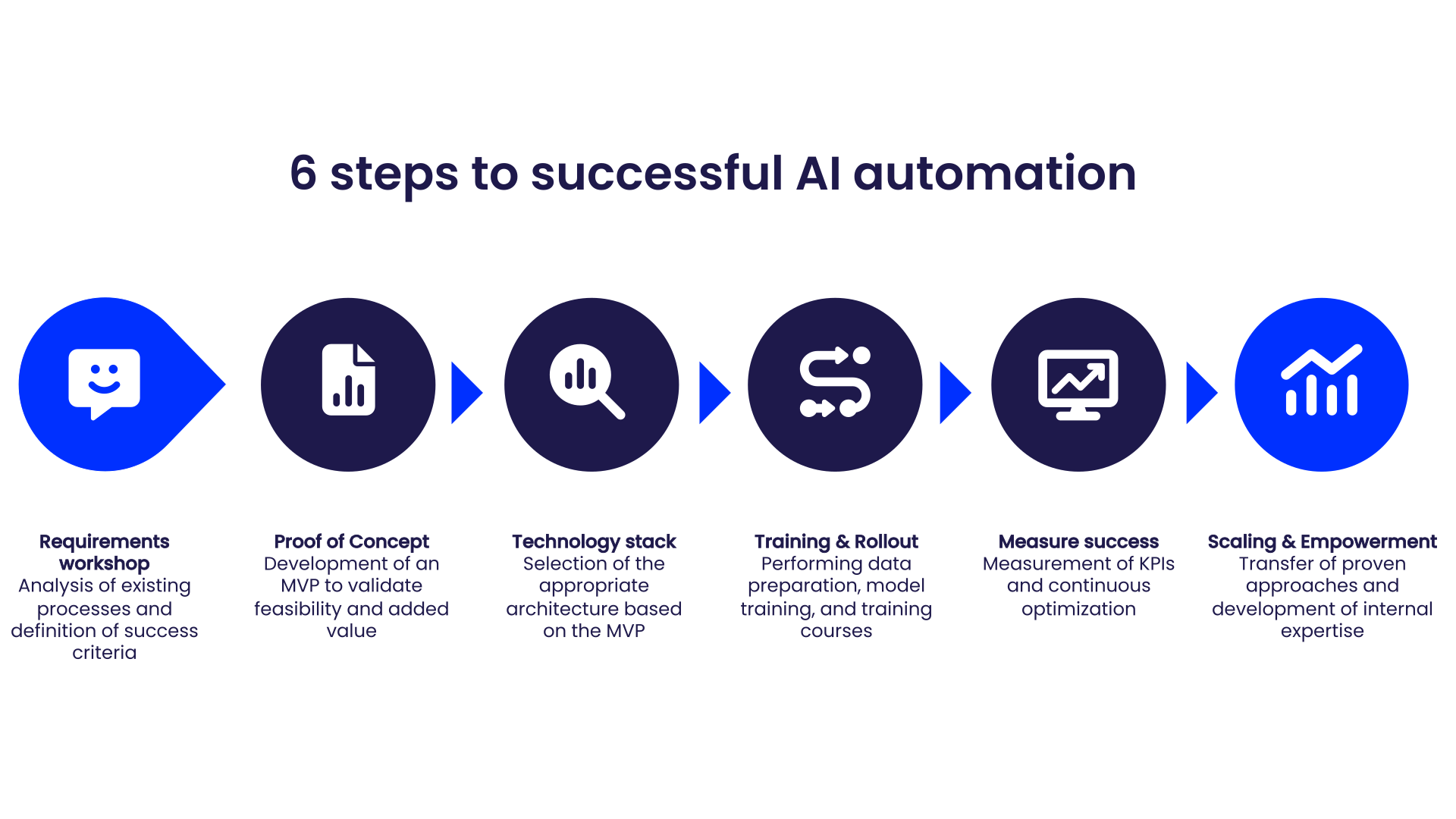
AI automation is the key enabler where traditional solutions fall short due to unstructured data or high complexity. MaibornWolff provides structured support, guiding you from initial use case identification through MVPs to scaling in live operations. We specifically leverage trends such as platform-based MLOps orchestration and low-code approaches to establish cooperative intelligence.
According to Gartner, the hyperautomation market will reach a volume of nearly $1.04 trillion by 2026. Europe’s AI spending is expected to rise to $290 billion by 2029 (IDC, CAGR 33.7%). Those who set the course now will secure a sustainable competitive advantage.
The result: AI speeds up routine analyses, while you, as a strategic leader, remain responsible for the context and governance.

Frequently asked questions about AI automation
How does AI automation differ from hyperautomation?
AI automation focuses on adaptive systems that can make decisions and handle uncertain or unstructured data. Hyperautomation, on the other hand, describes a broader approach in which various automation technologies—such as RPA, AI, process mining, and analytics—are systematically combined to automate entire process landscapes.
What is the typical cost of getting started with AI automation?
The process often begins with a clearly defined use case and an MVP. The initial effort depends less on the technology than on data quality, process clarity, and decision-making logic. Many companies deliberately start small to minimize risks and gain reliable insights early on.
How does AI automation affect existing IT landscapes?
Modern AI automation solutions can generally be integrated in stages. Existing systems remain in place and are supplemented via interfaces, RPA, or event-driven architectures. The goal is evolution rather than disruptive replacement.
“52% of respondents report that the prevalence of inefficient software within their own companies has continued to rise over the past year.” (MaibornWolff Study on Technology Efficiency, 2026)
How can the ROI of AI automation be realistically assessed?
A robust ROI is achieved through an integrated set of KPIs: In addition to financial metrics such as cost savings, we measure operational metrics such as turnaround time and error rate. Added to this are specific model performance metrics such as accuracy (precision/recall) and drift detection, as well as technical stability metrics such as MTTF (Mean Time to Failure) and the conversion rate from manual to automated processes.
To put this into perspective: According to the McKinsey Global AI Survey, companies that deploy AI strategically achieve an average ROI of 5.8x within 14 months. However, 42% of companies also report having discontinued most of their AI initiatives by 2025—a clear indication that success requires a structured approach. (Sources: McKinsey, 2025; Forrester, 2026)
What does the EU AI Act mean for AI automation projects?
The EU AI Act has been in force since December 2024 and is being implemented in phases. Since February 2025, bans have been in place for AI systems posing an unacceptable risk. Rules for general AI models (GPAI) will take effect in August 2025. The main provisions for high-risk AI systems will take effect on August 2, 2026. Companies should classify the risks of their AI applications early on and establish compliance processes. (Source: artificialintelligenceact.eu)
What are AI agents, and how do they differ from traditional AI automation?
AI agents (Agentic AI) are autonomous software units that independently plan and execute tasks and learn from their results—without requiring human input at every step. Unlike traditional AI automation, which relies on predefined workflows, agents can respond flexibly to unforeseen situations. According to Deloitte, the market for autonomous AI agents is estimated at $8.5 billion in 2026 and is projected to grow to $35 billion by 2030. However, only 14% of companies currently have operational agentic solutions. (Sources: Deloitte Tech Trends 2026; Gartner, 2025)
As a consultant and software designer, Vadim actively shapes the solutions developed by the Pro-Code AI Solutions delivery unit. With a background in digital design and process usability, he focuses on measurably improving business and production processes. In customer projects, he ensures that new solutions can be easily and intuitively integrated into the existing corporate ecosystem without any friction losses.