


Manufacturing companies are facing a new era in which artificial intelligence not only optimizes processes but also lays the foundation for innovative production methods.
Learn how AI increases efficiency in manufacturing, drives the development of new products and services, and what it takes to successfully integrate this key technology into your business.
The trend is clear: According to the MaibornWolff Technology Efficiency 2025 Study, 61% of companies report that the use of AI tools will have increased by 2025—AI has evolved from a promise for the future into a key competitive factor. However, strategic integration into existing processes and systems is crucial.
- What are the benefits of AI in manufacturing? AI massively increases efficiency and productivity. It enables predictive maintenance, automates processes, and minimizes downtime through intelligent data analysis.
- How does AI reduce costs? By automating repetitive tasks and conserving resources. This significantly reduces operating costs and gives employees more time for value-adding activities.
- How does AI promote innovation? By drastically reducing development times (time-to-market). AI enables rapid simulations of new products and analyzes customer data for tailor-made offers.
- What is the biggest hurdle? Poor data quality (“shit in, shit out”). Successful implementation requires clean, relevant data and a high level of acceptance among the workforce (change management).
- How do you get started? With a strategic inventory and small pilot projects (PoC). Analyze existing use cases and focus on scalable solutions instead of expensive individual experiments.
What is AI? Fundamentals & Key Technologies
Artificial intelligence (AI) refers to computer technologies that simulate human-like thinking and decision-making processes. Unlike conventional software, which follows rigid rules, AI adapts flexibly to new information. It uses algorithms and artificial neural networks to independently recognize patterns in data, make decisions, and solve complex problems.
The core of this functionality of AI is machine learning. AI systems are not only programmed, but also trained with examples, enabling them to continuously improve. Various key technologies are used in this process:
- Machine learning (ML): This discipline enables computers to learn independently from data and make predictions without being explicitly programmed for each individual case.
- Deep learning: As a subfield of machine learning, deep learning uses multi-layered artificial neural networks. This structure is modeled on the human brain and allows the processing of highly complex data sets.
- Natural Language Processing (NLP): This ML-based technology enables computers to understand, interpret, and generate human language (e.g., for translations or sentiment analysis).
Areas of application and added value of AI in manufacturing
Artificial intelligence is no longer a futuristic concept; rather, it has established itself as the driving force behind numerous innovations and efficiency gains in manufacturing. Its use could not only significantly boost the productivity and competitiveness of the German economy, but also sustainably optimize production processes—from automated root cause analysis to knowledge management and data-driven decision-making.
The bottom line is this: Those who view AI merely as a panacea will be disappointed. Those who, on the other hand, see it as a specialized tool will reap significant benefits (MaibornWolff Study on Technology Efficiency 2025, p. 23).
Already 52% of respondents report that the prevalence of inefficient software within their own companies has continued to rise over the past year (MaibornWolff Technology Efficiency 2025 Study, p. 5). This makes it all the more important not to view AI investments in isolation, but rather as part of a comprehensive technology strategy.
In the following, we will therefore explain the benefits of AI in manufacturing:
According to the MaibornWolff Technology Efficiency 2025 Study, 42% of respondents already view increased efficiency in their processes as the primary benefit of AI (p. 23). When AI is deployed in a targeted manner with clear objectives, it delivers measurable benefits.
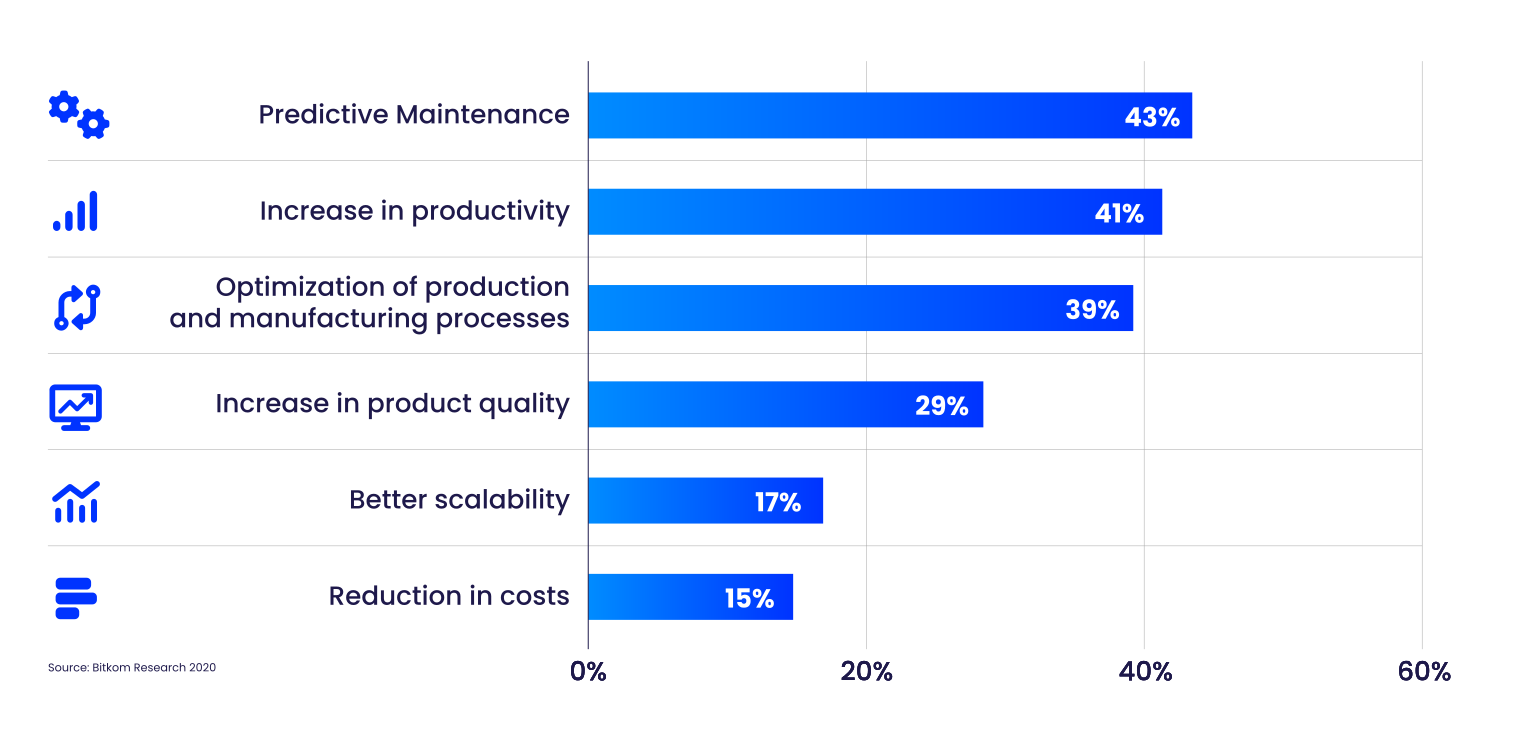
Detection and analysis of data anomalies using AI
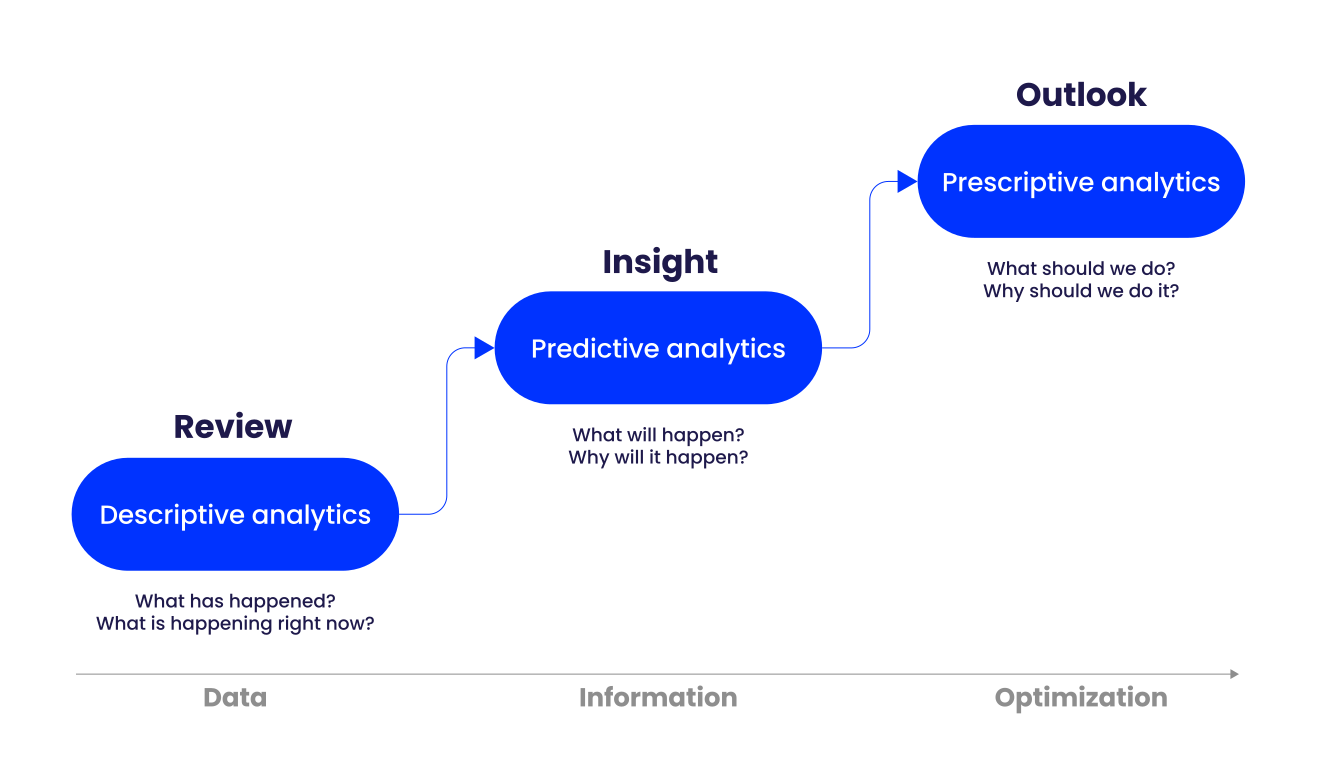
One of the core capabilities of AI is its ability to analyze large amounts of data in a very short time and recognize patterns. Beyond pure analysis, it can predict future outcomes and recommend actions. This process is based on three consecutive stages:
- Descriptive analysis: Analyzes current data in real time to immediately identify anomalies.
- Predictive analysis: Uses historical and current data to predict future events or conditions (such as machine failures).
- Prescriptive analysis: Provides specific recommendations for action or executes them autonomously to ensure optimal results.
The use of AI agents makes it possible to analyze and modernize existing software landscapes and complex domains much more quickly (MaibornWolff Study: Technology Efficiency 2025, p. 23).
Innovation through AI in production
The use of AI in manufacturing is a catalyst for innovation. By analyzing large amounts of data, it provides insights that would be virtually impossible to obtain manually.
- Precise customer focus: Products can be tailored more precisely to customer needs and dynamically adapted to market conditions.
- Faster time-to-market: AI accelerates research and development through rapid simulations and testing. This shortens the time to market and increases agility in competition.

Get a personalised AI consultation for your business now.
Cost efficiency through AI in manufacturing
AI conserves financial and human resources by automating repetitive and time-consuming tasks. The resulting cost efficiency frees up funds for research and further development. To exploit the full potential, systematic implementation, the use of specialized AI platforms, and precise machine learning operations (MLOps) are crucial.
In fact, 42% of companies already report lower operating costs, and just as many report a lower error rate as a direct result of reduced complexity (MaibornWolff Study on Technology Efficiency 2025, p. 30).
Those who succeed in freeing up budgets from the management of legacy systems create the financial capacity for innovation and a faster time-to-market (MaibornWolff Study on Technology Efficiency 2025, p. 6).
Our expertise goes beyond pure technical implementation. We embed the necessary specialist knowledge directly into your team. With our AI training courses, we empower you to use systems independently, benefit from AI advantages in the long term, and secure your competitiveness for the future.
Challenges and decision-making aids
A survey by Statista from 2022 shows that 54% of companies already use AI in production. However, its widespread use should not obscure its complexity: implementation requires a customized strategy to overcome specific hurdles beyond the mere introduction of the technology.
When AI is applied to inefficient processes, it does not lead to greater efficiency, but merely to a faster execution of the wrong actions (MaibornWolff Study: Technology Efficiency 2025, p. 21).
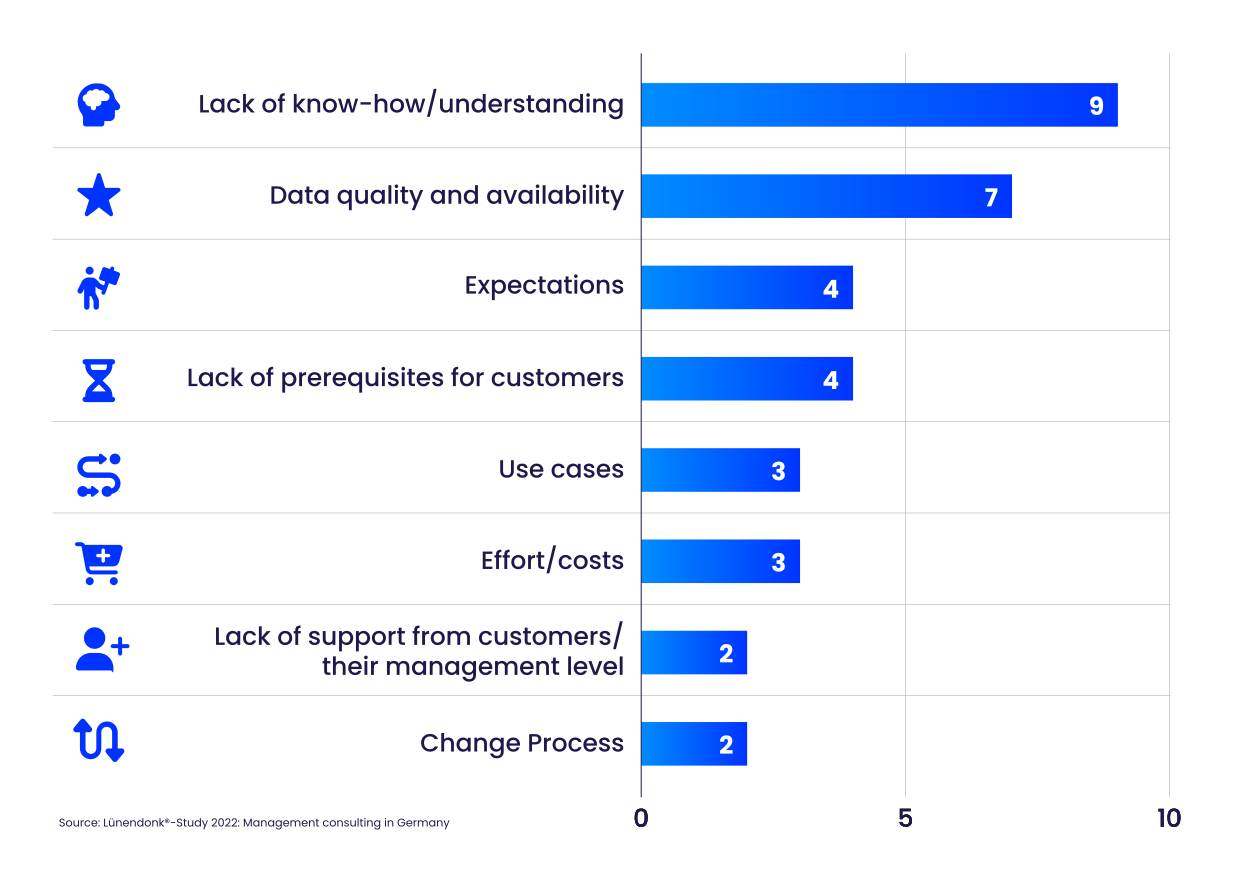
Use cases and company specifics
A key hurdle: There is no “one-size-fits-all” solution. AI systems must be precisely tailored to your individual processes and existing IT landscape.
- Challenge: It is often difficult to identify profitable applications and realistically estimate implementation costs.
- Solution: Analyze existing use cases from similar industries. Looking at best practices helps to identify industry-specific potential and realize competitive advantages more quickly.
Already 56% report a noticeable loss of time due to a lack of integration and the resulting system disconnects (MaibornWolff Study on Technology Efficiency 2025, p. 10).
Our study confirms this as well: digital projects often fail not because of the software itself, but because of the invisible barriers between CRM, ERP, and proprietary siloed solutions (MaibornWolff Technology Efficiency 2025 Study, p. 27).
Establishing a good database
The effective application of AI technologies depends not only on the quantity of data, but above all on its quality. The succinct principle of ‘shit in, shit out’ makes it clear that the quality of the data fed into AI systems directly determines the quality of the results.
Insufficient or irrelevant data leads to disappointing outcomes. It is therefore important to check the existing data for its suitability for specific AI applications before starting to implement an AI solution.
Generative AI produces content and code at a pace that is virtually impossible to keep up with manually. Fifty-nine percent of respondents fear that digital waste—specifically unused technical features, dead code, and redundant artifacts—will increase in the future due to AI (MaibornWolff Technology Efficiency 2025 Study, p. 22). A solid data foundation and clear governance structures are therefore essential for AI to realize its full potential in production—without creating new technical debt.

Our tailor-made data analytics consulting is here to support you.
Resource requirements
The introduction of AI requires high initial investment, not only in the technology itself, but also in the necessary infrastructure and skilled personnel. A thorough assessment of costs and benefits is crucial to ensure that the necessary resources are available for successful implementation.
Our study paints a clear picture: German companies are drowning in complexity. Investment in digitalization has been rising for years, yet operational productivity has stagnated in many areas (MaibornWolff Study on Technology Efficiency 2025, p. 2).
Employee acceptance and effective change management
The success of AI integration in your company depends largely on how willing your workforce is to embrace new technologies. To ease this transition and ensure that employees actively and successfully participate in the new AI-supported processes, well-thought-out change management is crucial. It is important to
- address concerns,
- promote acceptance and
- adequately support employees.
Current figures highlight the urgency of the situation: 64% of IT managers and specialists report that employees are rarely or never involved in technology decisions—and 54% confirm that they have to adapt their work processes to the systems in use because these systems do not meet existing needs (MaibornWolff Study on Technology Efficiency 2025, p. 15). Furthermore, 48% state that technological complexity triggers uncertainty or even fear, and 47% of IT managers feel overwhelmed by the sheer volume of new AI applications (ibid., p. 16 and p. 22). Technological change can only succeed if people are at the center.
Regulatory and ethical considerations
When using AI, companies must ensure compliance with data protection regulations and ethical guidelines. This is crucial for building trust and acceptance. Ethical considerations include:
- Accessibility and barrier-free access,
- Non-discrimination,
- Inclusion,
- Sustainability, and
- Usefulness of AI use.
These aspects must be carefully considered to ensure the responsible use of AI.
The so-called Jevons Paradox is particularly relevant here: since AI drastically reduces the cost and time required to create code and content, we do not produce less code in less time, but simply produce significantly more code overall. Without governance, there is a risk of inflation in digital assets (MaibornWolff Study on Technology Efficiency 2025, p. 22 (Jevons Paradox)).
IT and AI maturity within the company
It is essential to view AI systems as complex systems that require specialized knowledge and tailored approaches. Therefore, a careful assessment and development of internal IT and AI capabilities is essential to ensure the successful integration and use of these technologies.
Currently, only 48% of companies have defined KPIs to systematically measure the actual benefits of their software solutions—and an alarming 37% have not yet taken any dedicated steps to reduce IT complexity (MaibornWolff Technology Efficiency 2025 Study, pp. 13 and 24–25).
Investing in training and partnerships with AI experts can play a key role in unlocking the full potential of AI and strengthening the company’s innovative capacity.
Our study confirms that this effort is worthwhile: 49% of respondents report that measures to reduce IT complexity have led to increased employee acceptance of the software (MaibornWolff Technology Efficiency 2025 Study, p. 30).

Get a personalised AI consultation for your business now.
What makes for effective consulting on artificial intelligence in production?
Effective AI consulting does not end with implementation. It covers the entire lifecycle – from ideation to operation (end-to-end). Our goal is enablement: we provide your team with the knowledge they need to independently manage AI solutions in the long term.
It’s no wonder that 68% of respondents insist on a thorough requirements analysis before a project begins and 66% view documentation as an integral part of the Definition of Done (MaibornWolff Study on Technology Efficiency 2025, p. 19). Our consulting services take these requirements into account from the very start.
How do we get started together? The journey often begins with an intensive exchange or workshop to identify potential:

Building on this introduction, we deepen the collaboration through five concrete service phases to future-proof your production:
- Strategy & Data Thinking: In Data Thinking workshops (2–3 days) we jointly develop tailored data products. We define concrete use cases and the roadmap for your AI projects – whether remote or on-site at your premises.
In fact, 46% of respondents cite a lack of coordination between business units and IT as the most common reason for inefficient or redundant solutions (MaibornWolff Technology Efficiency 2025 Study, p. 13)—and that is precisely the bridge our workshops help build. - Proof of Concept (PoC) & Cognitive Services: Before we scale, we validate. Through practical upfront tests (PoCs), we assess the suitability of intelligent services (Cognitive Services) with your real data. This ensures early on that the technology reliably solves your use case.
- Maturity Assessment (Maturity Analysis): Where do you stand today? We analyze the current state of your organization with regard to processes, data infrastructure and tools. The result is a clear action plan for building an effective data strategy.
- Platform Check & Knowledge Management: We assess whether your IT landscape is ready for cross-platform solutions. A focus here is on AI-powered knowledge management systems that make internal data accessible via voice control and break down silos.
- Scaling through MLOps: For long-term success we professionalize the operations. We implement Machine Learning Operations (MLOps) to make the entire lifecycle of your models—from data preparation to deployment—efficient and maintainable.

We are happy to help. Arrange a free initial consultation with our AI experts here.
AI in production – Successful application cases
Theory is good, practice is better. These two success stories from manufacturing show how AI optimizes processes and reduces the workload for employees:
Acceleration of business processes at GROB Werke
Challenge: Employees spent too much time searching for documents, data, and tools in internal systems. Solution: Implementation of Azure Cognitive Search and GPT. Result: A voice-activated search function now allows employees to make verbal requests and receive information immediately.
Vision for the future: The next step is hands-free communication. A production employee asks for a component via his headset and receives the answer (“Machine room B, ready for collection in 9 minutes”) directly in his ear without having to interrupt his work.
Construction of an AI demand prediction platform for Siemens
Challenge: High storage costs due to inaccurate demand forecasts for complex, individual product time series. Solution: Development of a self-service AI platform based on AutoML (automated machine learning). Result: Automated selection of the best algorithm for each product.
Success in numbers:
- Scaling: Expansion to over 2,000 products at additional locations.
- Performance: Weekly training of 100,000 models in less than 5 hours.
- Integration: Predictions flow directly into the data streams of the specialist departments.

Technology should always be used where it adds value—not for its own sake. It is important to avoid technological over-engineering and to build the IT systems of the future in a lean manner.
In this sense, the key to new competitiveness lies not in adding more tools, but in the ability to eliminate the unnecessary (MaibornWolff Study on Technology Efficiency 2025, p. 6).
FAQ – AI in production
How is artificial intelligence used in production?
In production, AI is used to automate processes, improve efficiency and minimize downtime. It enables accurate maintenance predictions, improves quality control and facilitates decision-making with data analysis. AI also promotes product innovation and increases flexibility in the event of market changes.
What does AI consulting cost?
The cost of a customized AI consultation depends on the scope of your project. At the outset, we will draw up a individual financing plan for you. We are committed to the principle that every project should deliver tangible added value. That's why we disclose the concrete benefits and potential savings resulting from your specific use case at an early stage.
What are the different types of AI?
There is a distinction between weak and strong artificial intelligence. Weak AI is geared towards individual, specialized tasks, such as ChatGPT. In contrast, strong AI, which would have a comprehensive understanding and consciousness similar to that of humans, is still in the realm of fiction and has not yet been realized.
Kyrill Schmid is Lead AI Engineer in the Data and AI division at MaibornWolff. The machine learning expert, who holds a doctorate, specialises in identifying, developing and harnessing the potential of artificial intelligence at the enterprise level. He guides and supports organisations in developing innovative AI solutions such as agent applications and RAG systems.