

M2M Communication:
How data is exchanged between machines
Estimated reading time: 11 minutes

Machines, sensors, vehicles, and vending machines collect data autonomously and transmit it. This automated data exchange is known as machine-to-machine (M2M) communication and forms a crucial foundation for connected applications in industry, logistics, retail, and energy supply. Here, you’ll learn exactly what M2M means, how this communication works both technically and in practice, and what opportunities it offers your business.
The most important points at a glance
- In machine-to-machine (M2M) communication, machines, devices, or systems automatically exchange data with one another.
- How M2M works: A device collects data, transmits it over a communication network, and sends it to a receiving system, which stores, analyzes, or uses the information for further processing.
- M2M communication makes processes more efficient, predictable, and consistent, for example through seamless data flows, improved maintenance planning, and standardized procedures.
- Typical use cases for M2M include smart metering, fleet management, vending machines, predictive maintenance, and other connected applications in industry, retail, and smart cities.
- For secure M2M communication, unique device identities, authentication, encryption, updatable devices, and segmented networks are essential.
What is M2M? Definition & scope
M2M stands for Machine-to-Machine and refers to automatic communication between machines, devices, or control systems without the need for human intervention. In this process, systems exchange information independently, transmit measurement data, or report specific statuses to other devices or to a central system. The goal is to make processes more efficient, faster, and more reliable.
Typical use cases for M2M include production machinery that reports its operational status, meters that automatically transmit consumption data, or technical systems that send fault reports directly to a control center. In these cases, communication is usually clearly defined and functional: one device sends specific data to another system so that a particular task can be performed.
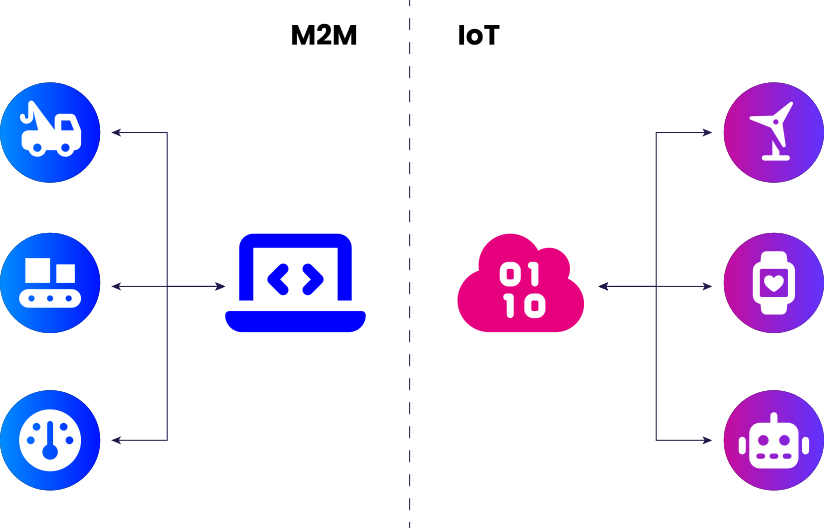
While M2M and IoT are closely related, they do not mean exactly the same thing. M2M is the narrower term. It focuses primarily on the direct exchange of data between devices or machines. The communication relationships are usually clearly defined and limited to a specific function. IoT, or the Internet of Things, is a much broader concept. In the IoT, not only are devices connected to one another, but software, cloud systems, data platforms, and applications are also integrated into a comprehensive networked solution.
3 benefits of machine-to-machine communication
The practical benefits of M2M communication are particularly evident during day-to-day operations:
- More efficient processes through automated data exchange
M2M communication enables devices, machines, or control systems to exchange information autonomously. As a result, data needs to be read, transferred, or entered manually less often. This reduces the workload on employees, lowers the risk of transmission and input errors, and ensures more efficient and reliable workflows for recurring processes. - A Better Data Foundation for Maintenance, Planning, and New Services
Continuously collected operational and condition data helps identify anomalies, malfunctions, or bottlenecks early on. This enables predictive maintenance (Predictive Maintenance) and improves planning capabilities. At the same time, costs can be reduced because failures are detected earlier, maintenance tasks are planned more effectively, and unnecessary downtime is avoided. Furthermore, the data provides the foundation for new services such as automatic reordering, fleet management, or energy monitoring. - More consistent workflows across systems and locations
In M2M communication, information is collected according to fixed rules and exchanged in a standardized manner between devices and systems. This makes it possible to standardize workflows even across multiple locations and better manage processes within complex structures. The benefits of M2M communication are thus evident not only in the networking of individual machines, but also in large, distributed infrastructures such as vehicle fleets, warehouses, meters, or vending machines.

We help you connect machines, equipment, and systems in a secure and future-proof manner.
How does M2M communication work?
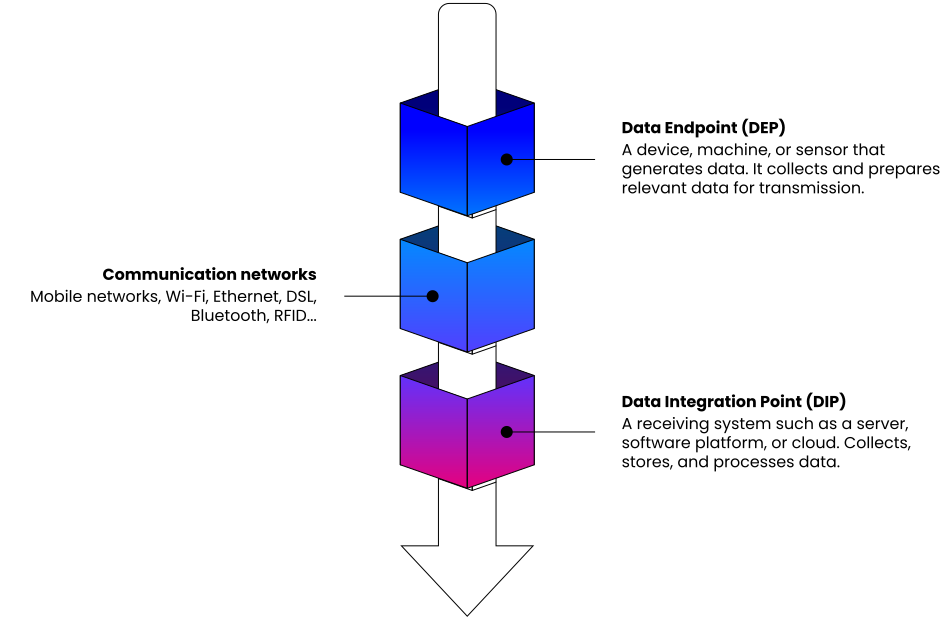
The basic principle of M2M communication is easy to explain: Data is automatically collected by a device or machine, transmitted over a network, and processed in a receiving system. For this process to function reliably, three elements typically work together: a data-providing device or system, a communication network, and a receiving or processing system.
Data endpoint (DEP)
The data endpoint is the device, machine, sensor, or controller where data is generated or collected. This can include, for example, temperature readings, fill levels, location data, consumption values, operational statuses, or error messages. The DEP is thus the starting point of communication: It collects relevant information from ongoing operations and prepares it for transmission.
Depending on the application, a data endpoint sends its information at fixed intervals, upon specific events, or when defined thresholds are reached. In practice, this could be, for example, a meter that transmits consumption data, a vending machine that reports its inventory, or a machine that sends a fault report to a central system. In this way, physical devices become active components of a networked system.
Communication networks
To ensure that the collected data reaches its destination, a suitable communication network is required. This is also referred to as an M2M communication network (MCN). The specific technology used for this depends primarily on range, power consumption, data rate, latency, and the environment. Different transmission methods are suitable depending on the application:
- Mobile networks: These include, for example, GSM, 3G, 4G, and 5G, as well as NB-IoT and LTE-M. They are particularly relevant when devices are mobile or are operated at distributed locations without their own network infrastructure. In such cases, M2M SIM cards are often used.
- Wi-Fi: This technology is particularly well-suited for situations where devices need to communicate within existing local networks, such as in buildings, manufacturing facilities, or warehouses.
- Short-range technologies: These include Bluetooth and NFC. Bluetooth is suitable for wireless communication between devices over short distances. NFC is primarily used for contactless identification, authentication, and triggering local processes.
- Ethernet or DSL: Wired connections are particularly important when a stable and continuously available connection is required, such as for stationary machines or equipment.
- LPWAN: LPWAN technologies, such as LoRaWAN, are also suitable for applications requiring low data rates, long range, and low power consumption. They are particularly well-suited for sensor networks, metering points, and distributed infrastructure.
In production environments involving industrial connections, protocols and architectures such as OPC UA, MQTT, and edge gateways are also frequently used. They ensure that machine and sensor data is reliably collected, preprocessed, and transmitted to higher-level systems or platforms. In smart factory and IIoT architectures, MQTT brokers, a unified namespace, and the integration of legacy-compatible devices are frequently used. However, this goes beyond the classic point-to-point connection of M2M communication. This is because the data is not transmitted directly to a fixed remote station, but is made available in a shared data space.”
Data integration point (DIP)
The data integration point is the reception point where the transmitted information converges. It acts as a hub between individual data endpoints and enables targeted data exchange. This point-to-point connection can exist either directly between two DEPs or between a DEP and a DIP.
This ensures that the collected information is directed precisely to where it is needed. In the next step, companies can store the data, analyze it, or link it to other information. This makes the data usable, for example, for monitoring, reporting, maintenance planning, automated notifications, or controlling other processes.
M2M communication: Real-world examples
How M2M communication is used in practice and the specific benefits it provides become clear in each specific application. The following examples provide an overview of typical applications across various industries.
M2M in the energy and utilities sector
A classic use case for M2M communication is smart metering. In this scenario, smart electricity, gas, or water meters automatically transmit consumption data, enabling remote reading without the need for manual meter readings. In addition, M2M enables remote monitoring of pumping stations, transformer stations, or heating systems by directly reporting malfunctions and abnormal conditions.
M2M in retail
Using M2M communication, vending machines automatically report their inventory levels, temperature readings, or malfunctions to a central system. This allows for more targeted planning of restocking and maintenance. Electronic shelf labels also rely on automated device communication: prices and product information are controlled centrally and transmitted directly to digital price tags.
M2M in logistics
A typical example is the electronic logbook. This system automatically records trip data such as distance, time, and location and transmits it to a central system. M2M is also used in fleet management: For example, vehicles automatically report their location data, fuel consumption, or technical condition. In practice, such systems are used for fleet management, order coordination, and cost control.
M2M in healthcare
In the healthcare sector, M2M is used for applications such as ECG devices, patient monitoring, and the transmission of vital signs. Blood pressure readings, pulse data, or other measurements are transmitted directly from a device to a receiving system. This allows health data to be collected and shared without manual intermediate steps. This is particularly relevant in telemedicine, home care, and the remote monitoring of chronically ill patients.
M2M in industry 4.0
In Industry 4.0, M2M communication serves as a key technical foundation for enabling machines, systems, and sensors to exchange data automatically. It is this capability that makes applications such as predictive maintenance, condition monitoring, and networked production—in the context of smart manufacturing—possible.
M2M in smart cities
In smart cities, too, M2M communication forms the technical foundation for connected applications. This is evident, for example, in traffic management systems. Here, sensors monitor traffic volume or congestion levels and automatically transmit the data to a central control center. Smart parking systems and intelligent street lighting are also based on such automated data flows, for example when available parking spaces are detected or lighting is controlled based on environmental data. When vehicles exchange data with each other or with the traffic infrastructure in real time, this is referred to as Car-to-X communication (Car-to-Car or Car-to-Infrastructure).
Whether in industry, logistics, or energy supply, we help you implement M2M communication tailored to your processes.
Ensuring secure M2M communication
M2M communication is not inherently secure. However, typical risks can be significantly reduced by implementing targeted security measures for devices, networks, and processes. The following table shows which threats occur most frequently and what measures you can take to address them.
| Risk | Possible consequences | Precautionary measures |
|---|---|---|
| Unauthorized access and spoofing | Unauthorized individuals gain access to devices or systems or impersonate a trusted device. This allows them to read data, change settings, or inject malicious commands. | Ensure unique device identification and mutual authentication. |
| Manipulation of data or commands | Data is corrupted or commands are altered during transmission. This can lead to malfunctions and incorrect responses. | Implement encryption of data in transit and at rest, as well as secure key management. |
| Power outages or equipment failures | Data is missing, processes are interrupted, or problems are detected too late. | Implement logging and monitoring, and establish incident response procedures. |
| Lack of update capability | Security vulnerabilities remain unpatched, leaving systems permanently vulnerable to attack. | Deploy devices that are configured to be secure against attacks and can be updated, and define patching processes. |
| Inadequate separation between IT and OT | Security incidents can spread more easily to other systems. | Work with segmented networks. |
You should not view the security measures mentioned above in isolation when it comes to M2M communication. Recognized standards and guidelines can help you design secure devices, communication channels, and system architectures.
ETSI (European Telecommunications Standards Institute) is a particularly important European standards organization and is involved in oneM2M. OneM2M develops specifications for interoperability, architecture, APIs, and security. ETSI SmartM2M is also working on SAREF and on specifications that connect devices and services regardless of the underlying technology.
In industrial environments, the IEC (International Electrotechnical Commission) plays a central role, particularly with the IEC 62443 series. This series of standards covers safety requirements for industrial automation and control systems, such as for secure development processes, safety requirements for components, and the protection of industrial systems and communication networks.
In addition, NIST (National Institute of Standards and Technology) and ENISA (European Union Agency for Cybersecurity) provide important guidelines for securing connected devices and systems. Also relevant are ISO/IEC 27400:2022 for IoT security and privacy guidelines, as well as 3GPP (3rd Generation Partnership Project) for mobile communication standards.
How M2M communication can help your business grow
M2M communication is a key foundation for the automated networking of machines, devices, and systems. It ensures that data is collected, transmitted, and processed without any manual intermediate steps.
M2M communication can therefore step in exactly where information in your company has previously been available only with a delay, manually, or not at all. Do you want your machines to reliably provide data and make their status visible? Do you want to make your maintenance more predictable or gradually transform an existing plant into a smart factory?
It is precisely with these kinds of questions that MaibornWolff is here to support you as an experienced partner. We typically start with a fit-gap analysis to systematically assess your current situation, requirements, and potential. We then support you throughout the implementation process with IIoT platform architecture, edge/cloud integration, the connection of legacy-compatible devices, embedded software, and technologies such as digital twins. We support the operational implementation not only conceptually but also practically, right through to ongoing operations.
Let’s discuss how connected machines and systems can create real value for your business.
FAQ: Frequently asked questions about M2M communication
What is M2M communication?
M2M stands for machine-to-machine communication and refers to the automated exchange of data between machines, devices, or systems. In this process, information is collected, transmitted, and processed without manual intervention.
How long has M2M communication been around?
At its core, M2M communication has been around since the mid-20th century. Its roots lie in telemetry and SCADA systems used for the remote monitoring and control of technical equipment. It became more widely established in the 1990s and 2000s with the increasing connectivity of machines via cellular and IP networks.
What are some use cases for M2M?
M2M is used in many areas where devices or machines automatically exchange data. Typical examples include smart metering, fleet management, remote monitoring of technical equipment, and connected vending machines.
What are M2M protocols?
M2M protocols are technical standards that define how machines, devices, and systems exchange data. They specify how information is transmitted, received, and processed to ensure reliable and consistent communication. The most important M2M protocols include MQTT, CoAP, OPC UA, and LwM2M.
What is an M2M SIM card?
An M2M SIM card is a specialized SIM card designed for mobile communication between machines, devices, and systems. It is used in M2M and IoT applications to enable connected devices to send and receive data over cellular networks. An M2M SIM card is designed for continuous operation, high availability, and remote management, and is often more robust and durable than standard SIM cards.
Albrecht Lottermoser is a Senior Smart Factory Expert at MaibornWolff. The mechatronics and engineering sciences expert specialises in automation, robotics, human-robot cooperation and intelligent process control. He supports organisations and companies in numerous research and industry projects relating to smart factories, digitalisation and artificial intelligence.