

What Are Data Silos? Definition, Causes and Solutions
Estimated reading time: 11 minutes

Your data is there – it's just locked behind thick walls and never meets. One set is walled up in the CRM, another in the ERP, a third in the standalone tool someone bought years ago. For every analysis, you first have to open one hatch after another: gather, reconcile, clean. These isolated data stores are called data silos – and they are one of the most common reasons why digital projects and AI initiatives fizzle out.
The name says it all: like a grain silo, a data silo is a hermetically sealed tower – the contents are valuable and plentiful, but each silo stands on its own, reachable only through a single hatch. The data is there, but it stays trapped behind its walls.
The good news: a data silo is rarely a problem of too little data. It is a structural and organizational problem – and that can be solved. This guide shows you what data silos are, how they emerge, why they cost more than any budget shows, and how to take the walls down again, brick by brick.
Key takeaways
- What is a data silo? A data silo is a data set that is locked inside an application, platform or department and is not available in a transparent, portable way that can be used across systems.
- How do data silos emerge? Mainly through legacy systems that have grown over time, multi-cloud fragmentation, redundant software, and a lack of governance and clear responsibilities.
- Why are data silos a problem? They cost time and money: a large share of project work goes into data preparation instead of value creation, processes slow down, and decisions are based on contradictory figures.
- What does this have to do with AI? AI readiness does not depend on the volume of data, but on data coherence. Data silos are the real ceiling for scaling AI.
- How do you break down data silos? By making them visible, prioritizing by actual data availability, putting integration before new tools, establishing clear governance and ensuring portability – not with a single tool.
What are data silos? A definition
A data silo is a data set that is locked inside a single application, platform or organizational unit – with no transparency into data flows, no standardized access and no portability. To stay with the image of the silo, it is the full but locked tower: the data exists, but it remains trapped within technical, organizational or platform-related boundaries.
The decisive shift in perspective: a data silo is not defined by missing data, but by the fact that its transparency, portability and controlled usability are restricted. A data silo is therefore less a storage problem than a usability problem – full shelves are of little use when the door is stuck.
Drawing the line: related terms
Not every distributed data landscape is the same. This distinction helps you classify what you are dealing with:
| Term | Short definition |
|---|---|
| Isolated data silo | Data is sealed off in one application or unit – without transparency, standard access or portability. |
| Fragmented data architecture | Data is spread across several systems and only partially integrated; exchange is possible, but costly and error-prone. |
| Redundant application landscape | Several tools with similar functions create parallel data sets and contradictory views of the same facts. |
| Platform-bound data space | Data is accessible, but proprietary formats or a lack of exit options make it hard to extract from the platform. |
| Integrated but unusable | Data is technically consolidated, but without clear semantics, ownership and governance it cannot be used reliably. |
How do data silos emerge? The five most common causes
Data silos are rarely the result of a single bad decision. They build up over years like limescale in a pipe – unnoticed, layer by layer, until hardly anything flows through anymore. Five causes are particularly common, and they are technical, organizational and strategic at the same time.
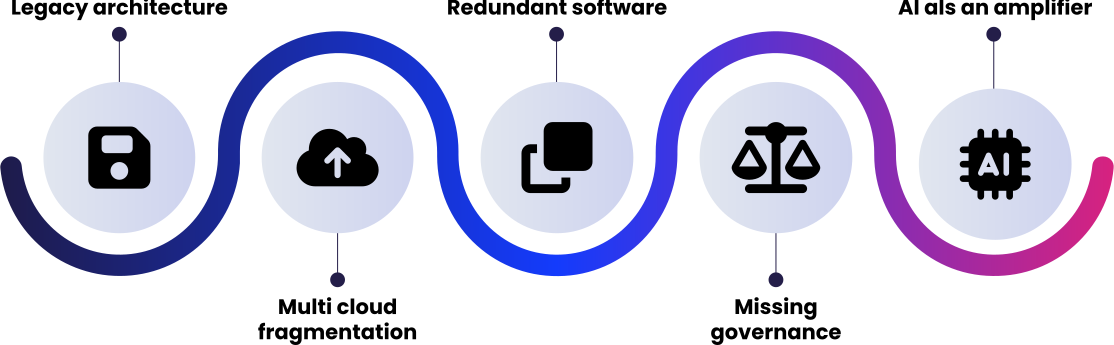
1. Legacy architecture and accumulated complexity
Legacy systems that have grown over time are the classic cause of silos. Monolithic legacy applications are hard to maintain, expensive and as stubborn as an old diesel engine: they run, but every change turns into open-heart surgery. New data requirements are patched into existing isolated structures instead of being built on a clean foundation. According to the Lünendonk study “Digital Sovereignty”, 65 percent of companies rate their IT landscape as very complex; in the MaibornWolff Technology Efficiency Report 2026, 61 percent say that overly complex software reduces their productivity.
2. Multi-cloud and platform fragmentation
Moving to the cloud does not automatically clear away data silos – it may just carry the moving box to a new place. When applications, data and responsibilities are distributed across several providers and operating models, new breaking points emerge in data flows and security models. The Lünendonk study shows that 42 percent of companies already use multi-cloud, and another 46 percent are planning to build it – and with every additional platform, the integration effort grows.
3. Redundant software and duplicate structures
When every department maintains its favorite tool, everyone ends up with their own version of the truth. The result: parallel data sets, duplicate maintenance and figures that contradict each other in meetings. In the MaibornWolff Technology Efficiency Report 2026, 41 percent report redundant software alongside functionally comparable solutions. What looks like a healthy “variety of tools” is often, in operational terms, a coexistence of competing data realities.
4. Lack of governance, transparency and ownership
Data silos are so persistent partly because no one can say exactly who owns which data. Without clear access rights, transparency into data flows and defined responsibilities, the data exists but has no one in charge – like a warehouse without an inventory list. Tellingly, according to the MaibornWolff Technology Efficiency Report 2026, only 48 percent of companies have defined metrics to measure the value of their software at all.
5. AI as an amplifier of existing silos
Unleashing AI on a cluttered data landscape is like fitting a turbocharger to an engine with clogged lines: it gets louder, not faster. If new AI tools are introduced before data structures and responsibilities have been clarified, the result is not a coherent AI architecture, but yet another layer of specialized tools with their own data access. Fittingly, around 59 percent of respondents in the MaibornWolff Technology Efficiency Report 2026 fear that AI will further increase “digital waste” such as redundant data and unnecessary artifacts.

Our practical guide shows IT decision-makers exactly how to track down, assess and dismantle data silos in their landscape step by step – with checklists and a process model.
Why data silos become a problem: consequences and costs
Data silos rarely come without consequences – they generate a bill that simply never shows up as a line item. Their impact ranges from sluggish processes and hidden costs to innovation projects that never get off the ground. Three levels are particularly relevant.
| Level | Specific consequence |
|---|---|
| Operational | A large share of project time goes into searching for and preparing data and manually bridging system gaps – according to industry consensus and providers such as AWS, 60 to 80 percent of the effort in AI/ML projects. |
| Economic | Duplicate data storage, repeated maintenance and integration effort create ongoing costs that are often not even visible as a separate item in traditional budgets. |
| Strategic | Contradictory data undermines sound decisions and prevents a reliable 360-degree view of customers, processes or products. |
The effect is especially unforgiving in AI projects. Across studies, a very high share of AI initiatives fail to make the leap from pilot to production – Gartner (2024) puts the share of projects that never go into production at around 87 percent, and MIT Sloan (2025) finds that 95 percent of enterprise pilots do not scale. The reason rarely lies in the model, but in disconnected data spaces. You can hire the best racing driver – if the track consists of nothing but dead ends, they still won't reach the finish line.
Data silos and AI: why more data does not mean more AI readiness
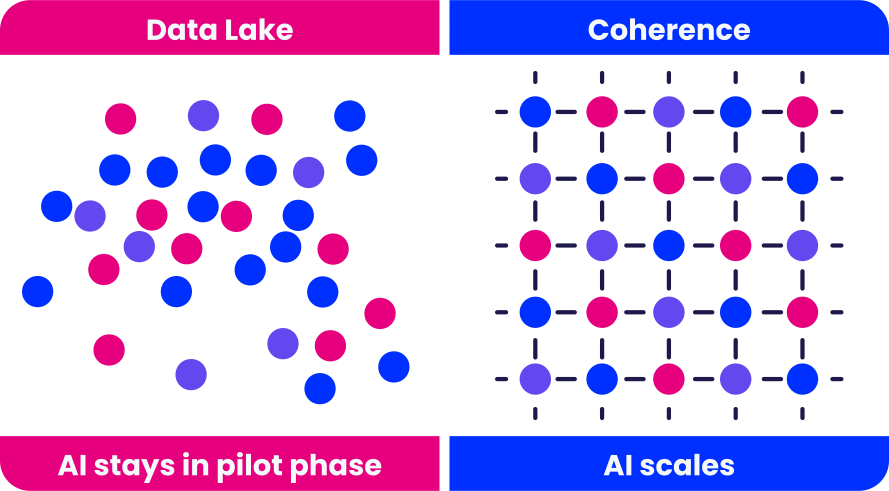
Many companies confuse data volume with data capability – along the lines of: if you have enough hay, you'll find the needle. But a large data lake or a pile of new AI tools does not guarantee productive use. The iron rule of “garbage in, garbage out” applies: if data is incomplete, outdated or contradictory, the AI model inherits these weaknesses and serves them back with complete conviction.
This shifts the decisive question from “Do we have enough data?” to “Is our data organized in a way we can trust?”. AI readiness does not depend on data quantity, but on data coherence – on whether data can be connected, ported and governed across system boundaries. This is exactly where the data silo draws the red line: it is the real ceiling for scaling AI.
Data silos look different in every industry
The basic pattern is the same across industries, but priorities and risks shift depending on the context. Three examples with in-depth industry reports:
Manufacturing
In manufacturing, data silos meet process and system landscapes that have grown over time, as well as gaps between OT and IT. Data from planning, operations, quality and service can often be combined only to a limited extent – which slows down responsiveness in production, the supply chain and maintenance.

The industry report shows where data silos emerge in manufacturing environments and which approaches ensure data continuity across the connected value chain.
Energy
In the energy sector, data silos are particularly critical because resilience, traceability and controlled data flows are high priorities. As critical infrastructure, energy providers depend on manageable complexity and controllable dependencies – here, data silos put operational capability and the pace of modernization at risk.

The industry report examines how data silos affect resilience and controllability in energy environments – and which paths lead to controlled, traceable data flows.
Financial Services
Banks and insurers are traditionally highly segmented – regulatory requirements sometimes force parallel systems. Here, data silos mainly aggravate governance issues: inconsistent customer views, redundant data storage and more difficult management of access rights and data localization.

The industry report shows how data silos make governance, auditability and consistent customer views harder for banks and insurers – and how end-to-end consistency can be achieved.
Breaking down data silos: an overview of solutions
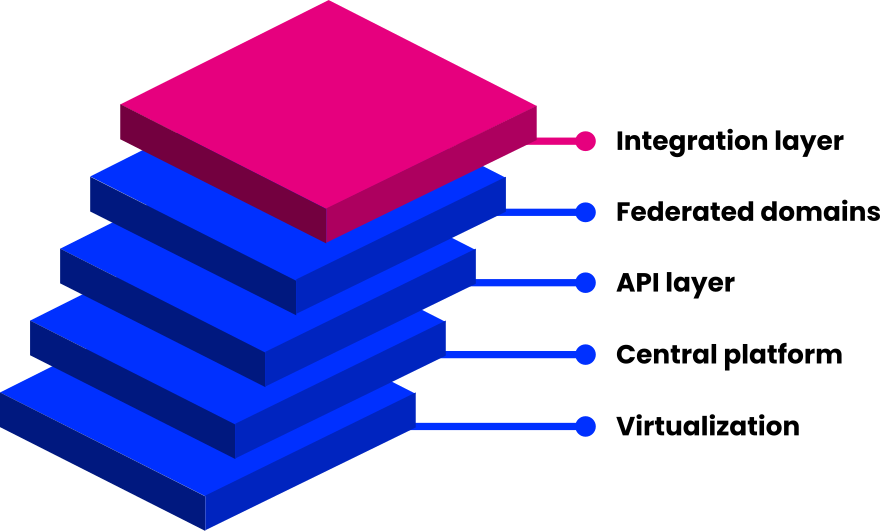
No single tool can break down data silos on its own. Whether an approach works depends on whether it creates transparency into data flows, reduces integration effort, enables portability and is organizationally sustainable. Five architectural approaches are discussed most often in practice:
| Approach | Core idea | Best suited for |
|---|---|---|
| Integration layer / orchestration | Distributed sources are connected through shared standards, metadata and access logic. | Heterogeneous landscapes under high integration pressure. |
| Federated domain ownership | Business and product domains take responsibility for their data closer to where value is created. | Organizations with mature domains and robust governance. |
| API and access layer | Existing systems are opened up step by step through defined access points. | Legacy environments that need to be decoupled quickly. |
| Central platform | Data, analytics and operations are consolidated on one platform. | Severe tool sprawl and a need for consolidation. |
| Federated query / virtualization | Data stays where it originates and is combined logically. | Contexts with data residency or protection requirements. |
So there is no universally superior target architecture. What matters is whether a solution actually dismantles data silos or merely relabels them technically – and whether it reduces integration effort, increases transparency and limits lock-in risks. For the decentralized route via independent data products per domain, Data Mesh is the established approach. Our project for digikoo shows how a consolidated data platform transforms scattered data sets into a structured schema.
Step by step: how to tackle data silos
Dismantling data silos is not a purely technical project, but a step-by-step approach covering architecture, data and organization. Five steps have proven effective:
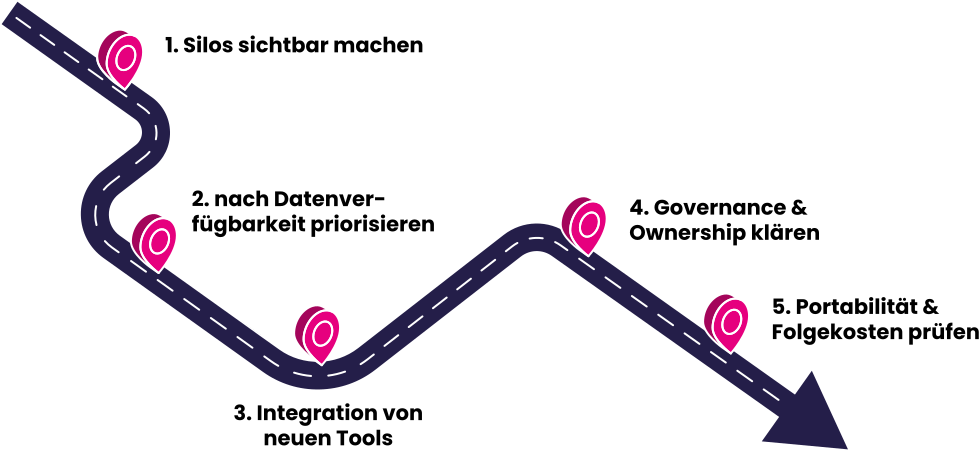
- Make silos visible. Gain transparency into data sources, systems and gaps: where do media breaks, duplicate data storage and unclear responsibilities occur?
- Prioritize by actual data availability. A use case that is attractive from a business perspective only belongs at the top if data sources can be connected, access rights are clarified and integration effort is manageable.
- Integration before new tools. First strengthen the connectivity of existing systems instead of adding yet another layer on top of disconnected legacy systems.
- Clarify governance and ownership. Define responsibilities, data standards and access rules – without clear ownership, silos are only bridged locally, not dismantled.
- Factor in portability and follow-up costs. With every platform decision, check whether new dependencies or lock-ins arise that would make future data migration and AI expansion more difficult.
Conclusion: data silos are a question of architecture, not data
Data silos are less a data problem than an architecture and organizational problem. Fragmented system landscapes, a lack of transparency, redundant software and unclear responsibilities turn genuinely valuable data into assets that are hard to use. Reducing data silos therefore also means working on technology efficiency and digital sovereignty – and laying the foundation on which AI applications can scale reliably.
This is exactly where we come in. With our data architecture consulting, MaibornWolff helps you assess data silos honestly and tear them down in a targeted way – vendor-independent and never as an end in itself. We recommend the architecture that genuinely reduces your silos, not the one with the biggest invoice. Our topic page shows how this fits into our entire Data & AI portfolio. Fewer walls, more usable data: Less Technology. Better Business.
Let's find out together where data silos are slowing down your projects – and how you can build a sustainable, AI-ready data foundation.
FAQ: Frequently asked questions about data silos
What is a data silo in simple terms?
A data silo is a data set that is locked inside a single system or department and cannot easily be connected with other data. The data exists but cannot be used freely – comparable to information stored in a locked room to which only a few people have a key.
What is the difference between a data silo and a data lake?
A data lake is a deliberately created, central repository for large volumes of different data. A data silo, on the other hand, is unintended isolation: data remains trapped in a single system. Important: a data lake can also turn into a silo if the access, semantics or governance needed to make the data truly usable are missing.
Why are data silos a problem for AI?
AI models need data that is consistent and accessible across system boundaries. Data silos interrupt exactly that: they force manual data preparation, create contradictory data and thus prevent AI applications from scaling from pilot to stable production.
How can I identify data silos in my company?
Typical signs are: data has to be gathered manually from several systems for analyses, different departments report different figures for the same facts, and no one is clearly responsible for a data set. A high share of time spent searching for and preparing data is also a clear signal.
Does the cloud automatically break down data silos?
No. A cloud migration alone does not eliminate data silos and can even create new ones in multi-cloud environments. Only when data flows are standardized, interfaces are consistent and portability and governance are actively designed does the cloud lead to more usable data.
Alexander Röckl is Head of Data & Analytics at MaibornWolff. As a data and AI expert, he specializes in developing robust data and AI strategies and translating them into scalable solutions. He supports organizations in building modern data platforms, governance structures, and data-driven products—from identifying relevant use cases to technical implementation.