

Multi-cloud strategy simply explained: opportunities, risks & implementation
Estimated reading time: 22 minutes

Multi-cloud promises the best of multiple worlds: less vendor lock-in, more flexibility, access to the strongest services per provider, and ideally greater resilience. In practice, however, the benefits quickly tip if governance, security, and operations don't keep pace. With each additional provider, coordination effort, compliance obligations, and skill requirements increase. In this article, you'll learn when multi-cloud truly makes sense, which risks are frequently underestimated, and which architecture and operational principles make multi-cloud sustainable, auditable, and economically viable in the long term.
Key takeaways
- Definition: Multi-cloud = multiple public cloud providers in parallel; hybrid cloud = public cloud + private/on-prem.
- Multi-cloud is a governance and operating model, not a provider collection: Without governance, security/compliance, and solid Day-2 operations, the benefits quickly diminish.
- Multi-cloud is particularly worthwhile when there are clear drivers: Regulatory requirements/data sovereignty, global requirements, M&A/heterogeneous landscapes, resilience requirements, or the targeted use of specialized services.
- Complexity as the price of diversification: More providers mean more integration effort (IAM, networks, logging/monitoring, data), more tooling, and higher demands on skills and processes.
- Security doesn't automatically improve: Multi-cloud often initially increases the attack surface (more configuration variants, policy drift). Security gains only come through consistent standardization and evidence capability.
- Day 2 is decisive: Clear SLOs/KPIs, standardized incident/change/problem processes, ownership, runbooks, and 24/7 operational capability are frequently the real bottleneck.
- FinOps is mandatory: Without a consistent cost taxonomy, showback/chargeback logic, forecasting, and architectural decisions addressing egress/duplicate structures, multi-cloud quickly becomes uneconomical.
What is multi-cloud?
Multi-cloud refers to the parallel use of cloud services from multiple public cloud providers within an IT landscape – for example, AWS, Microsoft Azure, and Google Cloud. Workloads and platform services are deliberately distributed across multiple providers: for instance, analytics with provider A, container platform with provider B, specific AI services with provider C.
The goal is to gain more flexibility and reduce dependency on a single cloud provider.
Multi-cloud is frequently confused with the term hybrid cloud, but it means something different.
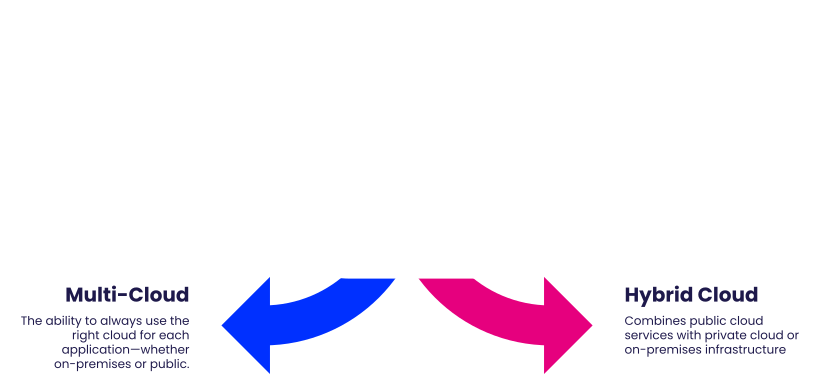
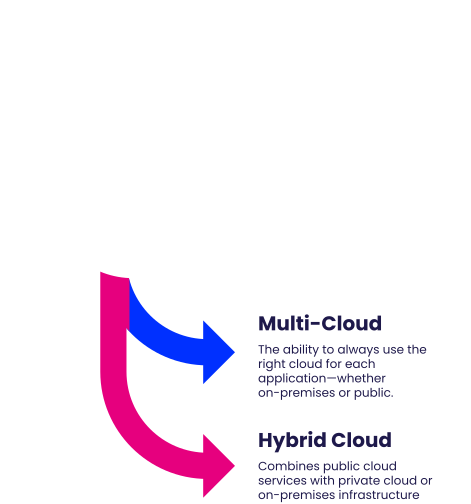
- With a multi-cloud strategy, a company relies on multiple (public) cloud providers that are used independently of one another.
- A hybrid cloud, on the other hand, combines public cloud services with a private cloud or own local data centers. This is about the connection of cloud and on-premise infrastructure, for example with a cloud data warehouse.
In practice, hybrid forms frequently emerge: hybrid plus multi-cloud (e.g., an on-premise solution and two public clouds).
When and why a multi-cloud strategy pays off for you
Not every company automatically benefits from a multi-cloud architecture. Using multiple cloud providers brings clear advantages for certain use cases but simultaneously increases technical and organizational complexity. The decisive question is therefore: When does multi-cloud really pay off?
Who benefits most from multi-cloud?
Multi-cloud is primarily used by organizations that work with complex, international, or highly regulated IT environments. There are various drivers that can fuel the decision to adopt a multi-cloud environment:
- Regulatory requirements and data sovereignty: Factors such as data residency, auditability, and compliance obligations represent explicit requirements for many companies. This is particularly relevant when requirements related to the EU legal framework, critical infrastructure (KRITIS), or ISO-compliant evidence capability restrict the choice of provider.
- Resilience/Disaster Recovery: Multi-cloud can be useful when cross-provider failover and recovery targets must be reliably met. In this case, multi-cloud serves to reduce single points of failure and strengthen recovery scenarios against large-scale disruptions or ransomware attacks.
- M&A and historically grown IT: Multi-cloud is often already a reality in one form or another because companies have built up multiple platforms over time or acquired them in previous M&A deals. The goal then is consolidation and, where applicable, migration to a manageable operating model with clear standards.
- Global requirements: Multi-cloud is also necessary in cases where regional coverage, latency requirements, or local regulatory specifications cannot be met by a single provider alone. In such cases, multi-cloud serves as enablement for international delivery and compliance.
- Specialized services: Multi-cloud can deliver added value when individual providers are significantly superior in certain services and this is strategically relevant for the product. It is crucial that usage remains targeted and does not lead to fragmentation of the entire stack.
- Negotiation/sourcing strategy: Multi-cloud can help reduce dependencies in contracts and roadmaps. The effect materializes when sourcing is actively managed and alternatives are realistically operable.
If none of these drivers is strong, a good single cloud or hybrid cloud is often the better choice.
Assessing the complexity of a multi-cloud strategy
Multi-cloud almost always means a change to the entire operating and governance model. The additional effort arises not primarily from the one-time introduction of a second or third provider, but from the ongoing need to keep decisions, controls, and operational mechanics consistent across multiple platforms.
In practice, it becomes clear: the more clouds are involved, the greater the integration and coordination needs grow, and the faster friction losses arise when standards are missing or responsibilities are unclear. That's why it pays to soberly assess the complexity costs as part of the new cloud strategy upfront, specifically along the areas where multi-cloud typically generates permanently more work and therefore also more costs:
- Governance: In a multi-cloud environment, policies, standards, exceptions, and control mechanisms must be defined and enforced across providers. Additionally, effort increases because audit and evidence requirements must be consistently met across multiple environments.
- Security & IAM: Identities, permissions, key management, and security services differ by provider and must be harmonized. If this isn't done cleanly, gaps, inconsistent controls, or over-privileged access result.
- Operations & Tooling: Monitoring, logging, alerting, incident response, and automation must work across all environments to prevent operations from fragmenting into silos. Without tooling consolidation, effort frequently grows due to duplicate systems and signals that are difficult to compare.
- Integration: Network, connectivity, data flows, and interfaces increase technical complexity, especially when data is moved between clouds. Each additional connection is a potential cost and security factor and must be deliberately designed.
- Skills: Multi-cloud requires deep expertise across multiple ecosystems as well as roles for platform engineering, cloud security, and FinOps. When competence is only available in isolated pockets, the risk of misconfigurations and operational inefficiency increases.
Go or no-go for multi-cloud?
Once the strategic drivers have been clarified and the real complexity costs across critical areas have been assessed, the next step is to translate these insights into a robust decision. The following go/no-go arguments present both perspectives in condensed form:
- Go: Multi-cloud is a sensible decision when a strong driver exists and a realistic plan for governance, Day-2, and FinOps is in place simultaneously. In this case, multi-cloud is a meaningful tool for achieving clearly defined objectives.
- No-Go: Multi-cloud is generally not sensible when the decision is primarily driven by trends or as a diffuse precaution. When the operating model, skills, and evidence capability are lacking, costs and risks typically rise faster than the benefits.
- Pilot project/Selective multi-cloud: A selective entry is sensible when drivers exist but the organization is not yet scalable. In that case, multi-cloud should be applied in a targeted manner to a few workloads or a clearly defined objective, while governance and operations are built up in parallel.
Advantages of a multi-cloud strategy
When implemented correctly, multi-cloud can deliver strategic advantages – but only if these advantages are explicitly defined as goals and operationalized:
Multi-cloud can reduce dependencies on a single provider, particularly in contract terms and roadmap decisions. The benefit materializes when alternatives don't just exist in theory but are operationally feasible.
Multi-cloud allows workloads to be placed where the technical and economic fit is highest. This enables IT to respond more quickly to new requirements without being tied to a single ecosystem.
When individual platform services are significantly better with one provider, multi-cloud can specifically increase the pace of innovation. It is important that this specialization is consciously managed to avoid fragmentation of the platform. Well-known examples exist in areas such as AI, data processing, or security. In doing so, a deliberate decision must be made between using these highly specialized cloud features and maintaining portability, as deep functional dependencies can undermine protection against vendor lock-in.
A managed multi-cloud model can reduce uncontrolled cloud usage by providing clear standards, landing zones – i.e., secure environments in the cloud – and self-service within clearly defined guardrails. However, this effect only occurs when governance is practical and teams are not pushed toward workaround solutions by excessively high barriers.
Multi-cloud can reduce dependency on a single platform and thereby lower outage risks. However, there is also a "but" here: This advantage only materializes when central dependencies such as identity, observability, operations, and recovery mechanisms function consistently across providers and are regularly tested.
When critical systems are distributed across multiple providers, outages of individual platforms can be better absorbed – keyword: single point of failure. For many threat scenarios (e.g., ransomware), resilience and a functioning recovery concept with backups are enormously important.
Multi-cloud can be useful when organizations need to remain capable of action in the face of price increases, contract changes, or geopolitical shifts. Workloads can be redistributed within already operational environments, rather than having to manage a complete provider switch.
However, such a cloud architecture can significantly increase operational complexity. Therefore, the appropriate technical expertise must absolutely be available within the company (or with an external provider).

What challenges does a multi-cloud strategy bring?
As attractive as multi-cloud is in terms of flexibility and resilience, it also brings clear challenges. Because: as soon as multiple cloud providers are used in parallel, the requirements for operations, governance, and security increase significantly. A multi-cloud strategy is therefore not a sure-fire success and must be professionally planned and implemented.
-
Higher governance and administrative overhead:
More providers mean more rules, more exceptions, and more evidence: Each additional cloud increases the number of control points, documentation requirements, and responsibilities that must be consistently maintained. Without a clearly defined governance model, standards quickly become inconsistent and audit-critical.
-
Interoperability takes work, it's not automatic:
Provider ecosystems are not interchangeable and must be actively integrated. IAM, observability, or certain PaaS components are tightly coupled to provider-specific logic. Interoperability only emerges through deliberately defined architecture standards, interfaces, and patterns.
-
Security often gets worse first:
More complexity can create misconfigurations and policy drift. Multi-cloud brings different defaults and role models, which can cause security levels to diverge. Security only improves when the corresponding measures are standardized, automated, continuously verified, and made available as evidence.
-
Skill gaps slow down implementation:
Multi-cloud requires genuine platform expertise across multiple worlds: When teams are only familiar with one cloud, knowledge gaps, dependencies, and operational errors emerge. This applies especially to security and networking topics that must be consistent across providers.
-
Developer focus: code instead of cloud management:
When developers have to juggle between many different portals and tools, it creates overhead and slows down velocity. An Internal Developer Platform (IDP) helps here: It bundles cloud complexity into a simple self-service portal. This way, your teams can focus on code instead of losing valuable time on provider details.
-
False resilience:
More providers does not equal more resilience: If central dependencies are not designed redundantly or recovery processes are not tested, resilience remains merely a theoretical promise. Often the platform becomes broader, but operational responsiveness stays the same or even decreases.
-
Cost traps and duplicate structures:
Parallel operations and data movement can make costs harder to control: Egress fees, duplicate platform services, and inconsistent tagging reduce transparency and predictability. Without FinOps discipline, the business case collapses and results in high (additional) costs.
Building a multi-cloud strategy: what matters
For many companies, multi-cloud is the next logical step in cloud evolution: Instead of aligning all systems to one platform, multiple providers are deliberately used – depending on strengths, area of application, and strategic needs.
For this to become a successful multi-cloud strategy and a functioning overall model, clear planning, prioritization, and clean implementation along central architecture and operational questions are needed. Below, we summarize the most important aspects.
1. Goals, workloads, protection requirements: structuring the portfolio
Every workload needs a clear classification in terms of criticality, data classification, and compliance. This includes explicitly defining availability and recovery requirements and documenting protection needs in a traceable manner.
Companies should therefore first analyze:
- Which applications are business-critical?
- Which systems require particularly high availability?
- Where do data protection, location requirements, or compliance play a role?
- Which workloads need to scale significantly or be particularly performant?
Only from this can it be determined whether multi-cloud can deliver added value for a given workload.
2. Making the provider selection: criteria instead of gut feeling
Once goals, workloads, and protection requirements are clear, the provider selection can be made in a much more targeted manner. Now it's about evaluating providers based on whether they can actually deliver on the strategic drivers (e.g., compliance, resilience, global delivery) and can be integrated into a unified operating model.
- Regions, residency, and evidence matching the compliance reality: The provider choice must cover regulatory requirements, certifications, and auditability and must not be based solely on feature lists.
- Integrable security and IAM capabilities: Can identities, role models, and security mechanisms be cleanly integrated into the existing enterprise setup?
- Platform services compatible with architecture and product: The selection should consider which PaaS services will actually be used and how strongly they affect portability.
- Manageable cost models: Commitments, billing logic, and transparency must be designed so that budget planning and cost allocation work realistically.
- Suitable toolchain and operating model: Support models, partner capability, and integration into existing processes are just as critical as technical features.
Here too, digital sovereignty and compatibility with the EU legal framework are increasingly important, central selection criteria when handling sensitive data in companies. Storage locations or access chains for (sensitive) data that may leave the EU legal framework can become exclusion criteria for potential end customers in certain industries.
3. Defining governance artifacts
At the latest when multiple providers are in play, the question arises whether and how standards, responsibilities, and evidence work reliably in day-to-day operations. This means: The multi-cloud strategy must be translated into binding governance artifacts that empower teams while simultaneously ensuring auditability, security, and manageability.
- Cloud Policy Set (Minimum Controls): A binding minimum standard for identity, logging/monitoring, network, encryption, data classification, secrets, and vulnerability/patch management must exist and be implemented equivalently in every cloud.
- Roles and responsibility model (RACI): Which tasks lie with the platform team, with product teams, with security/compliance, and with finance? To ensure decisions in ongoing operations are not delayed by unclear responsibilities, functioning structures are needed from Day 1.
- Cloud Center of Excellence / Architecture Board: Especially in larger companies, a body should be established that sets standards, evaluates exceptions, and documents decisions in a traceable manner, so that governance doesn't happen on an ad-hoc basis.
- Evidence and audit mechanisms: It must be defined how evidence is generated, versioned, reviewed, and provided in the event of an audit, so that auditability doesn't depend on the individual project knowledge of specific people.
- Standardized Landing Zones: The foundational structures for accounts/subscriptions, network basics, guardrails, and baseline security must be provided in a standardized way, so that teams can deliver quickly without starting from scratch each time.
A practical principle: The more heavily regulated an industry is, the more important it becomes to have clear governance rules and security evidence from the very beginning. In certain environments, it can even happen that contracts are lost due to missing certifications or compliance errors trigger contractual penalties.
4. Establishing architecture principles
Once providers and governance foundations are defined, architectural guardrails are needed that enable interoperability and consistency across all clouds without prescribing every detail. The following points formulate the few but decisive principles that make integration, operations, and security scalable.
- Identity Federation: Identities and roles must be centrally managed and federated so that access is consistent, auditable, and revocable.
- Observability Pattern: Logging, metrics, and tracing must be designed so that operations and security can recognize cross-cutting dependencies and manage services.
- Connectivity Pattern: Network segmentation, secure connections, DNS, and ingress/egress rules must be consistent so that security and performance don't vary depending on the cloud.
- Data Movement Pattern: Data flows between clouds must be minimized, protected, and designed economically, because data movement creates both security and cost risks.
- Deployment Pattern: CI/CD, Infrastructure as Code, and Policy-as-Code must be standardized so that changes happen in a controlled, repeatable, and auditable manner.
Perhaps the most important aspect for successfully running multi-cloud operations is full transparency across the entire environment. Individual monitoring solutions per provider are usually not sufficient, as questions and problems in tightly connected systems typically arise across platforms.
Multi-cloud is in place – now what? Setting up efficient Day-2 governance
After the rollout of the new structures, it becomes clear whether multi-cloud can sustainably improve business goal planning and execution, whether risks remain controllable, and whether total costs (TCO) are predictable. Day-2 operations are therefore about repeatable governance mechanisms: uniform service quality, standardized operational processes, end-to-end observability, and a cost model that reliably supports priorities and investments.
1. Operationalizing goals: SLOs, KPIs, and responsibilities
If multi-cloud is to be manageable in daily operations, strategic goals must be translated into measurable operational and governance metrics. SLOs and KPIs shift the basis of discussion from subjective impressions to objective facts. Additionally, clear responsibilities ensure that deviations are noticed and corrected.
- Track measurable service targets: For critical services, SLOs should be defined that capture availability, performance, and error rates and guide operational decisions.
- Regularly evaluate operational metrics: MTTR, incident rate, and change failure rate are examples that show whether stability and delivery capability are increasing or decreasing.
- Include security and FinOps metrics: Policy compliance, vulnerability backlog, and patch times as well as unit costs and forecast accuracy make security and costs manageable.
2. Standardizing end-to-end processes
With multiple clouds, the likelihood increases that operations fragment into silos, with each platform running by its own rules. The goal here is to standardize the critical operational processes so that incident, change, and problem management work equally reliably across providers and scaling doesn't lead to a loss of control.
- Incident management that works across providers: Triage, escalation, on-call, runbooks, and postmortems must be standardized so that internal teams can respond quickly regardless of the provider.
- Change management controlled and automated: If releases, approvals, rollbacks, and change transparency are not carried out and documented according to consistent standards, multi-cloud over time leads to qualitatively different output.
- Problem management that systematically reduces root causes: Recurring incidents must be structurally resolved; otherwise, operational effort grows with each platform.
3. Central observability as a must
Without a consolidated view of status, dependencies, and incidents, multi-cloud quickly becomes flying blind. Observability is therefore a central prerequisite for manageability.
- Without central transparency, multi-cloud becomes unmanageable: Monitoring and logging signals must be consolidated so that dependencies, bottlenecks, and incident root causes can be identified.
- Alerts need ownership and clear quality: It must be clearly defined who is responsible for which monitoring and logging signals and according to which criteria alarms are triggered, so that the on-call team is not flooded with too many irrelevant notifications.
- Correlation across domains is critical: Ideally, service health, changes, security events, and costs can be correlated so that decisions are not made in isolation.
4. SecOps and compliance become routine
Security and compliance in multi-cloud cannot be addressed through one-off audits or individual measures, because platforms and configurations can change constantly. For standards to remain stable and evidence to be generated in daily operations, routine implementation is required.
- Controls must be continuously verified: Policy-as-Code, automated checks, and ongoing monitoring of security and compliance controls ensure that deviations are detected early and corrected.
- IAM and credentials must be consistently managed: Who has access to what and how passwords, tokens, and keys are stored and used must follow the same rules everywhere. If access, credentials, and keys are handled differently per cloud, security gaps quickly emerge.
- Evidence capability must be built into operations: Documentation and evidence should be generated as automatically as possible and maintained in versioned form, so that auditability is consistently ensured.
5. FinOps: cost management as an operational discipline
As soon as multiple providers are involved, cost management without structure quickly becomes reactive and ends in surprises rather than predictability. FinOps as an operational discipline must ensure that costs are transparently attributable, forecasts become reliable, and architecture decisions factor in economic impacts from the outset.
Cost model and accountability
- Costs must be assigned to an owner: Showback creates transparency by making costs visible to teams/products, and chargeback can be useful where genuine budget accountability and cross-charging are needed.
- Strict separation of platform overhead and product consumption: Only this way can budgets be planned fairly and optimization measures be prioritized in a targeted manner.
Unified cost taxonomy
- Tags/labels and account structures must be standardized: A consistent taxonomy is a prerequisite for comparing and analyzing costs across clouds.
- Cost reports work without manual rework: If every analysis requires individual interpretation, governance is not scalable in daily operations.
Forecasting and commitment strategy
- Regular maintenance of forecasts: Cost and capacity forecasts should be continuously updated, taking into account expected trends, seasonal fluctuations, and planned releases. Only this way do assumptions about future consumption remain realistic and chosen commitments continue to match actual developments.
- Commitment management follows clear rules: Price commitments such as reservations or commitment plans should only be used where consumption is stable and highly predictable. They should also be regularly reviewed – particularly whether they are sufficiently utilized and whether the discount for certain capacity commitments is economically worthwhile.
- Finance and engineering must steer together: FinOps only works when technical decisions and budget logic are regularly aligned.
Defusing architecture-driven cost drivers
- Minimizing egress and unnecessary data movement: Data should be processed as close as possible to where it originates, and cross-cloud flows should be deliberately limited.
- Reducing duplicate structures: Platform services operated in parallel are often the biggest cost driver and should only exist where justified.
- Scaling must match usage: Excessive safety margins or outdated capacity assumptions can only be avoided when architecture and operational rules are adapted to actual load profiles.
Conclusion: Multi-cloud only delivers value when governance and operations keep pace
Multi-cloud can increase flexibility, independence, and resilience potential. However, the decisive lever lies not in simply having more providers, but in the professionalism behind it: clear workload allocation and goal definitions, binding standards and responsibilities, governance with security and compliance evidence, and centralized transparency over operations and costs.
Even with a successful introduction, the job is not yet done. In fact, the successful implementation of a multi-cloud strategy requires vigilance. Typical tipping points at which multi-cloud needs refinement must not be ignored and include, for example, the following scenarios:
- Policies, controls, and audit evidence cannot be consistently mapped: When security and access controls are implemented differently for each cloud, security gaps and audit risks emerge that can only be closed later with significant effort.
- Operations lose transparency: When incidents, dependencies between systems, and platform changes are not visible centrally and uniformly, troubleshooting takes longer and teams react more slowly. This increases the number of escalations, and operational effort rises noticeably.
- Cost management becomes reactive: When budget surprises become the norm, something is wrong with the taxonomy, the applied cost models, or the forecasting.
- Competencies are only available in pockets: When platform and security know-how is not available in a scalable manner, decisions and operations become dependent on a few individuals or external service providers.
- Regulatory pressure increases faster than the ability to provide evidence: When requirements for documentation increase, documentation and auditability must be embedded in the operating model—otherwise compliance becomes a permanent project.
External support is particularly cost-effective when several of these points have been reached or when the organization cannot scale its platform, security, and FinOps operating model quickly enough.
MaibornWolff supports companies even before implementation in setting up and evolving multi-cloud so that strategy and day-to-day operations align: from workload and architecture decisions through governance, security, and compliance to a stable operating model including observability, incident/change processes, and FinOps. This way, you operate your multi-cloud in a manner that is manageable, auditable, and economical in the long term.

Benefit from tailored cloud solutions. Talk to us about how
you can make your company fit for the digital future.
FAQ: Frequently asked questions about multi-cloud strategy
What is a multi-cloud?
Multi-cloud refers to the parallel use of cloud services from multiple providers (e.g., AWS, Microsoft Azure, Google Cloud) within an IT landscape. Different workloads, platform services, or regions can be deliberately distributed across different providers. The goal is usually to reduce dependencies, leverage the best technology for each use case, or meet regulatory requirements.
Important distinction: Multi-cloud is not synonymous with hybrid cloud: hybrid combines cloud and on-premises data centers, while multi-cloud encompasses the use of multiple cloud providers.
What types of cloud architectures are there?
There are three common basic forms:
- Single cloud (one provider)
- Multi-cloud (multiple providers)
- Hybrid cloud (public cloud plus on-premises/private cloud)
Beyond these, there are community or industry cloud models designed for specific industries or user groups. Additionally, many definitions distinguish between public cloud, private cloud, and edge/distributed cloud (computing power close to end devices/locations). In practice, hybrid forms frequently emerge because organizations combine historically grown landscapes with new cloud platforms.
When is a multi-cloud strategy worthwhile?
Multi-cloud is worthwhile when there is a clear business or compliance driver: This can include data residency requirements, high availability targets across provider boundaries, targeted use of specialized services (AI, analytics, PaaS), or strong negotiating power on pricing and contracts.
Also in M&A situations or when different business units use historically driven different clouds, the (meaningful) consolidation via a multi-cloud architecture is a popular method of collaboration. Multi-cloud often becomes unprofitable when it is introduced just in case, without clear governance, skills, and an operational concept.
What risks are underestimated with multi-cloud?
Frequently underestimated are operational complexity (more tools, processes, and operating models than before), skill gaps (teams must truly master multiple platforms), and interface risks (network, identity, logging, monitoring).
Also critical: cost traps such as data egress, dual operations, and inconsistent tagging/account structures that destroy transparency. On the security side, policy drift and inconsistent configurations are underestimated—small deviations between clouds can create large attack surfaces. Without clear standards, the error rate increases.
Is a multi-cloud strategy automatically more secure?
No, a multi-cloud strategy is not automatically more secure than its predecessor model. Multi-cloud can reduce risks, such as dependency on a single provider or the impact of individual platform outages. However, security does not improve without additional effort—in fact, it often becomes even more difficult because the attack surface and configuration variants increase. Different IAM models, security services, and default settings easily lead to gaps.
Multi-cloud only becomes truly more secure with consistent standardization: centralized identities, uniform policies, end-to-end logging/monitoring, automated compliance checks, and clear responsibilities. Without this discipline, the risk of misconfiguration increases.
How many cloud providers make sense?
In many mid-sized organizations, two to three providers represent a practical sweet spot: enough diversification, yet still manageable in terms of operations, security, and cost management. Each additional provider increases organizational and governance complexity: policies, controls, evidence, and reporting must be implemented consistently each time—otherwise steering and audit risks arise. Even more providers are usually only worthwhile with high specialized requirements (regulatory, regional, specialized services) or when the company is large enough to scale platform engineering, FinOps, and security centrally.
Also decisive is the ability to provide evidence for security and compliance including documentation, because inconsistent evidence can stall entire initiatives. Tipping points emerge when governance overwhelms available staff, skills are lacking, or transparency over operations and costs is lost.
Philipp Hauptmann is a Lead Cloud Engineer with extensive experience in the AWS world. He supports companies in migrating, modernising and optimising their systems in the cloud – efficiently, scalably and securely. In addition to cloud-native development, his expertise also includes economically relevant aspects such as cost optimisation, data protection and compliance in AWS. He uses modern technology (such as GenAI) to implement innovative solutions for a variety of industries and IT requirements.