

Smart Maintenance: The intelligent way to keep assets running
Estimated reading time: 14 minutes

Unplanned downtime, rising maintenance costs, and a lack of transparency regarding the condition of equipment pose significant challenges for companies. Smart Maintenance offers an innovative approach to maintenance: data-driven, predictive, and closely integrated with operations. In this guide, you’ll learn how Smart Maintenance works, what technologies are used, and what’s key to a successful implementation.
The most important points at a glance
- What is Smart Maintenance? Smart Maintenance is a data-driven approach to maintenance in which companies continuously monitor machine conditions and tailor maintenance activities accordingly. The goal is to keep equipment reliably available while minimizing resource consumption.
- How does Smart Maintenance work? Sensors continuously collect data from machines and equipment. This data is consolidated and analyzed in networked systems. This allows for the early detection of anomalies and wear and tear, enabling maintenance to be scheduled as needed.
- Which technologies are essential? The foundation consists of sensor technology, IIoT or OT connectivity, and a data platform. Depending on the use case, analytics, machine learning, cloud computing, or AI may also be added.
- Why is it worth implementing? Smart Maintenance reduces unplanned downtime, improves maintenance planning, and lowers maintenance and repair costs. At the same time, it allows for more targeted use of resources and extends the service life of equipment.
- How can it be successfully implemented in the workplace? Smart Maintenance is successfully implemented when companies start with a clear goal, suitable use cases, and a realistic pilot project. Equally important are reliable data, clear responsibilities, and the early involvement of all relevant departments.
Was ist Smart Maintenance? Definition
Smart Maintenance refers to all technical and organizational measures aimed at using digital tools to make maintenance more efficient and generate greater value. The core principle is data-driven, predictive maintenance: condition and performance data from machines and systems are continuously collected, networked, and analyzed. This allows maintenance decisions to be made based on current facts.
This is precisely where the difference from traditional maintenance concepts lies. Reactive maintenance only intervenes once a machine has already broken down. Preventive maintenance is performed at fixed intervals, regardless of the actual condition of the equipment. Smart Maintenance takes a different approach: Here, measures are taken as needed at the optimal time. This prevents both late intervention—which can lead to consequential damage and unplanned downtime—and premature maintenance, which involves unnecessary effort.
Smart Maintenance transforms maintenance from a "necessary cost center" into a value-adding partner for production. Maintenance and production are becoming more closely integrated in Industry 4.0, resulting in increased plant flexibility, availability, and productivity, while unplanned downtime decreases.
Smart Maintenance is thus a core principle of the Smart Factory, because only with highly available, reliably maintained production equipment can customized manufacturing and flexible concepts be implemented cost-effectively.

Together, we are laying the groundwork for data-driven, sustainable maintenance.
How does Smart Maintenance work?
At its core, Smart Maintenance refers to maximizing equipment availability while minimizing resource usage through data-driven, integrated, and predictive maintenance. But what exactly does that mean, and how does it work in practice? Let’s take a closer look at the individual basic principles:
- Data-driven means that maintenance decisions are based on specific machine and plant data. A typical example from production is program-controlled machine tools, known as CNC (Computerized Numerical Control) machines. Sensors measure values such as vibrations, spindle temperature, or power consumption. If these values change, it may indicate bearing or tool wear.
- Integrated means that this data does not remain isolated, but is consolidated within interconnected systems and incorporated into operational processes. If the system detects signs of wear on a CNC machine, the maintenance team can use this information directly to order replacement parts in a timely manner and coordinate the replacement with production planning. This allows the work to be scheduled during a suitable time window without unnecessarily disrupting production.
- Predictive means that anomalies or wear are detected and reported early on, before a failure occurs. For example, in conveyor systems, unusual running noises can indicate worn rollers. In presses or injection molding machines, changes in pressure and temperature curves indicate that seals or valves are wearing out. Smart Maintenance means that such anomalies do not become relevant only after damage has occurred, but rather indicate future maintenance needs at an early stage.
Why Smart Maintenance? An overview of the benefits
The goal of Smart Maintenance is to make maintenance more predictable, efficient, and cost-effective. Instead of simply reacting to breakdowns, you continuously monitor the condition of your equipment, allowing you to take proactive action. This offers a number of benefits:
Instead of simply reacting or waiting at fixed intervals, measures are planned and implemented as needed.
Early warnings of wear or anomalies allow for timely intervention. This reduces the risk of unexpected malfunctions and costly production downtime.
With the help of Smart Maintenance, companies can stock spare parts in a targeted manner and allocate personnel and budgets where action is actually needed.
Smart Maintenance helps prevent unnecessary maintenance as well as costly consequential damage caused by delayed intervention.
Early detection of wear and tear makes it possible to repair components before more serious damage occurs. This protects key system components and extends their service life.
Smart Maintenance provides transparency into the actual condition of the equipment. As a result, decisions are based not only on experience, but also on up-to-date operational and condition data.
From IIoT to AI: These are the technologies behind smart maintenance
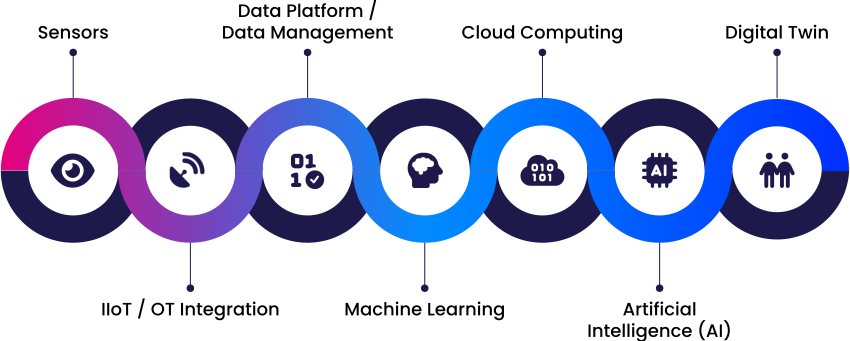
Smart Maintenance is based on the intelligent use of data. Various digital technologies are used to reliably monitor machine conditions and plan maintenance activities in a timely manner.
However, it is important to note that: Smart Maintenance is not a strictly defined technology stack. Rather, it is an application principle of modern maintenance. The specific technologies used depend on a company’s level of maturity and the particular use case.
Sensory
Sensors form the foundation of every smart maintenance application. They monitor the physical conditions of equipment in real time, such as vibration, temperature, or pressure. This data reveals how a piece of equipment is performing during operation. Changes can serve as early indicators of wear, malfunctions, or unusual stresses. Without sensor technology, condition-based or data-driven maintenance would not be possible.
IIoT / OT integration
IIoT stands for the Industrial Internet of Things and enables the interconnection and communication of machines, sensors, and systems. This connectivity is essential to ensure that condition and operational data are not only collected but also continuously transmitted and analyzed. Only then can individual measurement values be transformed into a usable data foundation for smart maintenance. In short: Without IIoT or a comparable OT (Operational Technology) connection, sensor data remains isolated and cannot be systematically utilized for smart maintenance.
Data Platform / Data Management
Data platforms are essential for consolidating sensor, maintenance, and operational data in a central location. There, the data is not only stored but also structured, making it usable for analysis, evaluation, and planning in maintenance. Data storage can be either on-premises or cloud-based. The key to successful smart maintenance is not the storage location itself, but rather reliable access to relevant data.
Machine Learning
To gain actionable insights from large amounts of data, analytical methods are used. These include statistical analyses and machine learning techniques. They are used in most smart maintenance approaches, but are not a prerequisite for intelligent maintenance.
Typical applications include:
- pattern recognition
- Analysis of wear and trends
- identifying anomalies
It is important to note that not every smart maintenance system uses complex AI models for this purpose. Often, simple statistical analyses are sufficient to detect anomalies at an early stage.
Cloud Computin
Many companies use cloud infrastructures to efficiently process large amounts of data and analyze it centrally. One advantage is scalable data processing, which can be flexibly adapted to growing data volumes. In addition, cloud computing enables centralized analysis across multiple locations and facilitates the integration of different data sources.
In the context of smart maintenance, while the cloud is widely used, it is not a mandatory requirement. In practice, edge or on-premises approaches are also common, in which data is processed and analyzed locally.
Artificial Intelligence (AI)
Artificial intelligence is primarily used in advanced or specialized forms of smart maintenance (advanced, predictive, and prescriptive maintenance). AI in industry enables complex predictive models, adaptive learning systems, and automated decision-making logic. This allows for more accurate failure predictions, more targeted planning of maintenance measures, and further optimization of maintenance processes.
Digital Twin
A digital twin is a virtual representation of systems or processes. It links real-world operational data with a digital model, thereby making it possible to track current states, changes, and potential developments. On this basis, it is possible, for example, to simulate wear patterns or specific operating conditions.
The digital twin is a very powerful technology, but it also involves a significant amount of modeling work. It is not necessary for basic smart maintenance applications. It should be viewed more as a supplement rather than a core component of smart maintenance.
Technology Isn't Everything – How to Successfully Integrate Smart Maintenance into Your Operations
The biggest challenges in implementing smart maintenance lie not in the technology, but in operations, organization, and established work practices. It is therefore crucial to identify typical obstacles early on and integrate smart maintenance into processes and responsibilities in such a way that it becomes a sustainable operational approach.
Clarify collaboration and responsibilities early on
One of the biggest challenges is collaboration between maintenance, production, and IT. Each of these functions has its own objectives and operates according to a different logic. While maintenance relies heavily on experience, production focuses on availability and throughput. IT, on the other hand, thinks in terms of systems, data, and standards. Without clear coordination, misunderstandings, false expectations, or delays can quickly arise.
It is therefore important to define responsibilities early on. Companies should clarify who is responsible for data, systems, and assessments, and how decisions are coordinated across departments. Smart Maintenance can only be sustained in the long term if collaboration is organized across departments and does not run parallel to day-to-day operations.
Ensuring data quality and translating insights into processes
Even good models and thorough analyses are of little use if the underlying data in the operation is not reliable. Incomplete maintenance data or a lack of standards for data collection and maintenance quickly lead to results that appear implausible and a decline in trust in the system. Ensuring data quality is therefore not a one-time preparatory task, but rather an ongoing operational responsibility.
Process integration is just as important. Smart Maintenance generates new information, such as warnings, forecasts, or recommendations for action. However, this information must also be acted upon in practice. Companies should therefore determine early on who will evaluate such alerts, how they will be prioritized, and how they will be incorporated into existing work orders or maintenance schedules. Only when data-driven insights are translated into concrete processes does real added value emerge.
Build acceptance and approach change realistically
Another critical issue is acceptance within the maintenance department. Many skilled workers have extensive practical knowledge and make decisions based on years of experience. If smart maintenance is perceived as a monitoring tool, an additional burden, or a substitute for this knowledge, reservations quickly arise.
That is why it is important to position smart maintenance as a support rather than a competitor to experience. Operational experts should be involved early on, for example in selecting use cases, evaluating results, or further developing solutions. At the same time, it pays to start small and scale gradually. A clearly defined use case with recognizable benefits often generates more acceptance than a rollout that is too large. In this way, Smart Maintenance is integrated into regular operations step by step.
We’ll help you successfully implement smart maintenance in your business.
Smart Maintenance in ractice
Smart Maintenance proves its value above all in situations where systems must operate reliably and where breakdowns result in high costs or risks. Depending on the industry, different objectives take center stage. Sometimes the focus is on the operational safety of critical infrastructure; other times, it is on the availability of vehicles, building systems, or medical equipment. The specific implementation varies, but the basic principle of Smart Maintenance remains the same: condition data is continuously collected and analyzed, enabling companies to take preventive action and respond early.
The following table shows you some areas of application and specific examples of smart maintenance:
| Area | Typical use cases | Specific benefits |
|---|---|---|
| Energy & Utilities | Monitoring of gearboxes and rotor blades using vibration and ultrasonic sensors; analysis of turbine bearings based on temperature and oil parameters; condition monitoring of transformers, e.g., via gas-in-oil analysis | Prevention of costly major damage, extended service life of expensive equipment, and increased equipment availability |
| Transport & Logistics | Analysis of telematics data on engine load, brake wear, and battery condition; overheating detection in axle bearings; automatic engine analysis in aviation | Better maintenance planning, greater safety, lower downtime costs |
| Building & Facility Management | Identification of inefficient HVAC systems using temperature and flow data; detection of wear and tear on elevator cables, brakes, and motors; early warning of cooling or power supply issues in data centers | Fewer emergency repairs, energy savings, higher user satisfaction |
| Water & Wastewater Management | Vibration analysis for detecting bearing damage in pumps, leak detection in piping networks using acoustic sensors, condition monitoring of key equipment in wastewater treatment plants | Greater operational reliability, lower maintenance costs, and prevention of environmental damage |
| Medical Technology & Healthcare | Monitoring of critical components in MRI and CT scanners, predictive maintenance of emergency power systems, and early warnings regarding calibration or wear and tear in laboratory equipment | No unplanned equipment failures, improved predictability, and enhanced patient safety |
Conclusion: How to Get Started with Smart Maintenanc
Smart Maintenance provides you with a solid foundation for making better maintenance decisions. You can identify critical changes in equipment condition earlier, plan maintenance more effectively, and reduce unplanned downtime. But how do you get started with implementing Smart Maintenance in your company? One point cannot be emphasized enough: Getting started with Smart Maintenance is not a technology project, but rather a step-by-step organizational, data, and operational approach.
Therefore, the starting point is not the question of sensors, AI, or data platforms, but rather the specific operational problem. First, ask yourself why you want to implement smart maintenance in the first place: Is it due to high rates of unplanned downtime, rising maintenance costs, a lack of transparency regarding equipment status, or a heavy reliance on the experiential knowledge of individual employees? Only once this starting point has been clearly identified can a viable target vision be formulated, such as fewer outages, better predictability, or higher plant availability.
In the next step, focus on the systems where the need for action is particularly high and where early benefits are already apparent. Then, assess what data is already available from machines, processes, and maintenance, how reliable that data is, and where technical or structural shortcomings still exist. The best way to get started is with a clearly defined pilot project that allows you to verify technical feasibility, data utility, and operational relevance under real-world conditions. It is equally important to define responsibilities early on. Therefore, clarify:
- Who is responsible for the data?
- Who interprets the results?
- How are insights incorporated into daily maintenance?
- How do IT, OT, maintenance, and production work together?
MaibornWolff serves as your experienced partner in implementing smart maintenance—from the initial analysis of your current situation to the prioritization of suitable use cases and the implementation of concrete pilot projects. We combine in-depth IT, data, and technology expertise with a deep understanding of operational and industrial requirements. This enables you to lay the groundwork for effectively integrating Smart Maintenance into your operations, reducing unplanned downtime, increasing plant availability, and making maintenance processes more predictable and efficient.
FAQ: Frequently Asked Questions About Smart Maintenance
What is Smart Maintenance?
Smart Maintenance refers to all technical and organizational measures that companies use to make their maintenance operations more efficient with the help of digital tools and to generate greater value. At its core, it involves continuously collecting and analyzing machine condition and performance data to make maintenance decisions based on actual needs.
What types of maintenance are there?
Generally speaking, there are three main types of maintenance:
- Reactive maintenance is only performed after a machine or component has already failed. This approach is simple, but it can lead to unplanned downtime and high follow-up costs.
- Preventive maintenance is based on fixed time intervals or defined maintenance cycles. This means that equipment is maintained as a precautionary measure, even if no immediate damage is present. While this makes planning easier, it can also lead to unnecessary maintenance.
- Predictive Maintenance uses condition and performance data to predict actual maintenance needs. As a result, maintenance is not carried out rigidly according to a schedule, but rather as close as possible to the exact moment it is truly needed.
Important: Smart Maintenance is not just another type of maintenance, but rather an overarching, strategic approach that combines technical and organizational measures.
For which companies and facilities is smart maintenance particularly beneficial?
Smart Maintenance is particularly beneficial in situations where unplanned downtime results in high costs, significantly disrupts production, or interrupts critical processes. The key factors are always the extent of the financial loss caused by a breakdown and how the investment in Smart Maintenance compares to the previous maintenance strategy in terms of return on investment.
Generally speaking, implementation is easier when a company has a relatively homogeneous fleet of machinery. In such cases, tools for condition monitoring and early fault detection can usually be applied more easily to other systems. With a heterogeneous fleet, the effort involved is often greater because models and analyses must be tailored more closely to each specific machine type.
How do I get started with implementing smart maintenance in my company?
Smart Maintenance isn't simply rolled out as a technical solution; rather, it is systematically implemented throughout the organization. In practice, a phased approach consisting of five sequential steps has proven effective:
- Clarify the current situation and the desired outcome: First, define the specific operational problem you want to solve with Smart Maintenance, such as unplanned downtime, high costs, or a lack of transparency.
- Select relevant systems and use cases: Start with a few, clearly defined systems or use cases where the benefits are particularly evident.
- Review data and technical infrastructure: Determine what machine, maintenance, and process data is already available and whether sensors, control systems, or maintenance systems can be utilized.
- Launch a pilot: Start by testing Smart Maintenance in a limited pilot project to realistically assess its feasibility, benefits, and limitations.
- Establish the organization and roles: Determine early on who is responsible for the data, who evaluates the results, and how the findings will be incorporated into daily maintenance.
Albrecht Lottermoser is a Senior Smart Factory Expert at MaibornWolff. The mechatronics and engineering sciences expert specialises in automation, robotics, human-robot cooperation and intelligent process control. He supports organisations and companies in numerous research and industry projects relating to smart factories, digitalisation and artificial intelligence.