

Using artificial intelligence: Areas of application and opportunities

The figures speak for themselves: while on average one in five companies in Germany relies on AI, the figure for large companies is already 48%. Competitive pressure is growing. This guide not only analyzes where the technology is already standard today, but also highlights strategic ways in which your company can use artificial intelligence to automate processes and make data-driven decisions.
- How widespread is AI in the German economy? AI is no longer a niche topic: 61% of companies report that the use of AI tools has increased by 2025.
- Where is it most worthwhile for companies to use AI? The greatest leverage currently lies in software development (coding assistants), customer service (automation through NLP), and data analysis (predictive maintenance and forecasting).
- What concrete business value does AI deliver? Artificial intelligence not only increases efficiency through automation, but also enables more informed strategic decisions and personalized customer approaches through precise data analysis.
- How can companies get started successfully? The key lies not in the blind use of tools, but in a clean data strategy and the identification of use cases that solve real business problems.
Reality check
AI has long since made its way into businesses—but widespread adoption alone does not guarantee success. This is demonstrated by the MaibornWolff study “Technology Efficiency: The Way Out of the Complexity Trap” (2026): “Artificial intelligence (AI) dominates the IT agenda, yet its impact is mixed. The available data suggests that the use of AI without a fundamental strategy and clear definition of goals does not automatically solve problems, but rather scales existing inefficiencies and drastically increases the amount of digital waste."
AI areas of application in companies
Artificial intelligence has also taken the business world by storm. One in five companies (20%) in Germany already relies on the technological advantages that AI brings—and that number continues to grow.
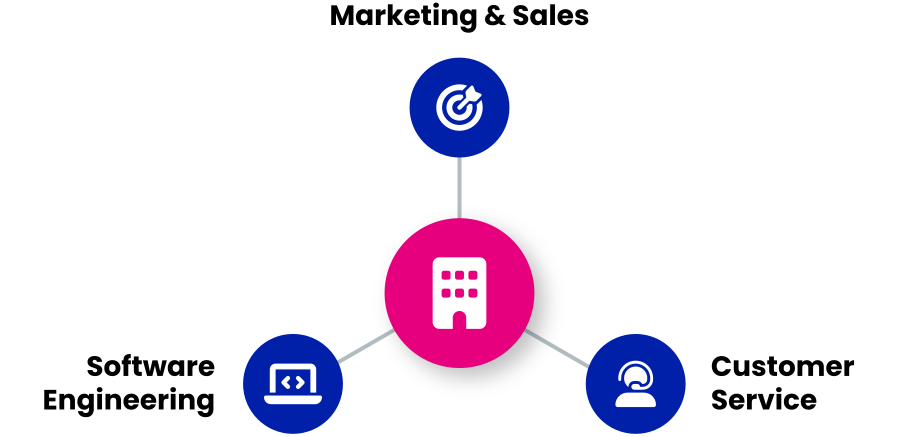
Marketing and sales: personalization on a new level
Marketing is another area where AI really shines – 33% of companies that use AI deploy it specifically for this purpose. And that makes sense: marketing revolves around data—customer preferences, purchasing behavior, and the question of when which offer will be most well received.
AI takes on the hard work here: it evaluates huge amounts of data, recognizes patterns, and makes predictions that can steer campaigns with pinpoint accuracy. The MaibornWolff study “Technology Efficiency: The Way Out of the Complexity Trap” (2026) demonstrates that this works in practice: “42% of respondents already see increased efficiency in their processes as the primary benefit.” This makes personalized content a reality and marketing measures more efficient and targeted.
Some examples of the use of AI in marketing and sales:
- Newsletters and blog posts: AI automatically creates relevant content based on customer data such as purchase histories, interests and interactions.
- Social media: AI analyzes user behavior and selects optimal publication times and content to achieve maximum reach. This makes every post a success.
- Churn forecasts: AI identifies customers who are at risk of dropping out at an early stage and suggests measures to win back their loyalty. This saves costs and strengthens customer loyalty.
- Sentiment analysis: AI evaluates customer feedback, social media comments or ratings in forums in real time. This allows companies to immediately recognize which topics are positively received or where there is a need for improvement and can react in a targeted manner.
Customer service: efficient, flexible and personal
In customer service, AI enables scalable efficiency gains through speech recognition (47%) and NLP (34%).
Some examples of the use of AI in customer service:
- Request classification: AI systems analyze incoming requests in seconds and automatically forward them to the relevant departments. This saves time and ensures that requests are processed more quickly.
- FAQ bots: AI answers routine questions such as "When will my order be delivered?" immediately. This allows service employees to concentrate on more complex tasks.
- Personalized customer conversations: Intelligent chatbots recognize customer needs and offer tailored product recommendations or special offers directly during the conversation. This not only creates satisfaction, but also strengthens customer loyalty.
- 24/7 availability: Chatbots are available around the clock. They provide relevant information, solve problems and can even help close sales - whether at the weekend or in the middle of the night.
AI offers enormous opportunities in customer service—but the flood of tools also brings risks. This is demonstrated by the MaibornWolff study “Technology Efficiency: The Way Out of the Complexity Trap” (2026): “47% of IT managers and specialists feel overwhelmed by the sheer volume and frequency of new AI applications.” Before AI is introduced into customer service, it should be clarified which processes can truly be automated—and which require human empathy.
Software engineering: more efficient processes, better results
AI shows its true potential in the field of software engineering: it optimizes processes, increases accuracy and relieves teams of routine tasks. From code creation to testing and documentation - AI offers support at all levels.
- Coding: AI-supported tools such as code generators or intelligent auto-completion help developers to program faster and make fewer mistakes. They suggest code snippets, detect syntax errors and optimize readability.
- Testing: Automated test systems based on AI identify errors in software solutions at an early stage and suggest targeted corrections. Regression tests or load tests run more efficiently and reduce the time to market.
- Requirements engineering: AI supports the analysis and prioritization of requirements. It helps to clarify unclear requirements, identify potential conflicts at an early stage and improve coordination between stakeholders.
- Create documentation: Instead of spending hours writing instructions or reports manually, AI analyzes the code and automatically generates comprehensible documentation. This not only saves time, but also ensures consistent quality.
MaibornWolff Study “Technology Efficiency: The Way Out of the Complexity Trap” (2026): 59% of respondents fear that digital waste—specifically unused business functions, dead code, and redundant artifacts—will increase in the future due to AI. To prevent AI from becoming a driver of complexity in software engineering, binding quality rules should be defined before its implementation.
Curious for more? These guides offer further in-depth insights into how companies can use AI:
Artificial intelligence: areas of application in the public sector
AI has quietly and stealthily crept into many areas of public life. Whether health, education or cyber security - the smart machines optimize, analyze and make decisions, often without our knowledge. Time to take a closer look at where AI has its fingers in the pie.
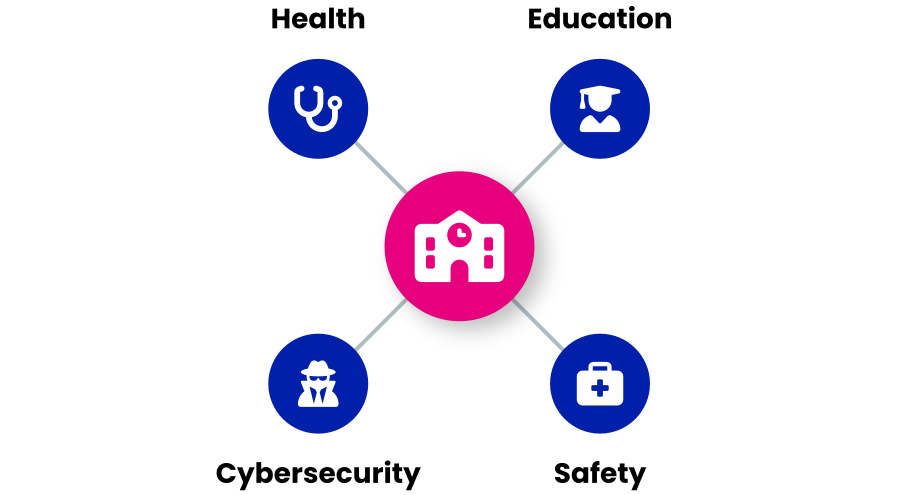
Healthcare: Precise diagnoses and more efficient processes
In healthcare, AI supports the analysis of patient data, for example in the early detection of diseases such as cancer. Machine learning can be used to recognize patterns in medical images more quickly. Chatbots and AI-supported systems also make administration in hospitals easier, from appointment scheduling to patient communication.
Education: Individual learning support
In education, AI enables personalized learning. Adaptive learning platforms adjust the level of difficulty to the learning pace of the individual and provide immediate feedback. Teachers are relieved by automated assessment systems that process large amounts of data and provide analyses to improve teaching.

Get personalized AI consulting for your business now.
Security and disaster management
AI supports public safety by analyzing surveillance cameras and detecting unusual activity. In disaster management, algorithms help to identify risk areas and efficiently design evacuation plans. Early warning systems use AI to predict natural disasters such as floods or earthquakes in good time.
Cyber security: smart protection against digital threats
AI strengthens cyber security by detecting threats in real time and automatically initiating countermeasures. Intelligent algorithms analyze network data, identify unusual behaviour and protect sensitive information through dynamic encryption. This keeps the digital infrastructure secure and effectively wards off attacks.
Artificial intelligence areas: Everyday use cases
So we all use artificial intelligence every day—often without even realizing it. But when used strategically, AI can do much more and make our everyday lives noticeably easier in many areas. That's why we'd like to introduce you to some exciting and practical applications of AI tools such as ChatGPT and others. From creative tasks to increasing productivity—let yourself be inspired!
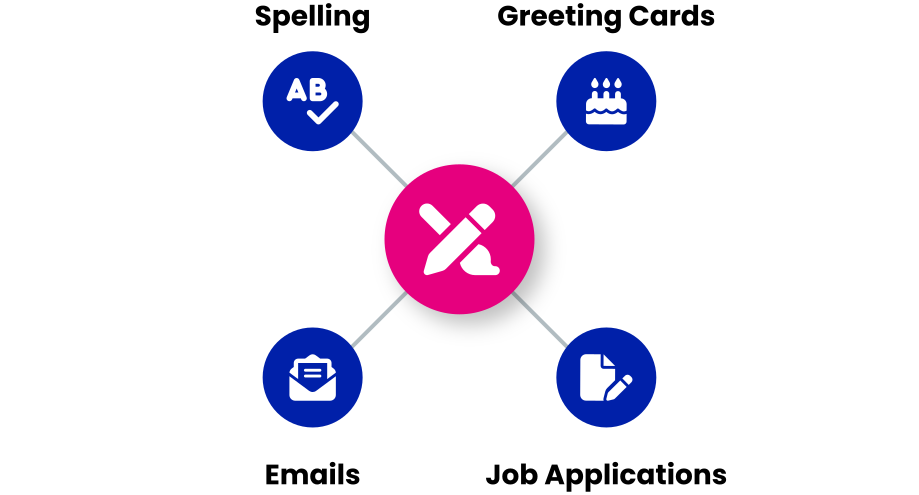
Efficiency in everyday office life & communication
Routine tasks take up valuable working time every day. AI tools act as intelligent assistants that not only speed up corporate communication but also improve its quality:
-
Intelligent quality assurance: AI goes far beyond traditional spell checking. Modern tools analyze semantics and style, suggest more precise wording, and ensure that every message matches the company's professional tone of voice.
-
Automated correspondence: Instead of laboriously typing emails word for word, AI models convert bullet-point notes into fully formulated responses. In addition, complex email threads can be summarized in seconds, which greatly speeds up information absorption within the team.
Have your spelling checked
Writing applications
An application should not only be formally correct, but also individual and convincing . AI-supported writing assistants help to optimize CVs, personalize cover letters and tailor them to specific job advertisements. With the right prompts, texts are created that look professional and authentic.
Editorial support & HR
AI provides decisive speed advantages in the war for talent and corporate communications. It does not act as a substitute for human creativity, but rather as an intelligent co-pilot for text work:
-
Optimized recruiting: Instead of manually writing job ads, AI tools generate target group-specific drafts in seconds, which can be checked for gender bias and optimized for search engines (Google for Jobs) if desired.
-
Efficient active sourcing: AI helps recruiters formulate highly personalized messages for candidates on LinkedIn or Xing, which significantly increases response rates compared to standard templates.
-
Corporate content: Whether internal newsletters, press releases, or blog posts, generative AI delivers outlines and draft texts that editorial teams only need to refine (human-in-the-loop).

This series explores technology, organization, and governance—so you can safely and scalably integrate AI into your business. Available in German language.
Using artificial intelligence - into the future with MaibornWolff
When AI is applied to inefficient processes, it doesn’t lead to greater efficiency—it simply speeds up the execution of the wrong approach. That’s why AI consulting at MaibornWolff doesn’t start with the technology—it starts with your processes. We guide your company on its journey into the digital future. With the help of customized AI consulting, a holistic approach, and an interdisciplinary team, we turn your ideas into reality. Discover all the possibilities AI has to offer and make the most of the opportunities presented by digitalization. Contact us—we look forward to exciting projects with you!

Use artificial intelligence sensibly now.
FAQs
How do we use AI in everyday life?
Artificial intelligence has long been our constant companion, often without us even noticing. Navigation apps such as Google Maps use real-time data to avoid traffic jams, while streaming services use algorithms to personalize music or movies based on your preferences. Voice assistants, smart home systems, and automatic spam filters are also based on machine learning to make our everyday lives more efficient and comfortable.
What are the advantages of AI in the company?
The biggest advantage lies in the massive increase in efficiency and scalability of business processes. By automating repetitive tasks, companies save valuable resources and costs. In addition, AI enables well-founded, data-driven decisions through advanced analytics, improves the customer experience through hyper-personalization, and identifies market trends at an early stage, securing a decisive strategic advantage over the competition.
Will AI replace jobs in the long term?
No. AI will not replace jobs across the board, but will fundamentally transform job profiles in nearly every industry. While repetitive routine tasks are increasingly being automated, entirely new job roles are emerging that require creativity, strategic thinking, and emotional intelligence. The focus is shifting from simply performing tasks to monitoring and managing AI systems, which is why upskilling is crucial. The MaibornWolff study “Technology Efficiency: The Way Out of the Complexity Trap” (2026) sums it up: “Those who view AI merely as a panacea will be disappointed. Those who, on the other hand, understand it as a specialized tool will achieve significant advantages.”
Why is it so difficult to demonstrate the benefits of AI internally?
A key bottleneck is the lack of measurement logic: “Only 48% have defined KPIs to systematically measure the actual value of their software solutions.” Without a KPI baseline, AI quickly becomes a matter of opinion rather than a manageable investment. Read the study for free now.
Kyrill Schmid is Lead AI Engineer in the Data and AI division at MaibornWolff. The machine learning expert, who holds a doctorate, specialises in identifying, developing and harnessing the potential of artificial intelligence at the enterprise level. He guides and supports organisations in developing innovative AI solutions such as agent applications and RAG systems.