
AI as a Service: Rent AI Instead of Building It
Estimated reading time: 8 minutes

AI as a Service (AIaaS) delivers AI capabilities from the cloud – models, inference and platform components as a usage-based service. This gives you access to a powerful model in days rather than quarters.
The effort does not disappear, it shifts: to data integration, system integration and governance. In this guide, you will learn what AIaaS really delivers, where its limits lie and when you are better off running models in-house.
- What is AI as a Service? AIaaS is a cloud delivery model for AI – models, inference and platform functions are provided as a usage-based service via APIs.
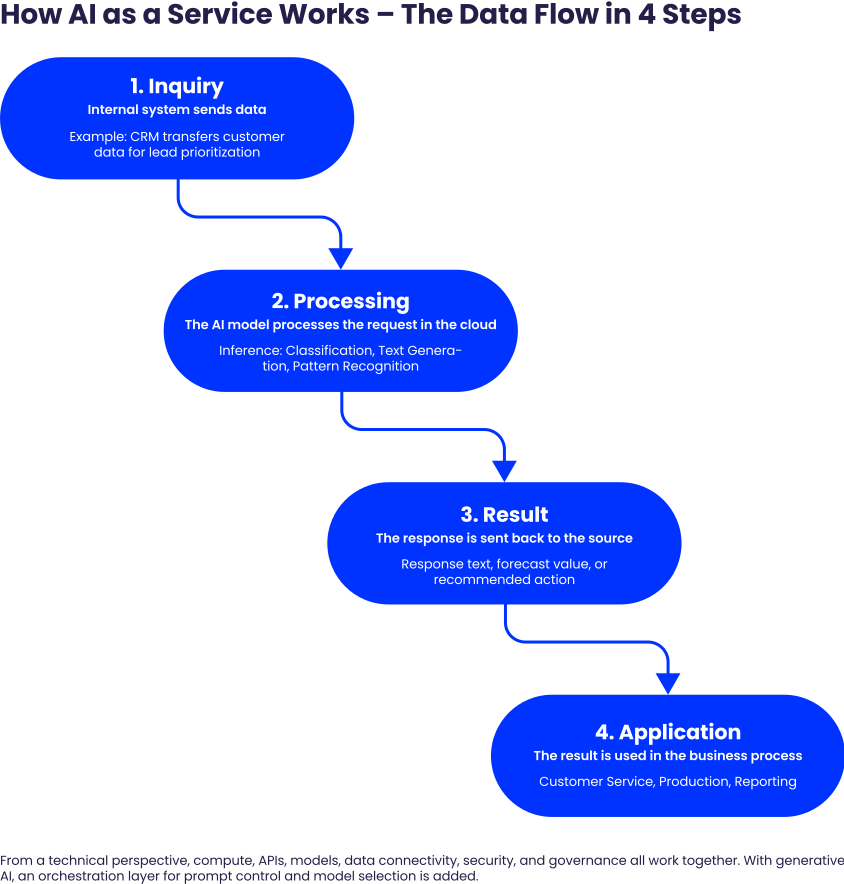
- How does AIaaS work in practice? Internal systems call an AI model via an API, processing takes place in the cloud and the result flows back into the business process.
- When is AIaaS worthwhile for companies? When the use case is clear, the data raises no sovereignty issues and the benefit clearly exceeds the variable costs – for example in knowledge work, forecasting and service automation.
- When is running AI in-house worthwhile? With permanently high load, regulatory-sensitive data, IP-critical processes or deep model customisation – meaning operating pre-trained models yourself, not training them from scratch.
- Can AIaaS be used in compliance with the GDPR? Yes, provided EU tenants, a data processing agreement and exclusion from training are contractually agreed and high-risk applications undergo a data protection impact assessment.
- What does AI as a Service cost? Usage-based per API call, token or compute time – hidden follow-up costs arise mainly from data integration, governance and growing volumes.
What is AI as a Service?
AI (Artificial Intelligence) as a Service is the cloud-based provision of AI functionality via APIs and platforms, billed according to usage. Instead of building and operating your own model environment, you obtain artificial intelligence (AI) as an ongoing service.
From our experience with large enterprises, this market definition falls short. Whether AIaaS works in a company depends on three dimensions:
- Infrastructure: secure tenants, runtime environments, controlled model integration.
- Service: APIs, models and ready-made AI functions such as language, vision or forecasting.
- Governance: roles, access, auditability, compliance.
You can buy the first two dimensions. Not the third: no provider delivers governance. It is created in-house – and determines whether model access becomes a robust solution.
How does AI as a Service work in practice?
For the user, AIaaS looks like an API call. The architecturally relevant question comes before that: at which delivery level you start – and how much operation remains in-house as a result.
How AI as a Service works – data flow in 4 steps
AIaaS is offered at three delivery levels that build on each other technically – analogous to infrastructure, platform and software in the classic cloud.
| Delivery level | What is provided | Examples | When it makes sense |
|---|---|---|---|
| Infrastructure service | GPU compute, inference hosting, vector storage – the foundation. | AWS, Azure, Google Cloud | Running your own models, regulatory depth, own control over volumes |
| Platform service | Managed framework for training, deployment, versioning, monitoring. | SageMaker, Azure ML, Vertex AI | Several models in parallel, building MLOps, integrating governance early |
| Software service | Ready-made AI functions via APIs – text, OCR, forecasting, image analysis. | OpenAI, Anthropic, Mistral, Google | Quick start, clear use cases, low operating effort |
These delivery levels describe what you buy – not what makes AIaaS enterprise-ready. Governance cuts across all three and is not included in the price of any of them. In practice, companies combine the levels anyway: standard models for knowledge work, sensitive workloads on controlled infrastructure. Which path is right is clarified by the specific AI implementation.
What types of AI services are there?
It is not the model name that matters, but proximity to the business process: five categories shape the market.
- Predictive AI: forecasting, risk assessment, anomaly detection. Typical fields: battery analytics in e-mobility, predictive maintenance in smart manufacturing, fraud detection in the financial sector.
- Generative AI: text generation, summaries, code, knowledge dialogues. Foundation models from OpenAI, Anthropic, Mistral and Google provide the basis – productive use is currently most evident with ChatGPT in business.
- Conversational AI: chatbots, virtual assistants, voice interfaces. Generative models plus dialogue logic plus company knowledge.
- Vision AI: image recognition, OCR, quality inspection. Visual inspection and automatic defect detection are among the classic applications of AI in industry and in logistics.
- Decision AI: optimisation, routing, prioritisation. Closely linked to operational systems – resource planning, dynamic pricing, supply chain management.
In practice, the service types interlock. A service assistant often combines generative AI for answers, conversational AI for dialogue management and predictive AI for prioritisation. As soon as such systems act independently and solve tasks over several steps, we speak of AI agents.
Across industries, knowledge-intensive areas benefit most: marketing, sales, finance and engineering work with large volumes of information every day, in which AI use cases such as research, knowledge condensation or document processing quickly pay for themselves.
When AI as a Service pays off – and where its limits lie
AIaaS pays off where speed counts – and becomes expensive where control matters more than pace. How differently the benefits turn out is shown by our technology efficiency study: 42% cite increased efficiency in their processes as the primary benefit, 19% currently see no noticeable business value.
Benefits and limits compared
| Benefits | Limits |
|---|---|
| Speed: productive AI in weeks rather than months – model hosting and scaling are handled by the provider. | Vendor lock-in: proprietary interfaces, provider-specific security models and limited portability tie you to the platform. |
| Low initial investment: usage-based instead of reserved GPU capacity, platform setup and your own operations team. | Data protection and regulation: as soon as data leaves the service, the GDPR, ISO 27001 and TISAX apply in full. |
| Model maturity: foundation models bring language understanding and multimodality from day 1. | Rising costs when scaling: API costs scale with tokens, calls and compute time. |
| Low operating effort: updates and load balancing are handled by the provider – internal teams focus on business integration. | Integration remains complex: AIaaS replaces infrastructure work, not enterprise integration. |
The most frequently underestimated factor is rising costs: what seems viable in the proof of concept becomes a budget problem as load increases. Gartner counts these operating costs among the main reasons why GenAI projects fail between PoC and production.
Lock-in deserves a closer look: a model gateway – the mediation layer between application and model – makes the model itself largely interchangeable. What remains sits one level deeper. Data storage, vector storage, identity and operating model tie you to the provider, not the model name.
When it pays to switch from renting to building
AIaaS pays off when three conditions come together:
- a clearly defined use case,
- data without strict sovereignty requirements,
- a benefit that clearly exceeds the variable costs.
Building does not mean training a model from scratch. It means operating pre-trained or open models yourself on controlled infrastructure, with your own integration, your own monitoring and your own governance.
This path makes sense with permanently high load, regulatory-sensitive data, IP-critical processes or deep model customisation. This is where the economics tip: what starts as low-cost API usage adds up at millions of inferences per month.
The time advantage of renting is smaller than often portrayed: an open model is up and running quickly; what takes time is data integration, operation and governance – in both variants. What matters is therefore less the industry than the nature of the process, across all AI application areas: structured data, repeatable workflow, integrable, governance manageable.
What is currently shifting in the market
Four developments are currently shaping the market – and should feed into every sourcing decision.
- Foundation models are becoming interchangeable. What was still a competitive advantage of individual providers in 2024 is largely a commodity in 2026: model access is becoming easier, differences between base models are shrinking. Architecture is gaining importance over model choice.
- Hybrid setups are becoming standard. Standard models external, sensitive data internal, specialised services operated under control. We hardly see pure "all-in cloud" strategies in large enterprises any more – use speed, keep control of data is the line.
- Agentic systems are shifting the concept of service. Individual API calls are turning into multi-step processes in which AI agents work through research chains, pre-structure decisions and return results. AIaaS supplies the building blocks – orchestration remains the task of enterprise architecture.
- Governance is becoming a differentiator. How high the regulatory effort turns out to be depends not on how deeply AI penetrates processes, but on what these processes decide – the EU AI Act works with risk classes, not degrees of usage. Those who set up roles, auditability and cost transparency early will scale. Those who retrofit them build shadow AI.
Trusted Zone: AIaaS that holds up in large enterprises
The Trusted Zone is the controlled layer that we at MaibornWolff place between corporate IT and external AI services. It handles model integration, data flow control, access and output control as well as logging – exactly the governance dimension that no provider delivers.
It comes into play as soon as sensitive data is processed, several business units use AI or regulatory requirements apply. That the Trusted Zone is no luxury is shown by our study: 47% of IT managers feel overwhelmed by the flood of new AI applications, 59% expect more digital waste as a result.
Frequently asked questions about AI as a Service
How does AIaaS differ from classic SaaS?
SaaS delivers a finished application with fixed functionality. AIaaS delivers AI functions that you integrate into your own applications – via APIs, with usage-based billing per token, call or compute time. Put simply: SaaS uses AI in the background, AIaaS provides it to you as a building block. With AIaaS, the integration work remains with you.
Can AIaaS be used in compliance with the GDPR?
Yes, if the architecture is right: EU tenants, a data processing agreement under Art. 28 GDPR, documented technical and organisational measures and exclusion of customer data from training. For high-risk AI, a data protection impact assessment under Art. 35 GDPR is mandatory. The transparency obligations of the EU AI Act for general-purpose AI models have applied since August 2025, and the requirements for high-risk systems since August 2026.
What does AI as a Service cost?
AIaaS is usually billed on a usage basis – per API call, token, compute time or storage volume. Hidden follow-up costs arise mainly from data integration, building governance and growing volumes. At millions of inferences per month, it is worth examining a switch to a hybrid or in-house architecture.
Kyrill Schmid is Lead AI Engineer in the Data and AI division at MaibornWolff. The machine learning expert, who holds a doctorate, specialises in identifying, developing and harnessing the potential of artificial intelligence at the enterprise level. He guides and supports organisations in developing innovative AI solutions such as agent applications and RAG systems.