
MLOps: Machine Learning in Continuous Operation
Estimated reading time: 8 minutes

Many large enterprises have ML pilot projects running – but few of them make it into production. According to a 2025 Capgemini study, however, two thirds of executives are already deliberately pausing low-value AI initiatives in order to accelerate productive use cases. The study shows that the economy is ready for the transition from experiment to operational architecture. This is exactly where MLOps comes in: as a framework for data, models, monitoring and governance.
- What is MLOps? MLOps (Machine Learning & Operations) is the technical and organizational framework that takes machine learning models from development into stable, scalable production.
- Does MLOps end with deployment? No, the lifecycle includes data pipelines, model versioning, monitoring, retraining and governance.
- What are the four principles? Automation, reproducibility, monitoring and governance interlock. No principle works on its own.
- Which types of drift should you know? Data drift shifts input data, concept drift changes business relationships, performance drift measurably lowers prediction quality.
- Is an MLOps platform a tool? No, it is an architectural concept made up of several integrated components – whether open source, cloud-native or hybrid.
Understanding MLOps – productive ML operations instead of a toolset
MLOps stands for Machine Learning & Operations – also written as machine learning operations or machine learning ops. Model development and operations move closer together; it is not simply about operating machine learning. The framework standardizes the steps that take machine learning models from the notebook into stable production: data pipelines, model versioning, deployment, monitoring, retraining and governance.
Three levels support the model
We do not see MLOps as an isolated toolset, but as an architectural topic:
- Technical operability: automated training and deployment processes, API integration, monitoring of model quality and data changes, controlled retraining cycles.
- Real-world operation under enterprise conditions: changing data quality, new business requirements, scaling across several use cases, security and compliance requirements.
- Governance as an integral part: documented model history, clear responsibility, traceable approvals.
When does MLOps become relevant for you?
Not every ML project needs a complete MLOps architecture from day one. But at one of these points at the latest, it becomes indispensable:
- A model is to run in production permanently, not just as a pilot.
- Several teams are working on ML applications in parallel.
- Business units expect reliable, repeatable results.
- Regulatory requirements apply – such as the GDPR, the EU AI Act or industry-specific regulations.
- Models must be traceable and auditable.
- You use a pre-built model instead of your own – provider version changes, monitoring and approvals still have to be handled.
If at least one of these points applies, MLOps replaces manual individual processes with a manageable operating framework.
MLOps vs. DevOps, DataOps and analytics automation
Four disciplines are regularly confused in practice: DevOps, DataOps, analytics automation and MLOps. This creates false expectations regarding responsibilities, tooling and project scope – and becomes expensive as soon as models are in production.
The "Ops" in DevOps, DataOps and MLOps always means the same thing: Development & Operations, Data & Operations, Machine Learning & Operations. Development and operations move closer together because their dependencies are too great to organize the two sides separately.
| Dimension | DevOps | DataOps | Analytics automation | MLOps |
|---|---|---|---|---|
| Artifact | Software code | Data pipelines | Reports, dashboards, forecasts | ML models |
| Driver of change | Code updates | Schema/source changes | Rule updates | Data and model drift |
| End of lifecycle | stable deployment | stable data provisioning | recurring run | continuous loop |
| Monitoring focus | App performance | Data quality | Report availability | Model quality, drift |
| Owner | Dev + Ops | Data engineering + Ops | BI / reporting | Data science + platform engineering + business unit |
The decisive difference: with DevOps, the logic remains stable after deployment – with MLOps, model quality already changes as soon as the data shifts (continuous training). This is also exactly where DataOps ends: at data provisioning. MLOps begins where this data flows into training, inference and model operation. A functioning data warehouse is therefore not yet a foundation for productive ML systems.
The impact of MLOps in enterprise practice
From the PoC graveyard to the factory floor – that is the movement MLOps makes possible. Three effects make the difference:
- Faster to production: manual handovers and unclear operating processes are the typical bottlenecks. MLOps systematizes training, validation, deployment and approval; friction drops measurably.
- More stable in operation: models lose quality when data shifts. Monitoring detects drift early, retraining maintains prediction quality over time.
- Scalable and auditable: central pipelines, model registries and governance processes turn individual PoCs into an ML landscape – with a documented history that supports audits and compliance.
MLOps creates the operational foundation on which AI in companies can have a productive impact at all – not as a pilot project, but as part of value creation. A study by Fraunhofer IAIS and KI.NRW confirms: MLOps investments pay off quickly through efficiency gains, quality optimization and new products. The prerequisite is that architecture and operating model fit together. Stacking tools alone has no effect.
The MLOps lifecycle
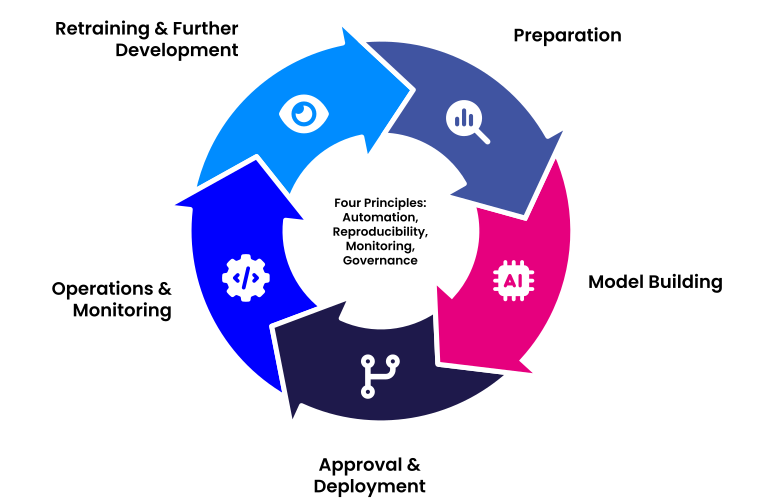
The MLOps lifecycle runs as a closed loop, not a linear project with an end date.
MLOps lifecycle: a closed loop
The 5 phases at a glance
- Preparation: clarify the problem, tap into data sources, validate data, build feature pipelines – reproducible and identical for training and inference.
- Model building: training with experiment tracking and systematic versioning; validation beyond pure accuracy – bias risks, edge cases and business plausibility are part of it. This is where MLOps is closely intertwined with classic data science, which provides model selection and validation logic.
- Approval and deployment: governance review with clear responsibility, versionable rollout with rollback capability, tests under realistic load conditions.
- Operation and monitoring: monitor model quality, error rates and response times – not just technical availability. Above all, detecting drift matters here: data drift (input data shifts), concept drift (business relationships change) and performance drift (prediction quality measurably declines). Regular drift checks are standard practice, because model quality can deteriorate at short notice.
- Retraining and further development: controlled retraining with business approval in regulated contexts. New use cases reuse existing platform components instead of starting from scratch every time.
4 principles hold the loop together
Whatever the phase: four principles interlock – no principle works on its own. Together, they are what the "Ops" in MLOps means.
- Automation controls recurring processes.
- Reproducibility ensures traceability of data, models and parameters.
- Monitoring checks model quality in operation.
- Governance regulates responsibility, approvals and auditability.

MLOps platform: open source, cloud-native or hybrid?
An MLOps platform is not a single tool. It is an architectural concept made up of several integrated components: training and pipeline orchestration, model registry, deployment control, monitoring, governance. AWS, Microsoft Azure and Google Cloud dominate the European market as the three hyperscalers, alongside open-source stacks and specialized EU providers. Which architecture makes sense in concrete terms is closely linked to the existing cloud strategy.
Three platform models compared
| Dimension | Open source | Cloud-native | Hybrid |
|---|---|---|---|
| Examples | Kubeflow, MLflow, Airflow | SageMaker, Vertex AI, Azure ML | MLflow + SageMaker or Vertex AI + on-prem Kubeflow |
| Setup time | Weeks to months | Days to weeks | Weeks, with architecture effort |
| Lock-in risk | low | high | medium |
| Compliance profile | flexible, own setup required | EU region selectable, ISO-certified | critical workloads on-prem, standard in the cloud |
| Typical constellation | regulated industries, own cloud, existing platform engineering | cloud-first strategy, fast scaling, standard use cases | mixed reality of large enterprises |
Which option suits which enterprise?
- Cloud-native for cloud-first enterprises: short time-to-pilot, scaling comes built in, ideal for standard use cases.
- Open source for your own cloud or data-sensitive workloads on-prem – but with your own platform engineering effort.
- Hybrid for the mixed reality of large enterprises: for example MLflow as registry, a cloud service for serving, your own data platform plus a compliance layer.
What matters is a clear architectural decision at the start – tool sprawl arises exactly where it is missing.
Where MLOps fails – and how to recognize maturity
Maturity is measurable, but not binary. Large enterprises often fail at the same six points. With the EU AI Act, in force since August 2024, the requirements become even stricter – Article 9 requires continuous risk monitoring across the entire AI lifecycle.
6 stumbling blocks that cause initiatives to fail
- Pilot purgatory: no transition from PoC to production – usually not because of model quality, but because of missing architecture.
- Data validation at the model, not at the input: data problems disguise themselves as model problems.
- Governance as an afterthought: if it is only introduced once there are several production models, historical traceability is missing.
- Monitoring only at the technical level: model quality drift goes unnoticed, a gradual loss of value follows.
- Tool sprawl instead of a platform: every model develops its own special path, scaling fails.
- Handovers between roles: data scientists, data engineers, platform teams and business units work with different tools and priorities – most production problems arise precisely at these interfaces.
Our Technology Efficiency Study 2026 confirms the pattern beyond ML as well: 61% increased their use of AI tools in 2025 – 52% at the same time report increasingly inefficient software solutions in their own company. AI applied to unclear processes scales the wrong things instead of the right ones.
4 maturity levels: where does your company stand?
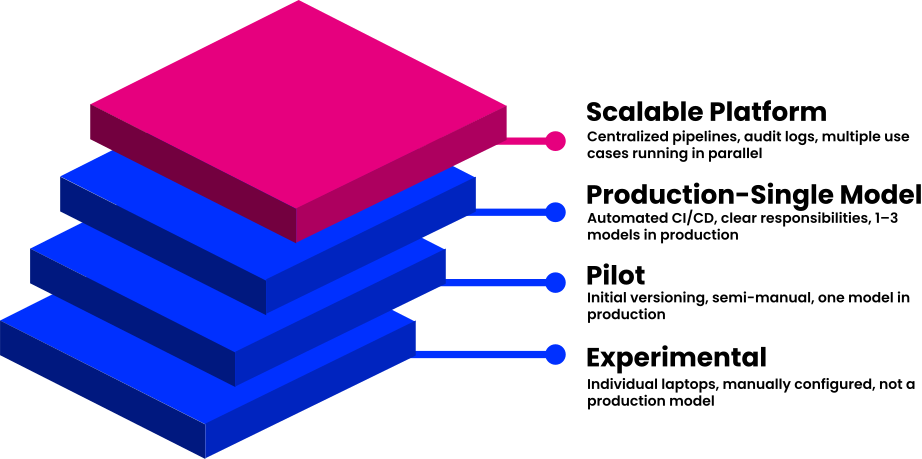
Self-check: four questions about your maturity level
- Which model version is currently running in production?
- What data is it based on?
- When was it last retrained and approved?
- Who is responsible for its outputs from a business perspective?
If you cannot clearly answer three of these questions, you are at maturity level 2 or below.
MLOps with MaibornWolff
Maturity assessment, target picture, roadmap, implementation, scaling – our approach combines IT consulting with concrete implementation. We think about data, models and governance together from the start instead of integrating tools after the fact. 35 years of enterprise experience, ISO 9001, ISO 27001 and TISAX certifications as well as strategic partnerships with AWS, Microsoft and StackIT form the framework.
Less Technology. Better Business.
Frequently asked questions about MLOps
How does MLOps fit with the GDPR, ISO 27001 and TISAX?
Article 32 GDPR requires documented data provenance and encryption. ISO 27001 requires RBAC, encryption and audit logs covering at least twelve months. TISAX adds automotive-specific access and supply chain requirements. MLOps platforms meet these requirements if EU data residency and audit pipelines are part of the architecture from the start – an area in which MLOps and cybersecurity must always be considered together.
How do you detect data, concept and performance drift in operation?
Data drift is detected via statistical comparisons of input distributions – for example using the Kolmogorov-Smirnov test or the population stability index. Concept drift often only becomes apparent when prediction quality drops; targeted plausibility checks help to spot it earlier. Performance drift becomes visible through continuous tracking of accuracy, business metrics and error rates against defined thresholds. Regular drift checks – weekly or monthly depending on the use case – are standard practice.
How do you measure the success of an MLOps approach?
Three indicators underpin the assessment: time-to-production (reduction from the model idea to productive use), stability (documented model history, auditability, fewer unplanned outages) and business impact (measurable effect on business KPIs, not just model accuracy).
As a consultant and software designer, Vadim actively shapes the solutions developed by the Pro-Code AI Solutions delivery unit. With a background in digital design and process usability, he focuses on measurably improving business and production processes. In customer projects, he ensures that new solutions can be easily and intuitively integrated into the existing corporate ecosystem without any friction losses.