
Artificial Intelligence in Marketing 2026: The Operator Guide to Strategy, Compliance and ROI in the DACH Market
Estimated reading time: 68 minutes

If you search for "artificial intelligence in marketing" today, you get the same article twenty times over: a definition, a list of nine use cases, thirty tools compared, two sentences about personalization, and a conclusion promising that AI will change everything. That's not wrong. It's just strategically worthless. In our consulting practice, we see marketing teams that have licensed twelve AI tools, are running three pilot projects in parallel, and at the end of the quarter cannot quantify which euro of revenue or which hour of work was actually generated or saved as a result. The problem is rarely the tool. The problem is the lack of an operator perspective: Who decides, who builds, who reviews, who measures, and who is liable when the EU AI Act takes effect from August 2026?
This guide is therefore structured differently. It gives you the logic behind the tools, not the next tool list. Three things you will find here:
- A complete compliance perspective on the EU AI Act and GDPR in the marketing context, with a concrete checklist per use case — by far the biggest blind spot in the German SERP.
- An operating model with RACI, five new roles in the marketing team, and €-ROI ranges per use case, instead of the twentieth enumeration of "personalization, chatbot, content generation."
- A 5-level maturity model and a 90-day implementation plan that treats SMEs and enterprises differently, because data maturity, budget, and risk appetite are fundamentally different.
If you need a quick definition for the board, jump to Section 1. If you need to make operational decisions as a marketing lead, start at Section 2 (status quo) and work through linearly. Compliance, operating model, ROI, and maturity build on each other.
AI in marketing in 2026 is not decided by the tool, but by the operating model. Those who rigorously manage their use-case portfolio, compliance architecture, measurement methodology, and maturity logic unlock 30–50% efficiency gains and 10–25% conversion lift; those who think in tool lists collect license corpses.
-
Twelve high-impact use cases along the funnel (Awareness, Acquisition, Retention, Operations) — per use case with AI category, ROI range, and payback horizon.
-
Tool architecture instead of tool list: Embedded-first (HubSpot Breeze, Salesforce Einstein, Adobe Sensei) covers 60–80% of all use cases; specialty tools selectively, build only with a clear data strategy.
-
Compliance is a design criterion, not a roadblock: EU AI Act from 02.08.2026 (transparency, GPAI), GDPR pitfalls in profiling, data processing agreements, and automated decisions.
-
Operating model with five roles, RACI for 9 use-case phases, 5-level maturity self-check, and 90-day implementation plan. The jump from level 1 or 2 to level 3 can be achieved in one quarter.
1. What artificial intelligence in marketing really means in 2026
Before we talk about use cases, tools, and compliance, we need a clean terminological foundation. Artificial intelligence in marketing is misused in practice as a catch-all term — for everything between a rule-based email trigger and an autonomously operating campaign agent. This imprecision is the main reason why boards approve budgets without understanding what they're buying. And why marketing teams celebrate successes that have nothing to do with actual AI. The following three sections create clarity: first a citable definition for the board and pitch deck, then the four AI categories that are operationally relevant in marketing, and finally a demarcation from everything that calls itself AI but isn't. Those who exercise discipline here avoid 80 percent of later misinvestments.
1.1 Definition: AI marketing in one sentence that is citable
A good definition must fulfill two tasks simultaneously: It must hold up in one sentence before the board and at the same time be precise enough that the marketing team can derive tasks, roles, and success metrics from it. The following formulation meets both requirements. And simultaneously makes clear what AI marketing is not.
The operative core definition. Marketing with AI is the systematic use of learning or generative models to derive scalable marketing decisions from customer and market data. That is, content, audiences, channels, timings, prices, or messages that are deployed in real time or near-real time without individual human decisions. This definition is deliberately narrow. It excludes classic reportings, dashboards, and rule-based workflows because no model "learns" anything there. Anyone who applies it as a filter to their own initiatives immediately sees which projects truly have AI character. And which are merely classics labeled as AI.
The three building blocks: data, models, decisions. Every robust AI use case consists of exactly these three layers. Data is the substrate (CRM, web analytics, product data, third-party signals, unstructured content). Models are what learns or generates (predictive ML models, foundation models, embedding models). Decisions are what reaches the market (a personalization, an audience expansion, a generated ad copy). If one of these layers is missing — for example, data without a model or a model without decision logic — the project is either analytics or a gimmick, but not a marketing use case.
The difference from marketing automation. Marketing automation works with "if-then" rules that a human defines once. AI in marketing works with models that derive patterns from data and continuously improve their predictions or outputs. A trigger workflow that sends an email after 24 hours of inactivity is automation. A model that learns the optimal send time per recipient from historical behavior is AI. Both have their place. But only one of them creates compliance obligations under the EU AI Act, and only one cannot be replaced by simple Excel logic.
What counts as a "marketing decision." In the AI sense, a marketing decision encompasses six classes: content (which text, which image, which video), audience (who is addressed), channel (where it is deployed), timing (when), price or offer (what), and message (with which tonality or argument). Each of these six classes can today be supported or fully automated by a model. This classification helps in structuring your own use-case portfolio. And in recognizing which classes in your own team are still entirely human-controlled.
Why this definition has operative consequences. As soon as a use case falls under the definition, three obligations arise simultaneously. First, it needs a data owner, because without clean data no model scales. Second, it potentially falls under the EU AI Act and the GDPR, because automated decisions about natural persons are captured. Third, it needs a measurement design, because a learning system only improves when its impact can be separated from the baseline. Anyone who does not set up these three obligations is not doing AI marketing — they are doing AI theater.
With this definition as a filter, the rest of this guide becomes more precisely readable: We consider exclusively use cases that fulfill all three building blocks, and we classify each of them into the operating model, compliance obligations, and ROI logic that follow in Sections 5 through 8.
1.2 The four AI categories that actually create impact in marketing
Within the definition from 1.1, four categories can be distinguished that are operationally relevant in marketing. They have different data requirements, different maturity levels, different risks. And they are constantly conflated in everyday language. Anyone who wants to build a use-case portfolio should know for each initiative which of the four categories it falls into, because tooling, skill requirements, and compliance obligations follow from that.
Predictive models: What will probably happen? This includes all classic machine learning models that predict probabilities or values from historical data:
- Churn models,
- Conversion propensity,
- Customer lifetime value,
- Lookalike audiences,
- Lead scoring,
- Next-best-offer.
They are the most mature category, longest in productive use, and present in every serious CRM or analytics stack. Characteristic: They deliver a number or a label, not a finished action. The step from prediction to decision must be handled by the surrounding system.
Predictive models are the foundation for all data-driven personalization and targeting use cases. And simultaneously the category in which GDPR profiling rules and Article 22 on automated decision-making most frequently apply.
Generative models: What should we create? Foundation models and large language models belong in this category: ChatGPT, Claude, Gemini, Llama, as well as image and video generators like Midjourney, DALL-E, Remotion, or Veo. They produce content: texts, images, videos, audio, code, structured data. In marketing, they handle briefings, first drafts, variants, translations, personalization building blocks, and research. Their maturity level in productive use is high; their governance maturity in German marketing teams is usually low: training data provenance, copyright, bias, hallucinations, and brand conformity remain unresolved. They are also the area where the EU AI Act with its GPAI obligations from 02.08.2026 creates the largest wave of new requirements.
Decisioning and optimization systems: What is the best action? This category is most frequently overlooked in marketing but is operationally the most important once scaling is on the agenda. Multi-armed bandits, contextual bandits, and reinforcement learning decide in real time which content, which offer, or which price is deployed for a specific user at a specific moment. They connect predictive models with action logic and learn from real-world feedback. Platforms like Google Ads (Smart Bidding), Meta Advantage+, Adobe Target, or Optimizely-X use this class intensively. Anyone who regards A/B testing as their primary tool has not yet made the leap into this category. And is losing scaling advantages to competitors who have.
Agentic AI: What can the system carry out independently? Agentic systems combine a generative model with tools, memory, and a plan to handle multi-step tasks largely autonomously. For example, research, briefing, drafting, sending, and reporting of a campaign in one connected workflow. In 2026, this category has moved from the demo stage into a first productive wave, especially in narrowly defined domains such as outbound sequencing, SEO briefings, or report generation. It is the riskiest of the four categories: errors scale faster, outputs are harder to audit, and under the EU AI Act many agentic applications automatically fall into higher risk or transparency classes. Anyone starting here should absolutely build in human approval points (human in the loop). Maturity and risk increase from top to bottom. A sensible sequence for teams without AI history is therefore: first consolidate predictive, then make generative productive and governance-ready. In parallel, activate decisioning on the major platforms, and only then move into true agentic workflows. And not the other way around, just because the last category delivers the most impressive demos.
1.3 What AI marketing is not: Terminological hygiene against the buzzword
At least as important as a clean definition is a clean demarcation. Much of what is sold as AI-driven marketing in vendor decks, LinkedIn posts, and internal steering meetings falls under a different category. This is not a semantic problem. It leads to misinvestments, false expectations, and in the worst case to compliance gaps, because the true AI components are obscured.
Marketing automation is not AI. A lead nurturing workflow with fifteen if-then rules, a drip campaign system, or a trigger that sends a reactivation email after 14 days of inactivity are classic automation. They are valuable, often underestimated, and necessary in every funnel. But they learn nothing. Anyone who sells an existing HubSpot, N8N, Make, or Salesforce workflow setup as an "AI initiative" buys compliance obligations they don't actually have, while simultaneously building expectations the system cannot fulfill. Keep the two terms separate. Including in reports to the executive team.
A single tool is not a strategy. ChatGPT, Jasper, Midjourney, or a Copilot add-on are tools, not strategies. Anyone who equips a marketing team with an enterprise account and then speaks of "AI marketing" confuses procurement with transformation. The strategic part comprises the use cases, the data integration, the operating model, the compliance architecture, and the success measurement. Without these five layers, the tool remains a productivity add-on at the individual level. Useful, but neither scalable nor audit-proof nor competitively differentiating.
Dashboards with "AI insights" labels are rarely AI. A considerable share of reporting functions marketed as AI are statistical anomaly detection, threshold alerts, or rule-based anomaly notifications. That is good data work, but not a learning model. True AI-powered analytics exists when a model derives predictions from historical patterns whose accuracy is measurable and can be improved over time. Before paying any "AI-powered" surcharge, it's worth asking: Which model runs in the background, what data was it trained on, and how is its quality measured? Without a satisfactory answer: It's reporting, not AI.
A prompt is not a process. If a team's AI practice consists of each person collecting their own prompts in a Notion page and using them to generate texts, that is individual productivity, not a marketing process. An AI-powered process has versioned prompts or skills, defined inputs and outputs, quality control, metrics, an owner, and an escalation path for model drift or hallucinations. Only then is it reproducible, auditable, and scalable. The transition from prompt collection to prompt operations is one of the most underestimated maturity leaps in marketing over the next 24 months.
RPA and scripts are not AI. Robotic process automation, Zapier workflows, Make scenarios, or custom Python scripts that move data between systems are rule-based. They are often the right answer to an operational problem: cheaper, faster, more auditable than any AI solution. But declaring them as AI blocks exactly those use cases where real AI value creation would be possible, because the budget is already tied up under the wrong label. Maintain rule-based automation as its own, parallel discipline in the stack. It is an ally of AI, not its substitute.
These five demarcations should run as a filter in every investment decision. They prevent buzzword investments and protect against wrongly elevating classic tools into regulatory risk classes. With this terminological foundation, we can turn to the actual reality check: Why do so many AI marketing initiatives in DACH mid-market companies get stuck?
2. Status quo: Why 80 percent of AI marketing initiatives in mid-market companies get stuck
The media narrative about AI in marketing is a growth story. The operational reality in most DACH mid-market companies is different: high tool license budgets, many parallel pilot projects, little consolidated value creation. In consulting engagements, we regularly see marketing teams that have twelve AI tools in their stack but not a single scaled routine that works without individual human intervention. Before we dive into use cases, tools, and compliance, an honest assessment of the pitfalls is therefore worthwhile. Because 80 percent of failed initiatives fail not because of technology, but because of recurring patterns. The following three sections show the five most common failure modes in DACH marketing teams, why pure tool thinking slows down initiatives, and how SMEs and enterprises must differ structurally so that their respective AI roadmaps work.
2.1 The five most common failure modes in DACH marketing teams
In consulting engagements, we see the same five patterns recurring. Across industries, company sizes, and maturity levels. Each individual pattern is diagnosable and repairable. Most teams suffer from two or three of them simultaneously, because the patterns stabilize each other: Those who have no clear goal buy tools instead of defining use cases. And those who buy tools instead of use cases have no owner for value creation.
Tool-first instead of use-case-first. By far the most common mistake. The marketing team observes what the competition or a popular LinkedIn influencer uses, licenses the tool, and then searches for a use case to justify the purchase. The sequence is reversed: First the painful, measurable use case (e.g., "we need 35 percent more first drafts per week at the same quality"), then the choice between build, buy, or embedded. And only then the procurement. The consequence of the wrong sequencing: redundant tools, unused licenses, frustration in the team, and a stack that becomes more expensive each quarter without value creation growing at the same pace.
Shadow AI in the team. While officially "a strategy is being developed," employees have long been using ChatGPT, Claude, Perplexity, and tools from their personal lives for work. With their own logins, often on private accounts, frequently entering customer or strategy data. The problem is threefold: compliance risks arise (data protection, confidentiality, training data leakage), insights are not shared, and a two-tier productivity develops between heavy users and the rest. The right response is not a ban, but legalization: an approved tool stack, clear usage guidelines, a training offering, and a reporting obligation for new use cases.
Missing data foundation. Predictive and decisioning use cases almost never fail because of the model, but because of the data. CRM fields are not consolidated. Web and product data live in separate worlds. Identity resolution is half-solved. Consent status is not reliably documented per record in the GDPR sense. Anyone who starts an AI use case in this situation gets either a model trained on a skewed sample or a compliance problem. The sequence in mid-market companies should therefore be: clean up the data foundation (three to six months of effort), then layer AI on top. Not in parallel, because parallel initiatives block each other.
No owner for the use case. AI initiatives are frequently treated as a cross-functional topic: Marketing wishes, IT implements, data protection reviews, executive management expects results. Nobody owns the success or failure of a specific use case. In functioning setups, there is exactly one responsible person per use case with a defined mandate, budget, timeline, and success metric. This person does not have to be technical. But they must be able to decide whether the model goes into live operation, on what data foundation it is run, and when it gets shut down if it misses its targets. Without this owner, every pilot dies at the quarter change.
ROI blind flight. The fifth and most expensive pitfall: nothing is measured. Pilot projects are evaluated based on output ("we generated 200 texts"), not based on impact ("we saved 18,000 euros in personnel costs per quarter and lifted the conversion rate by 0.4 percentage points"). Anyone who defines no baseline, draws no control group, and sets no payback period cannot decide after twelve months whether to scale or shut down. The result is a permanent pilot limbo in which tool costs continue to run without the initiative ever transitioning to regular operations.
These five patterns are the main reason why a three-year investment cycle in AI fails to produce a lasting marketing capability. They are all leadership and organizational questions, not technology questions. And that is the good news: They can be repaired with the tools of operating model, RACI, measurement design, and compliance checklist that follow in Sections 5 through 7.
2.2 Why pure tool thinking slows down initiatives
When a marketing lead frames their first AI question as "Which tool is the best?", the initiative is already half lost. The question sounds operational but is strategically wrong. It shifts the engagement with data, processes, roles, and compliance to a point in time when the license budget is already committed. Four observations that appear in almost every one of our engagements explain why tool thinking systematically delays value creation.
Tools don't solve a problem that hasn't been defined. A tool is an answer to a precise question. Anyone who buys the tool before the question gets either an answer to a different question or none at all. In practice, this manifests as follows: A HubSpot extension is licensed because "we need AI in the funnel," but the actual bottleneck problem (lead qualification times too long, too few initial meetings, CAC too high) was never quantified. Six months later, the extension is active, nobody can quantify what it has delivered, and the discussion shifts to the next tool. The solution is a discipline, not a different tool: first the bottleneck with a number, then the use case, then the tool.
Three-quarters of the value contribution lies outside the tool. A productive AI application consists of five layers: data foundation, model, process integration, human in the workflow, and measurement. The tool typically covers the model layer and part of the process integration — roughly 25 to 30 percent of the total work. The remaining 70 to 75 percent is data work, prompt and workflow design, training, quality assurance, and reporting. Anyone who confuses the tool portion with the initiative effort plans too little time, too few people, and the wrong skill profile. Realistic rule of thumb: For every euro of license costs in the first twelve months, plan two to four euros for the remaining layers.
Tool comparisons are only valuable after the use-case definition. A list of the "20 best AI marketing tools" is not a decision aid as long as it is unclear which problem needs to be solved. Once the use case is defined, every tool list shrinks from 20 to 3 to 5 serious candidates. And this selection can be made in two weeks with demos and a structured requirements catalog. The right sequence is therefore: Bottleneck → Use case → Requirements list → Shortlist → Pilot → Decision. Anyone who starts with the tool list skips four steps and almost always ends up with the wrong tool, because the non-functional requirements (data residency, compliance, stack integration, skill prerequisites) are ignored.
Capability thinking instead of tool thinking. Mature marketing organizations formulate their AI roadmap not in tools but in capabilities: "We want to build the capability by Q3 to fully automatically generate first drafts for campaign texts and have them approved by a human editor." Such a capability has a clear outcome, an owner, success metrics, and is tool-agnostic. The tool can be swapped out without losing the capability. Tools are consumables in this view. Capabilities are fixed assets. Anyone who makes the switch from one to the other noticeably shortens their time-to-value and makes their AI investments independent of short-lived market phases.
The tool question remains important. But it is a later question, not the first one. Which tools are actually relevant in which categories is covered in detail in Section 4 — but then embedded in a build-vs-buy-vs-embedded logic and sorted by use case, not by popularity.
2.3 SME vs. enterprise: Where the real difference lies
A large share of the advisory literature treats AI in marketing as a uniform topic, even though the SME mid-market company with 20 marketing employees and the enterprise with 80 must solve structurally different problems. Three dimensions are particularly decision-guiding. Data maturity and stack complexity are deepened in 4.2 and 4.4; here we focus on the points that directly affect the operating model.
Budget and investment rhythm. SMEs typically operate with marketing tech budgets in the low six-figure range per year and need additive investments with payback in 6 to 12 months. Enterprises have significantly higher stack budgets but struggle with two to four years of tool legacy and are in consolidation mode. AI use cases here are often replacement, not additional investments. The pitch logic toward executive management and the board is therefore fundamentally different.
Risk appetite and compliance lead time. In an SME, a pilot can be started within four weeks because the managing director and the marketing lead often sit in the same meeting. In an enterprise, approval involving data protection, compliance, works council, IT, and procurement typically takes three to six months. Both are appropriate for the respective risk situation. What matters is to honestly calibrate both sides: SMEs must not be naively fast, enterprises must not be artificially slow. And innovations should not be missed due to regulations.
Organizational form and skill mix. In SMEs, generalists work. One person handles content, performance, CRM, and reporting in a combined role. AI introduction means expanding existing roles, plus an AI lead in a dual function with the marketing lead. In enterprises, specialized functions exist (CRM, performance, brand, insights, marketing operations), and AI introduction means a cross-functional role that connects all specialized functions. The five specific roles follow in 6.1.
A roadmap that works for an SME fails in an enterprise due to speed and compliance, and an enterprise roadmap suffocates in an SME due to overhead. With this classification, the next section addresses the twelve most impactful use cases. Structured by funnel stage, with concrete impact areas and ROI indicators.
3. The 12 most impactful use cases for AI in marketing
Use cases are the heart of every AI roadmap, and this is precisely where advisory content most often stays shallow: A list of nine examples without funnel logic, without impact area, and without any indication of which AI category from Section 1.2 actually applies. We structure the twelve most impactful use cases here consistently along the marketing funnel: Awareness and Demand Generation, Acquisition and Conversion, Retention and Expansion, plus a cross-functional block for Operations and Insight. This sorting has a practical reason: Use cases within the same funnel stage compete for the same data, the same owners, and often the same budget. Those who run a maximum of two to three initiatives simultaneously per stage keep value creation in view; those who start all twelve in parallel block themselves. For each use case, we name the underlying AI category and the primary impact area (efficiency, effectiveness, or new outputs). The robust ROI ranges follow collectively in Section 7.
3.1 Awareness & Demand Generation
In the upper funnel, AI primarily works on two levers: It scales the creation of content, and it improves the identification and reach of relevant audiences. Both levers have experienced the greatest maturity leap in marketing over the past 24 months thanks to generative AI. And at the same time the strongest compliance implications, because both generative models and profiling mechanisms converge here.
Use case 1 – Content generation at scale (Generative AI; Impact area: efficiency and new outputs). First drafts for blog articles, social posts, ad copy, email building blocks, landing page variants, and product descriptions are generated by an LLM in minutes and approved by a human editor. The realistic effect is 35 to 60 percent time savings per output unit, coupled with the ability to provide significantly more variants for A/B or multivariate testing. Prerequisites are a versioned prompt stack, a brand voice document as a system prompt component, and a quality gate logic. The anti-pattern: publishing content directly from the model without human review. The SEO and brand consequences are negative even when the text is grammatically clean.
Use case 2 – Audience modeling and persona mining (Predictive models; Impact area: effectiveness). Instead of defining personas once a year in a workshop, they are continuously derived from real CRM and behavioral data. Cluster models group existing customers by purchase behavior, engagement, and interest signals. The result is three to eight data-based segments with clearly distinguishable messaging patterns. The impact area is the effectiveness of upper-funnel investments: better briefings for agencies, sharper messages per segment, more precise channel selection. It is important to validate the results with sales and service insights. A cluster that looks clean in the model but is not recognized by sales leadership is usually not actionable.
Use case 3 – Lookalike models and predictive targeting (Predictive models; Impact area: effectiveness). Based on the best existing customers (defined by revenue, margin, or CLV), a model is trained that identifies similar profiles in advertising platforms or external data pools. The major platforms (Meta Advantage+, Google Ads, LinkedIn Matched Audiences) offer this function embedded. Custom models on first-party data often deliver more precise results but require a CDP (Customer Data Platform). Realistic impact in B2B: 15 to 30 percent lower cost-per-lead (CPL) at comparable lead quality; in B2C correspondingly lower customer acquisition cost (CAC). Compliance note: Lookalike methods are based on profiling and require a properly documented legal basis under GDPR Article 6 — Section 5.2 goes deeper into this.
The three use cases in the upper funnel stage are among the fastest AI wins for marketing teams. Content generation because the output is immediately measurable; audience modeling and lookalike because they immediately increase the efficiency of existing media budgets without the budget itself needing to increase.
3.2 Acquisition & Conversion
In the mid-funnel stage, it is no longer about reach but about conversion density: How does the system turn an anonymous visitor or a fresh lead into a paying customer, with as little human intervention as possible. This is where predictive and decisioning models are deployed simultaneously, and this is precisely where the greatest immediately measurable business value arises in practice.
Use case 4 – Predictive lead scoring and automated routing (Predictive models; Impact area: effectiveness). Instead of a manual point-based scheme, a model continuously calculates the conversion probability of each lead from firmographic, behavioral, and engagement data. High-probability leads go directly to sales, medium ones into an automated nurture track, low ones into a long-cycle track or a sales-disqualified bucket. Realistic impact in B2B: 20 to 40 percent shorter lead processing time in the SDR team and 10 to 25 percent higher SQL-to-opportunity conversion through focus. Prerequisites are reliable CRM data, an outcome jointly defined with sales (what counts as success?), and a mechanism to retrain the model quarterly. Market changes shift lead profiles faster than many teams react.
Use case 5 – Real-time personalization in web, email, and ads (Decisioning systems; Impact area: effectiveness). Which headline, which image, which product selection, which order recommendation the individual user sees at the moment of their visit is decided by a bandit or contextual decisioning model based on their profile and session data. Classic A/B testing becomes a stopgap solution in this logic. Contextual bandits deliver results faster without traffic being artificially distributed to losing variants. Realistic conversion lifts range from 5 to 25 percent depending on the baseline level. Critical is the data integration between the CDP, web frontend, and advertising platform. Without it, even the best model delivers only cosmetic results because it lacks the relevant context signals.
Use case 6 – Dynamic pricing and promotion optimization (Predictive plus Decisioning; Impact area: effectiveness). Especially in e-commerce and subscription models, a model decides on price level, discount amount, and promo triggering per segment, channel, and time period. Based on demand forecasts, competitor prices, inventory data, and margin targets. In B2B, the principle works in a scaled-down form as quote optimization. Realistic impact: 2 to 8 percent margin lift at stable sales volume, depending on industry and data quality. Compliance note: Personalized pricing touches both GDPR and consumer protection law and should only be deployed in the DACH region with a clear legal basis and transparent communication. See Section 5 for the regulatory classification.
The three use cases in this stage are tightly interlinked: Lead scoring provides the prioritization, personalization optimizes the experience, and dynamic pricing closes with the commercial lever. Those who want to set up all three should start them sequentially — lead scoring first, because it has the cleanest data and the clearest owner, and follow up with the others at a three to six month offset.
3.3 Retention & Expansion
In the lower funnel — and in the post-sale lifecycle — the economic lever shifts: Retention and expansion are three to seven times more profitable than new customer acquisition in most business models, yet are frequently treated as an afterthought in the marketing stack. AI shifts attention back, because it translates signals from behavioral data into scalable marketing actions. Three use cases have proven to be the most impactful here.
Use case 7 – Churn prediction and proactive reactivation (Predictive models; Impact area: effectiveness). A model estimates for each existing customer the probability of churning within the next 30 to 90 days, based on usage, engagement, and service signals. The top-risk customers automatically enter a reactivation track (marketing touch, personal outreach by customer success, targeted offer), while low-risk customers remain in standard communication. Realistic impact: 10 to 25 percent reduction in churn rate in SaaS and subscription B2B; in consumer goods contexts usually lower. A prerequisite is a clean definition of churn (logical, contractual, or behavior-based). Without this definition, the model encounters a skewed training basis and predicts unreliably.
Use case 8 – Next-best-action across the entire lifecycle (Decisioning systems; Impact area: effectiveness). Instead of playing out fixed email sequences, a decisioning model decides per customer and per touchpoint which action will have the greatest impact next. A cross-sell suggestion, an onboarding reminder, a training invitation, a reactivation offer, or simply silence. The model learns from every interaction and prioritizes across all active customers, so that send frequency and content are optimized on a segment-individual basis. Impact area: 5 to 15 percent additional revenue per existing customer year-over-year. Anti-pattern: understanding next-best-action as pure email optimization. The greatest lever lies in orchestrated control across all channels, including in-product, app push, and personal touchpoints.
Use case 9 – Sentiment analysis and voice-of-customer evaluation (Generative plus Predictive; Impact area: new outputs). From open response fields, support tickets, social posts, review platforms, and sales conversations, NLP models extract topics, sentiments, and concrete improvement suggestions — continuously, rather than once a year in a study. Marketing thereby gains a second, significantly richer data source alongside classic metrics: Which product promises are being fulfilled, which are not, where friction points arise, which competitors appear in which context. Combined with the customer journey, this becomes a continuous VoC loop. Compliance note: As soon as employee conversations or service recordings are analyzed, you are entering territory subject to co-determination — involve the works council and data protection early.
These three use cases have the highest ROI lever per euro invested, yet are typically tackled late in the DACH mid-market — usually only after acquisition and awareness appear to be "done." Those who reverse the order and stabilize retention first often finance the more expensive acquisition initiatives from the cash flow of existing customers.
3.4 Operations & Insight
The last three use cases are cross-cutting applications: they do not generate a funnel step but rather enable all other use cases to be managed cleanly. From an operational perspective, they are the least spectacular block; from a strategic perspective, the most important one. Because without a measurement, reporting, and insight layer, the remaining nine use cases remain stuck in the ROI blind-flight patterns from Section 2.1.
Use Case 10 – Attribution and Marketing Mix Modeling (Predictive Models; Impact Area: Effectiveness). Cookie-based multi-touch attribution is rapidly losing its explanatory power in a post-cookie world, while the number of touchpoints continues to grow. Model-based Marketing Mix Modeling combines aggregated media data with sales, weather, seasonal, and competitive data and calculates the marginal contribution of each channel and budget. Realistic impact: 10 to 20 percent efficiency lift in the media budget at constant output through reallocation. It is important not to set up MMM as a one-time project but as a continuously retrained process — market dynamics change channel effects, and a twelve-month-old model is already historical in today's media environment.
Use Case 11 – Reporting Automation and Insight Generation (Generative plus Predictive; Impact Area: Efficiency). Weekly and monthly reports, in which marketing managers spend hours copying numbers together from three tools and interpreting them in slides, can be largely automated with a combination of a BI backbone and an LLM frontend. The model pulls the data, identifies anomalies against plan and prior period, formulates initial interpretations, and suggests actions. The human reviews, curates, and decides. Realistic effect: 50 to 70 percent time savings per reporting cycle, with freed-up hours ideally flowing into use-case work. Anti-pattern: reporting automation as pure output acceleration. The real value lies in increasing the frequency from monthly to weekly or daily.
Use Case 12 – AI-Powered Market Research and Trend Mining (Generative plus Predictive; Impact Area: New Outputs). Traditional market research is slow, expensive, and usually only profitable for major strategic decisions. AI models are taking over a growing share of this work by continuously scanning forums, social media, review platforms, industry newsletters, and competitor websites, extracting topics, and comparing them against the company's own brand positioning. This gives marketing an ongoing early-warning system for trends, competitor moves, and customer sentiments. It is important to validate the outputs. Models tend to generate plausible-sounding but rarely substantiated statements, and if adopted into a strategy without verification, they become a source of costly bad decisions.
With that, all twelve use cases are on the table. Nine funnel use cases plus three cross-cutting use cases. Before choosing the specific tools in Section 4, one final point of discipline is worthwhile: most marketing teams should run a maximum of four to six of these twelve use cases simultaneously in Year 1, not all of them. Which ones depends on the maturity level.

With our free maturity assessment, you'll get a well-founded answer in 10 minutes — with concrete next steps for your organization.
4. AI Marketing Tools 2026: A Decision Matrix Instead of a Tool List
A list of twenty tools with profile and price is the most frequently discarded decision-making basis in our client engagements. It ages in six months, it ignores the stack logic, and it doesn't help with the actual problem: deciding whether a use case should be covered with the existing platform, solved with a specialized tool, or built in-house via a foundation model API. This section therefore provides not another tool list, but a decision architecture.
4.1 The Three Tool Categories Every Marketing Stack Needs
Rather than keeping 200 individual tools in mind, a rough sorting into three categories is worthwhile. They differ fundamentally in stack depth, customization effort, compliance profile, and total cost of ownership. By 2026, every mature marketing stack will have tools in all three categories. The only question is with what weighting.
Category 1 – Platform-Native AI (Embedded AI in the Existing Suite). HubSpot Breeze, Salesforce Einstein and Agentforce, Adobe Sensei and Firefly Services, Microsoft Dynamics Copilot, SAP Joule. This layer delivers AI capabilities directly within the system where the data already resides. Without additional integration, without separate contracts with foundation model providers, with the already validated compliance architecture. The value creation is high and fast, the depth per use case medium. Key characteristic: they cover the most common 60 to 80 percent of standard use cases, often at marginal additional cost or already included in the license. In every tool selection process, the first step should therefore be to fully review the AI capabilities of the existing platform. Many specialty tool purchases become unnecessary afterward.
Category 2 – Specialty Tools (Best-of-Breed for a Defined Use Case). Jasper, Writer, Persado, or Anyword for text generation with brand-voice depth. Surfer, Clearscope, or Frase for SEO-driven content optimization. Synthesia or HeyGen for AI video. Brandwatch or Talkwalker for social listening. Tealium or Segment with an AI layer for CDP-driven personalization. These tools are useful where the platform-native solution does not cover the use case in sufficient depth. For example, with highly complex brand voice, regulated industries, or specialized output formats. Risk: stack sprawl. A specialty tool should only be adopted if the use case is quantifiably solved significantly more economically than with platform capabilities, and if an owner for integration, data flow, and license review has been designated.
Category 3 – Foundation Model APIs (Self-Built Applications on Models Such as GPT, Claude, Gemini, or Mistral). This category was long underestimated but is, for mid-sized to large marketing organizations in 2026, the most economical answer to a growing share of use cases. Custom applications are built on top of an API. For example, a brand-compliant content generator, an internal RAG system on product and marketing documentation, a custom reporting assistant.
Advantages: maximum adaptability, data residency control (especially with EU hosting options on Google Vertex, Amazon Bedrock, or Azure AI Foundry), low variable costs per output.
Disadvantages: requires development capacity (in-house or partner) and a prompt-ops setup.
Rule of thumb: as soon as a recurring use case consumes more than 100,000 euros per year in specialty tool licenses, a build comparison on a foundation model basis is worthwhile.
The three categories are not alternatives but complementary: a mature marketing organization covers 60 to 80 percent of its AI applications via Category 1, purchases Category 2 selectively for high-value use cases, and uses Category 3 for distinctive competitive advantages that cannot be bought off the shelf. Which mix is right in any given case is clarified by the build-vs-buy-vs-embedded matrix in the next section.
4.2 Build vs. Buy vs. Embedded: The Decision Matrix
The following matrix compares the three tool categories along the ten criteria that are actually decision-relevant in a tool selection. It is not a ranking — each column has its justification. It is a filtering aid to narrow down the right candidate per use case before investing in demos and pilot projects.
| Criterion | Embedded (Platform AI) | Buy (Specialty Tool) | Build (Foundation Model API) |
|---|---|---|---|
| Time-to-Value | Days to a few weeks | 4–12 weeks incl. integration | 3–9 months for first productive application |
| Customization Depth | Low to medium; tied to platform logic | Medium to high within the narrow use-case corridor | Maximum; nearly any requirement can be implemented |
| License/Operating Costs p. a. | Often included in existing license or add-on 5–15% of platform costs | €10,000 – €200,000 depending on tool and volume | Variable API costs plus 0.5–2 FTE development |
| Setup/Development Effort | Configuration, no code | Configuration plus data integration | Engineering, MLOps, Prompt Ops |
| Compliance Effort | Low; platform provider bears the majority | Medium; separate DPA and risk assessment per tool | High; own responsibility as provider within the meaning of the EU AI Act |
| Data Residency/EU Hosting | Mostly available; dependent on platform provider | Heterogeneous; check per provider | Freely selectable; Azure EU, AWS Frankfurt, Mistral, Aleph Alpha |
| Scaling costs | Linear with platform license | Sudden jumps at tier changes | Scales with API volume, often cheaper per output |
| Competitive differentiation | Low; all competitors use the same feature | Medium; depends on tool maturity | High; proprietary logic and data as moat |
| Recommendation SME | Standard choice for 70–80% of all use cases | Selective for 1–2 high-value use cases | Only in exceptional cases with a clear data strategy |
| Recommendation Enterprise | Base layer for standard use cases | Selective with strict stack governance | Strategic for 2–4 differentiating use cases |
Three reading tips for the matrix make it especially useful in day-to-day practice:
Always start in the Embedded column. If the platform-native solution covers the use case in sufficient depth, it is almost always the most economical choice. The discussion "We need a specialized tool" should only be opened when you can concretely identify at which measurable point the embedded solution fails.
Buy decisions need an owner for license review. Specialized tools age quickly, their prices rise annually, and their vendors get consolidated. Anyone who does not establish a quarterly review will have a stack full of zombie licenses within 24 months. And in an enterprise, easily a six-figure savings potential that no one captures.
Build decisions need an internal capability commitment. A self-built AI service is not developed once and then handed over. It is operated, enhanced, and hardened against new model generations over years. Without at least 0.5 FTE engineering and 0.3 FTE prompt/model ops on an ongoing basis, a build decision will become a zombie application within 18 months.
With this matrix as a filter, the actual tool question in 4.3 becomes significantly easier: instead of asking "which tool is the best?", the question becomes "which embedded solution covers 70 percent of my use cases, and which specialized tool or build option covers the remaining 30 percent?" And in exactly this order, we organize the tools in the next section.
4.3 Top Tools by Use Case, with Price Range in Euros
The following selection groups the tools established in the DACH market along the five most common application field clusters. It is intentionally brief: per cluster, the one or two embedded options, the leading specialized tools, and the most important API alternative for a build decision. Price figures are orders of magnitude for DACH list prices or typical mid-market contracts in 2026 — actual contract prices vary significantly depending on volume, existing customer status, and negotiation.
| Application field | Embedded (platform-native AI) | Specialized tools (best-of-breed) | Build (API + own stack) | Recommendation / Note |
|---|---|---|---|---|
| Content generation (text, reporting, research) | HubSpot Breeze, Salesforce Einstein Generative, Microsoft Copilot for Marketing — typically 0–25% surcharge on the platform license | Jasper (approx. €50–100/user/month), Writer (approx. €18–48/user/month, Enterprise significantly higher), Persado for performance copy with brand logic (Enterprise, five figures p.a.), neuroflash as a German provider with a tonality focus (approx. €30–200/month) | Direct API access to GPT, Claude, or Mistral models, combined with a proprietary prompt stack — variable costs typically €50 to €5,000/month depending on volume, plus engineering | Embedded first, specialized tool only when a documented brand voice gap exists |
| Image and video generation | Adobe Firefly Services, Canva Magic Studio, Google Veo in Vertex AI | Midjourney (approx. €10–120/user/month), Runway (approx. €15–95/user/month), Synthesia for AI avatar videos (approx. €30/month Starter, Enterprise contracts five figures), HeyGen (approx. €30–90/month) | API access to Stable Diffusion forks, Flux, Veo, Gemini, or OpenAI image models | Copyright and training data are unresolved issues; brand compliance requires a human gatekeeper. For regulated industries, Adobe Firefly is often the legally safe choice because the indemnification commitment for training data disputes is part of the contract |
| Predictive analytics, lead scoring & churn models | Salesforce Einstein Lead Scoring, HubSpot Predictive Lead Scoring, Adobe Customer AI in AEP — usually included in the Enterprise tier | Datasolut (German provider, project-based), 6sense (B2B, from approx. €60,000/year), Clari for pipeline and forecast models (Enterprise, five figures) | Custom models on Snowflake, Databricks, or Google BigQuery with AutoML or dbt integration; makes sense once the data foundation is sufficiently rich and models are to be protected as IP | SME: check embedded first, then potentially a single specialized tool. Enterprise: build path for models that directly impact the business model |
| Personalization and decisioning | Adobe Target, Salesforce Personalization (formerly Interaction Studio), Optimizely-X | Dynamic Yield (Enterprise, five-figure p.a.), Bloomreach Engagement (Mid-Market and Enterprise), Insider (approx. €10,000–80,000 p.a.), Bunting/Symplify in the DACH mid-market | Contextual bandit implementations on proprietary data combined with Vertex AI, Azure ML, or AWS Personalize — worthwhile for e-commerce scale or subscription models with high user volume | The value hinges entirely on data integration between the CDP and the touchpoint. A tool without clean identity resolution doesn't deliver personalization — it delivers expensive non-personalization |
| Listening, Voice-of-Customer & Marketing Mix Modeling | Salesforce Marketing Cloud Intelligence, Adobe Customer Journey Analytics, HubSpot Service Hub sentiment features | Listening: Brandwatch / Talkwalker (approx. €12,000–60,000/year), Sprinklr Insights (Enterprise), Qualtrics XM for structured VoC (Enterprise, five- to six-figure p.a.). MMM: Nielsen, GfK NIQ; AI-driven newcomers Mass Analytics or Recast (from approx. €50,000 p.a.) | Meta Robyn as an open-source option for MMM with in-house engineering investment; proprietary MMM pipelines on Snowflake/Databricks | Listening is worthwhile for any consumer-facing brand. MMM is worthwhile starting from media budgets of approximately €2 million p.a. |
This collection will look different in twelve months — new vendors will emerge, others will be consolidated. The clusters and the logic (embedded–specialist–build), however, are stable. Anyone who internalizes the selection approach is better prepared for the next tool wave than someone who has memorized a current list.
4.4 AI in HubSpot, Salesforce, and Adobe: When Additional Tools Are Necessary
Most DACH marketing organizations primarily work with one of the three major platforms: HubSpot in the SME and upper mid-market, Salesforce in the upper mid-market and enterprise, Adobe Experience Cloud in the enterprise. All three have invested significantly in their own AI capabilities over the past 24 months. The most common expensive mistake we see in our engagements: specialist tools are purchased without first inventorying the AI capabilities of the existing platform. The following assessment protects against paying twice.
HubSpot Breeze. Breeze is HubSpot's AI layer across Marketing, Sales, and Service Hub, combining generative capabilities (content assistant for emails, blogs, landing pages, social posts, and data) with predictive capabilities (lead scoring, conversation intelligence, forecasting). Breeze Agents handle simple routine tasks such as knowledge base responses, data enrichment, or prospecting research. Coverage: covers a large portion of Use Case 1 (content generation), Use Case 4 (lead scoring), and Use Case 11 (reporting automation) very solidly for SMEs. Limitations: brand voice depth for complex brands, highly personalized decisioning logic, marketing mix modeling. HubSpot customers with under €5 million in revenue and without a complex stack should maximize Breeze for 12 months before purchasing specialist tools.
Salesforce Einstein and Agentforce. Einstein is the AI layer established since 2016 within the Salesforce suite; Agentforce has supplemented it since 2024 with agentic workflows. Feature scope: predictive models (lead scoring, opportunity insights, Customer AI), generative capabilities in Marketing Cloud (Einstein Copy Insights, Einstein Personalization, Einstein Engagement Frequency), and through Data Cloud the integration of external data and custom models. Coverage: in enterprise and upper mid-market, Einstein capabilities largely cover Use Cases 2, 4, 5, 7, 8, and 11, provided Data Cloud is cleanly implemented. Limitations: Einstein is not trivial in terms of pricing; many features are licensed in higher editions or as add-ons. Before any specialist tool purchase, a Salesforce architect should verify what is already contractually available.
Adobe Experience Cloud (Sensei, Firefly, Customer AI in AEP). Adobe pursues a two-layer approach: Sensei as the older ML layer (Customer AI for propensity and churn models, Attribution AI, lookalike models in Audience Manager) and Firefly as the newer generative layer for content and images, with indemnity contract terms in the enterprise tier. Real-Time Customer Data Platform (RT-CDP) and Adobe Journey Optimizer provide the decisioning and orchestration layer. Coverage: in enterprise and regulated industries, the Adobe suite is typically the deepest embedded solution; it substantially covers Use Cases 1, 2, 3, 5, 7, 8, and 10. Limitations: high complexity, high implementation effort, demanding skill requirements. Many features are licensed but insufficiently rolled out. Here the bottleneck is almost never the tool, but the internal capability.
Rule of thumb for the specialist tool question. Before a specialist tool or a build project is approved, three questions should be answered in writing: First, which specific capability of the existing platform have we evaluated, and why did it fall short? Second, what measurable value contribution do we expect from the additional tool, against what baseline? Third, who is the owner for the license, data integration, and lifecycle of the new tool? If all three questions are answered vaguely, there is a high probability that an existing platform module is sufficient. And the specialist tool purchase is an avoidance strategy for the actual problem — a missing data foundation or a missing skill investment.
With the tool understanding from sections 4.1 through 4.4, the next investment can be decided on a well-founded basis — without the reflex of immediately signing an additional license at the next webinar promise. Before we get to the operating model and ROI, however, we need to address the regulatory layer that plays a role in every one of these decisions: the EU AI Act and GDPR.
5. Compliance: EU AI Act and GDPR in the Marketing Context
Compliance is either ignored or treated as a roadblock in many marketing discussions. Neither stance is tenable in 2026. The EU AI Act has been in force since August 2024 and its central obligations for general-purpose AI models and transparency take effect from August 2, 2026. The GDPR continues to apply unchanged to every processing of personal data in AI systems. Those who only address both regulatory frameworks when the data protection officer or BaFin comes calling are building their initiatives on sand. Those who integrate them early gain a double advantage: legally secure scaling and an argument in the sales conversation, because B2B buyers in regulated industries increasingly evaluate the vendor's compliance maturity as a selection criterion. The following three sections classify the EU AI Act for marketing use cases, identify the five most common GDPR pitfalls in AI applications, and provide a practical compliance checklist that can be worked through use case by use case.
5.1 What the EU AI Act Requires for Marketing Use Cases from 2026
The EU AI Act is a product-regulating regulation. It classifies AI systems by their risk and attaches graduated obligations accordingly. For marketing use cases, most applications are classified as either "limited risk" (with transparency obligations) or "minimal risk." Certain special cases, however, fall into higher classes. The following five points are the operational consequences for every marketing team in the DACH region.
Note: This section does not replace legal advice. It provides the structure within which you can work efficiently with your data protection officer and legal department.
Four risk classes — and where marketing typically lands. The EU AI Act distinguishes prohibited practices (e.g., manipulation at a subliminal level, social scoring), high-risk systems (primarily in HR, education, critical infrastructure, credit scoring), systems with limited risk (transparency obligation), and systems with minimal risk (no special obligations). Marketing use cases fall in the vast majority into the latter two classes. Caution: personalized pricing with significant economic impact, profiling of vulnerable individuals (minors, the financially disadvantaged), and certain programmatic setups can, depending on their design, slip into high-risk or prohibited categories. These three constellations require a dedicated legal assessment.
Transparency obligations from August 2, 2026. Three transparency requirements directly affect marketing: First, content generated or substantially modified with generative AI (text, images, audio, video) must be labeled as such in a machine-readable format. Second, deepfakes must be disclosed as AI-generated. Relevant for avatar videos, voice clones, and AI influencers. Third, users of chatbots must be able to recognize that they are interacting with an AI. In practical terms, this means: workflows for content generation need a step for metadata tagging, and all conversational interfaces need a visible AI label. Retrofitting this burns engineering budget. Integrating it as standard from 2026 onward incurs no additional effort.
GPAI obligations — what they mean for marketing as a deployer. Providers of general-purpose AI models (OpenAI, Anthropic, Google, Mistral, Meta) must provide transparency about training data, technical documentation, and copyright compliance from August 2026. Marketing teams are typically deployers, not providers. They use the models. For deployers, this creates two concrete obligations: first, your own license agreement with the provider must confirm GPAI compliance; second, you must document which use cases employ which models, what data you feed them, and how you review outputs. As soon as you substantially fine-tune a model or adapt it with your own data to the extent that you create a new model, you may become a provider yourself. This threshold must be explicitly assessed in every build decision.
Prohibited practices: the three red lines for marketing. The EU AI Act prohibits certain practices entirely. Three of them are relevant in marketing: manipulation through subliminal techniques that alter a person's behavior to their detriment; exploitation of vulnerabilities based on age, disability, or socioeconomic status; and untargeted scraping of facial images from the internet to build biometric databases. What sounds like distant theory has operational consequences: aggressive dark patterns that build psychological purchase pressure are a risk area, as is highly personalized targeting of vulnerable audiences. Anyone investing in persuasion mechanics should have them reviewed to determine whether they fall into this category.
Fines and timeline. The EU AI Act's fine structure follows the GDPR benchmarks. Up to €35 million or 7 percent of global annual revenue for the most severe violations (prohibited practices), up to €15 million or 3 percent for other obligation violations. The timeline: prohibited practices have been banned since February 2025, obligations for GPAI and transparency take effect from August 2026, high-risk obligations from August 2027. Marketing teams should use 2026 to complete the inventory of their AI use cases along the risk classes, audit the model vendor portfolio against GPAI compliance, and prepare all generative workflows for the transparency obligations.
The EU AI Act is not a showstopper in marketing, but a mandate for structure. Most use cases remain under "limited risk" — provided they are documented, transparently labeled, and implemented with GPAI-compliant models. The GDPR deserves greater attention, because it applies independently of the AI Act to virtually every marketing use case.
5.2 GDPR + AI: Five Legal Pitfalls That Marketing Teams Underestimate
The GDPR has been in force since 2018 and is well known in marketing teams. Its AI-specific implications are not. The following five pitfalls regularly surface only when a pilot is supposed to go live and the data protection officer refuses approval. Those who recognize them earlier integrate them into the use case design. And avoid having to roll back a technically functioning application for legal reasons.
Training data and purpose limitation. Anyone who trains or fine-tunes a custom model on CRM data or other personal data opens a new processing purpose within the meaning of Article 5(1)(b) GDPR. The original legal basis (such as contract performance for CRM data) does not automatically cover this new purpose. Specifically: before you feed your own data into a foundation model training or fine-tuning process, you need a separate legal basis and, in many cases, a documented legitimate interest with a balancing test. Using existing data for inference (the model is applied to data without training on it) is a different and generally simpler question.
Article 22: Automated decisions with significant impact. When a model makes decisions in a solely automated manner that produce legal effects or significantly affect the data subject, Article 22 GDPR applies with rights to information, objection, and intervention. In marketing, the critical cases are: fully automated credit assessments, automated rejection in B2B lead routing ("lead will not be followed up"), personalized pricing with significant economic value, and algorithmic contract terminations. The clean answer is usually not to prohibit the use case, but to insert a human intervention point before the final decision. And documented explainability of what the model recommended on what basis.
Data processing agreements and model provider contracts. As soon as you feed OpenAI, Anthropic, Google, or any other model provider with personal data (including in prompts or system contexts), this constitutes data processing within the meaning of Article 28 GDPR. You need a current DPA with the provider that covers AI-specific points: training data usage, sub-processors, data residency, deletion obligations. The standard consumer accounts of LLM providers ("ChatGPT Plus," "Claude Pro") are generally not sufficient for the business processing of personal data. Enterprise contracts or API contracts are necessary because they typically contain a training data opt-out clause and a DPA.
International data transfers. Even after the EU-US Data Privacy Framework (DPF), every data transfer to third countries is subject to regulation. In practical terms, this means: for every AI tool, you must know where the model is hosted, where inference takes place, and where logs are stored. And whether the provider is certified under the DPF or uses standard contractual clauses. For regulated industries or particularly sensitive data, EU hosting (Azure EU, AWS Frankfurt, Google Vertex Frankfurt, Mistral, Aleph Alpha) is in many cases the only viable option. The question "Where does the data reside?" must be answerable during every tool selection process — not only during the audit.
Profiling and lookalike models. As soon as a model categorizes, scores, or predicts individuals, this constitutes profiling within the meaning of Article 4(4) GDPR — with extended information obligations in the privacy policy and a documented legal basis. Lookalike models (see Use Case 3) are a frequent point of contention here: they use existing customer data to identify new target audiences. The legally sound question is whether the existing customer data may be used for this purpose. When in doubt, explicit consent is the clean path; alternatively, a documented legitimate interest with a balancing test. Sentiment analysis of employee or sales conversations additionally falls under co-determination rights (see Use Case 9).
These five pitfalls are not blockers. They are design criteria. Those who incorporate them from the first use case briefing experience no significant delay in implementation in 80 percent of cases; those who integrate them retroactively lose weeks. In the next section, we turn this into a concrete checklist that every marketing team can work through per use case.
5.3 Practical Compliance Checklist for Every AI Use Case in Marketing
The following eight questions should be answered before approving any new AI use case. In writing, with named responsible parties, in a standardized use case brief. If three or more questions are answered with "unclear," the use case is not ready for approval. Regardless of how convincing the ROI forecast looks.
- Risk class under the EU AI Act determined? Prohibited / high-risk / limited risk / minimal — explicitly documented, with justification. Special cases (personalized pricing, vulnerable targeting, biometric procedures) require legal assessment.
- Legal basis for data processing documented? Which legal basis under Article 6 GDPR supports the processing? For fine-tuning on existing data, typically a separate legal basis; for legitimate interest, with a documented balancing test.
- DPA with the model provider current and AI-specific? Valid DPA with clauses on training data usage, sub-processors, data residency, and deletion obligations. Consumer accounts are not sufficient. Enterprise or API contracts with training opt-out are standard.
- Data residency and third-country transfer clarified? Hosting, inference, and logs located; DPF certification or standard contractual clauses documented. For regulated industries or sensitive data, EU hosting (Azure EU, AWS Frankfurt, Google Vertex Frankfurt, Mistral, Aleph Alpha) agreed in writing.
- Transparency mechanism implemented? Generative outputs labeled as AI-generated (metadata, deepfake notices), chatbots identifiable as AI. Mandatory from August 2, 2026. Implementation belongs in every workflow set up today.
- Human intervention point for Art. 22-relevant decisions? For decisions with significant legal or economic effect: reviewer in the workflow, plus documented explainability of the model recommendation upon request of the data subject.
- Co-determination for employee or conversation data? Are employee, sales, or service data being analyzed (sentiment, performance)? Works council informed and agreement concluded — otherwise this question blocks things at the latest before go-live.
- Data protection impact assessment (DPIA) conducted? When a high risk is anticipated (profiling, large data volumes, automated decisions), this is mandatory under Article 35 GDPR. Effort typically three to five person-days, distributed across marketing, IT, and data protection.
These eight questions can be clarified per use case in two to four hours with the data protection officer and a lawyer. Provided they are asked early. This concludes the compliance layer. In Section 6, we turn to the question that represents the second-largest gap in most AI initiatives: Who in the marketing team actually does what when AI is added as a layer?
6. The AI Marketing Operating Model: Who Does What on the Team
AI changes not only the output spectrum of a marketing team but its structure. When the majority of first drafts are generated automatically, personalization runs model-driven, and reports are accessible via voice interfaces, the critical activities shift from production and reporting toward curation, steering, and quality assurance. Existing job profiles rarely cover this shift completely. New roles become necessary, and responsibility per use case must be clearly divided among marketing, IT, data protection, and executive management. The following three sections make this concrete.
6.1 The Five New Roles Every Marketing Team Needs in 2026
These five roles are functional mandates, not necessarily new positions. In SMEs, two or three of them are frequently handled in dual roles by the marketing lead and an experienced senior. In enterprise organizations, they are typically distributed across four to five separate individuals, often as part of a dedicated marketing operations or cross-functional AI function. What matters is that all five functions are staffed. Anyone who leaves one of them open reintroduces the structural gaps from Section 2.1.
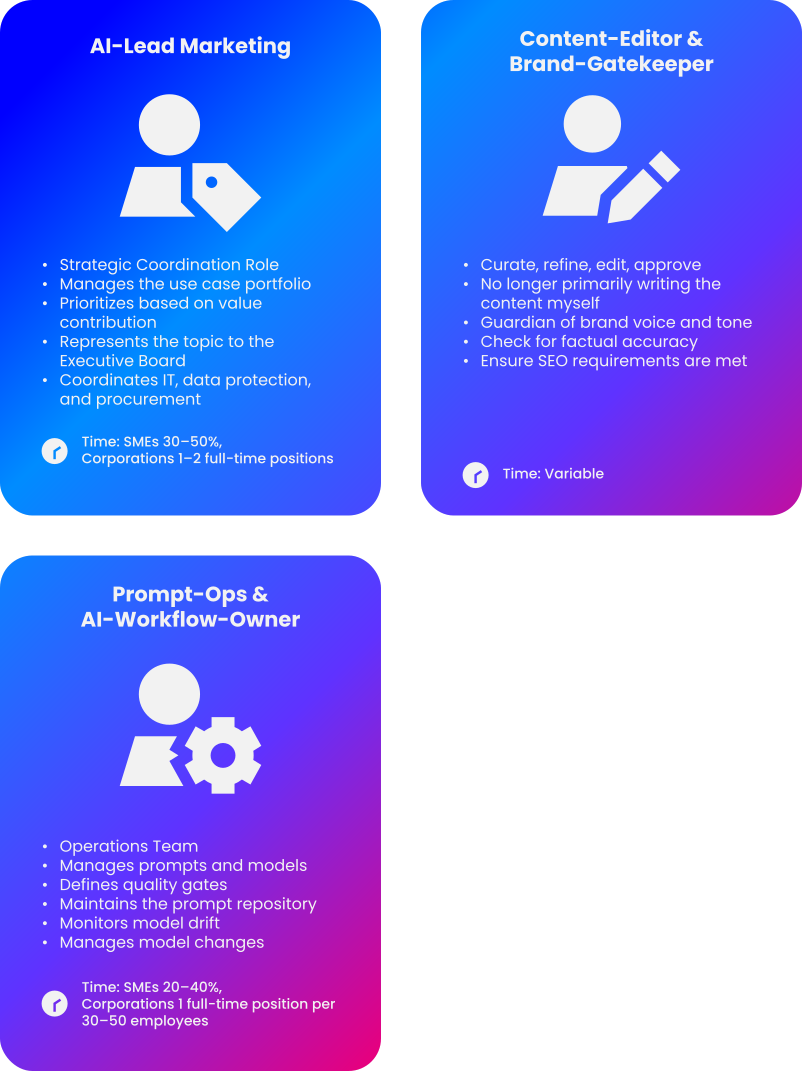
AI Lead Marketing. The strategic umbrella function. Owns the use case portfolio, prioritizes by value contribution and maturity level, represents the topic to executive management and the board, and coordinates with IT, data protection, and procurement.
Profile: senior marketing professional with a solid understanding of data and platform logic — not necessarily technical themselves. In SMEs, often combined with the marketing lead role; in enterprise organizations, a dedicated position in marketing operations or as a direct report to the CMO.
Time allocation: in SMEs, 30 to 50 percent of a full-time equivalent; in enterprise organizations, one to two full-time equivalents depending on portfolio breadth. Without this role, there is no portfolio — just a collection of initiatives.
Prompt Ops and AI Workflow Owner. The operational layer. Versions prompts and model configurations, defines quality gates, maintains the prompt repository, trains the editor layer, monitors model drift, and manages model transitions when providers update versions. This role is new and will still be underestimated in most DACH teams in 2026. Yet it is the lever that turns individual prompt practice into a marketing process.
Profile: marketing operations-oriented person with strong prompt practice, ideally from a performance or CRM background.
Time allocation: in SMEs, 20 to 40 percent; in enterprise organizations, one full-time equivalent per 30 to 50 marketing employees.
Content Editor and Brand Gatekeeper. The copywriter or content manager becomes an editor. The person no longer primarily writes themselves. They curate, sharpen, correct, and approve what the model drafts. They are the guardian of brand voice, tonality, factual accuracy, and SEO requirements.
Profile: experienced content professional with editor DNA, strong linguistic sensibility, and the willingness to shift from "writing" to "evaluating and sharpening."
Time allocation: for approximately every five content professionals actively using AI, one editor function is necessary — often the most senior existing writing voice on the team. Without this layer, brand consistency and factual accuracy erode within two to three quarters.
Data Owner Marketing. The prerequisite for every predictive and decisioning use case. Owns data quality, the data model, identity resolution, consent management, and the clean alignment between marketing sources (CRM, web analytics, CDP) and downstream systems.
Profile: analytical, process-strong, with good standing between marketing, IT, and data protection. In SMEs, often the CRM manager with an expanded mandate; in enterprise organizations, a dedicated marketing data function in marketing operations or in the customer data domain.
Time allocation: in SMEs, 30 to 60 percent; in enterprise organizations, almost always a dedicated function. Without it, predictive models fail not because of the model, but because of the training data.
Compliance Liaison Marketing. The bridgehead to the legal and data protection function. Maintains the use case register, drives the compliance checklist from Section 5.3 through for each use case, documents risk classes, keeps the DPA status of model providers current, and is the first point of contact for internal audits.
Profile: experienced marketing operations or legal-minded professional with a strong understanding of processes.
Time allocation: in SMEs, 10 to 20 percent; in enterprise organizations, half to one full-time equivalent. This role is almost always overlooked in the mid-market and is, in our experience, the most common reason why compliance obligations only become visible when they should have been implemented long ago.
In total, this amounts to approximately 1.2 to 2.0 FTEs (full-time equivalents) in SMEs, distributed across existing staff; in enterprise organizations, between 4 and 7 FTEs in dedicated functions. Those who properly staff these mandates have the organizational prerequisite for ensuring the use cases from Section 3 do not end up in pilot limbo. How these roles interact per use case is shown in the RACI matrix in the next section.
6.2 RACI Matrix: AI Use Cases from Concept to Live Operations
The following matrix shows the responsibilities per role and phase for a typical AI use case according to RACI logic (R = Responsible / executes, A = Accountable / bears responsibility, C = Consulted / is consulted, I = Informed / is informed).
There may be only one "A" per phase — otherwise responsibility is unclear. IT is involved as a platform and integration role; the data protection officer and executive management are engaged through the compliance and AI lead functions and are named in the comments below the table.
| Phase / Task | AI Lead | Prompt Ops | Editor | Data Owner | Compliance | IT |
|---|---|---|---|---|---|---|
| 1. Use case idea + business case | A/R | C | C | C | I | I |
| 2. Compliance clarification + risk class | A | I | I | C | R | C |
| 3. Verify and provision data foundation | C | I | I | A/R | C | R |
| 4. Tool decision (Embedded/Buy/Build) | A | C | C | C | C | R |
| 5. Pilot setup and configuration | A | R | C | R | C | R |
| 6. Pilot Measurement and Go/No-Go | A/R | C | C | C | C | I |
| 7. Live Operations and Monitoring | A | R | R | C | C | C |
| 8. Model and Prompt Maintenance | A | R | C | C | I | C |
| 9. Quarterly Review and Lifecycle | A/R | C | C | C | C | I |
DPO and executive management in the matrix. The Data Protection Officer must be involved as "Consulted" in Phase 2 (compliance clarification) and Phase 3 (data foundation); for high-risk use cases, additionally in Phase 6 (Go/No-Go). The executive management or CMO is involved as "Approved" in Phase 1 (business case approval), Phase 6 (Go/No-Go), and Phase 9 (lifecycle decision) — formally via the AI Lead A. Anyone who does not explicitly schedule these three approvals in the calendar will, in practice, lose weeks to stalling.
Phase 6 is the most important filter. The Go/No-Go after the pilot separates initiatives that move into live operations from those that are shut down. In ROI-blind organizations (see Section 2.1), this phase is skipped. Pilots continue to run indefinitely, tool licenses accumulate. The discipline of honestly completing Phase 6 is by far the most important organizational investment. Ideally, there is a fixed quarterly appointment in which all active use cases are tested against their hypothesis.
Phase 8 is systematically underestimated in mid-sized companies. Model drift, new provider versions, changed brand standards, and changed data turn every live use case into a living process. Anyone who does not actively manage Phase 8 will, within 12 to 18 months, have a quietly deteriorating use case whose effectiveness declines without anyone noticing. Minimum effort per use case: a quarterly model review of 4 to 8 hours, plus the response to major provider updates. This effort must be planned in at the time of pilot approval; otherwise, a permanent debt accumulates in the stack.
This matrix should be understood as a template, not as a standard for every organization. In SMEs, multiple roles are consolidated in one person; in large enterprises, specialized functions (brand, performance, CRM) are often added, carrying a "C" in individual phases. What matters is that every organization documents its own matrix once in writing and applies it to every new use case. Without it, the operating model remains abstract.
6.3 Skill Mix and Development Paths for Existing Marketers
Most tasks from Section 6.1 can be staffed from the existing team — provided the team is developed in a structured manner. External hiring of AI specialists is rarely the better path in mid-market marketing, because the domain expertise of an experienced marketer is more expensive to buy in than prompt and model competency is to retrain. Four building blocks form the skill architecture.
Core skills for every marketing person. By 2026, four capabilities belong to the basic toolkit of all marketing employees, regardless of function: structured prompting (system prompts, few-shot, chain-of-thought), critical output evaluation (hallucination detection, fact-checking, bias sensitivity), basic data literacy (reading KPI dashboards, understanding confidence intervals), and an awareness of compliance fundamentals (GDPR basics, transparency obligations). Deliverable in 1.5 to 3 days spread across the quarter, with subsequent hands-on coaching. Without this foundation, the result is either shadow AI with risk or refusal with loss of value.
Advanced skills for AI Lead and Prompt Ops. The two key roles require substantial additional competency: use case design and business case modeling, RAG architectures and prompt versioning, model selection and evaluation methodology, lifecycle governance, vendor management for model providers, comparison of embedded and API-based solutions. Realistically, this involves 8 to 12 training days over six to nine months, combined with hands-on application in one's own stack. External programs (universities, Institut der deutschen Wirtschaft, relevant providers) are advisable here, because the topics are too broad for pure on-the-job learning.
Data competency for the Data Owner. This role requires a different skill set: data modeling, SQL fundamentals, CDP or data warehouse concepts, identity resolution, consent management architectures, and ideally a basic understanding of predictive models (what does AUC measure, what does lift mean, when does a model drift?).
Existing CRM managers with an analytics affinity are the typical source. Where the internal profile is lacking, an external hire is worthwhile. A marketing data professional with three to five years of CDP experience costs between 75,000 and 110,000 euros in annual salary in the DACH market in 2026 and is often productive within six months.
Hire vs. Train: The decision rule. Three rules of thumb from our client engagements.
- Hire externally when the gap concerns specific technical competency that no marketing person can acquire with reasonable effort (e.g., proprietary model development, MLOps).
- Train internally when the gap concerns prompting, editor skills, use case design, or compliance operations. These topics can be learned in six to nine months.
- Mix both when the scope reaches enterprise level. An external senior hire as AI Lead, combined with internal skill distribution via a train-the-trainer approach.
What does not work: placing externally hired individuals without marketing domain knowledge into strategy roles.
Realistic investment for a marketing team of 30 people: approximately 60 to 90 training days in the first year, distributed across all roles, plus about 15 to 25 days for the two key role holders. Scaled accordingly in SMEs.
This investment is by far the most frequently underestimated line item in an AI roadmap. And at the same time the one with the highest leverage on all other investments.
With the operating model and skill architecture in place, we can now turn to the question of what can actually be calculated at the end of these investments.
7. ROI of AI in Marketing: What Can Actually Be Calculated
The CEO does not ask "Which model?" but "What does this do for us?" And in most marketing organizations, this question remains unanswered 18 months after an initiative launches. This is rarely due to a lack of value contribution — almost always due to a lack of discipline in measurement. A realistic ROI discourse requires three building blocks: an understanding of where AI actually creates value in marketing (efficiency, effectiveness, or new outputs); a range of robust effect sizes per use case against which one's own expectations can be calibrated; and a measurement methodology that can cleanly separate impact from chance and background noise. The following three sections deliver exactly these three building blocks: 7.1 sorts the value levers, 7.2 maps realistic effect ranges per use case in a summary table, and 7.3 shows how a pilot turns into a robust statement about live operations: pilot design, control groups, payback logic.
7.1 The Three Value Levers: Efficiency, Effectiveness, and New Outputs
AI in marketing creates value through three clearly distinguishable levers. Each of these levers has its own ROI logic, its own metric, and its own typical payback period. Those who correctly classify each use case by lever avoid the most common form of misevaluation: measuring efficiency investments with effectiveness benchmarks, or vice versa.
Lever 1 – Efficiency: The same thing, faster or cheaper. A use case is efficiency-driven when it produces the same outputs with less time, less personnel effort, or lower unit costs.
Examples: content generation at scale, reporting automation, translations, first drafts for briefings.
Metric: personnel hours, turnaround time, unit cost per output. Payback: typically 6 to 12 months, because the effect can be directly calculated against personnel costs and external service providers.
Characteristic: quickly visible, but limited growth impact. Saved hours must be actively redirected into other value creation; otherwise, the effect remains only on paper in reporting.
Lever 2 – Effectiveness: Better results with the same input. A use case is effectiveness-driven when it converts the same inputs (budget, team, reach) into higher output impact. Examples: predictive lead scoring, real-time personalization, lookalike targeting, next-best-action, marketing mix modeling.
Metric: conversion rate, CAC, CLV, pipeline velocity, channel ROAS. Payback: typically 12 to 24 months, because clean baselines and control groups must first be established.
Characteristic: higher value contribution, but more complex measurement and longer learning curves. And in most mid-sized companies, the lever with the greatest untapped potential, because efficiency use cases are more visible and simpler.
Lever 3 – New Outputs: What was not possible before. A use case falls into this category when it enables a marketing activity that would not have been economically viable without AI.
Examples: complete localization across 5 markets in parallel, real-time trend mining across all competitors, highly personalized 1:1 communication at medium reach, AI-powered market research as an ongoing process instead of an annual study.
Metric: context-dependent; markets opened up, topics covered, response time to market changes.
Payback: often strategic and difficult to map within a quarterly logic; pays off especially in competitive contexts where differentiation against slower competitors delivers the actual value contribution.
The three levers are not equally common: in consulting engagements, the use case population breaks down roughly into 50 percent efficiency, 35 percent effectiveness, and 15 percent new outputs.
A mature AI roadmap deliberately balances the three levers. It typically starts with efficiency for quick, visible wins, builds effectiveness for sustainable competitive advantages, and selectively invests in new outputs for strategic differentiation.
7.2 Realistic ROI Ranges per Use Case
The following table maps the twelve use cases from Section 3 with realistic effect ranges and typical payback periods. The ranges are based on observations from DACH consulting engagements, industry studies, and vendor reports and are intended as an expectation corridor — not as a guarantee. The upper range is typically achieved only with a good data foundation and a clean operating model; the lower range is realistic even in less favorable setups.
| Use Case | Lever | Primary Metric | Realistic Range | Typical Payback |
|---|---|---|---|---|
| 1. Content Generation | Efficiency | Personnel hours per output, turnaround time | 35–60% time savings | 6–9 months |
| 2. Audience Modeling, Persona Mining | Effectiveness | Conversion rate per segment, briefing quality | 5–15% conversion lift | 12–18 months |
| 3. Lookalike Targeting | Effectiveness | CPL, CAC | 15–30% lower | 9–15 months |
| 4. Predictive Lead Scoring | Effectiveness | SQL-to-opp conversion, processing time | 10–25% higher conversion, 20–40% shorter time | 9–15 months |
| 5. Real-Time Personalization | Effectiveness | Conversion rate, AOV | 5–25% conversion lift | 12–24 months |
| 6. Dynamic pricing, promo optimization | Effectiveness | Margin per order, margin mix | 2–8% margin lift | 12–18 months |
| 7. Churn prediction, reactivation | Effectiveness | Churn rate, NRR | 10–25% churn reduction | 9–18 months |
| 8. Next-best-action, lifecycle management | Effectiveness | Revenue per existing customer, engagement | 5–15% revenue increase per customer | 12–24 months |
| 9. Sentiment analysis, VoC | New outputs | Topic breadth, response time to sentiment shifts | Qualitative; response time from weeks to days | Strategic |
| 10. Attribution, marketing mix modeling | Effectiveness | Media budget efficiency, ROAS per channel | 10–20% efficiency lift | 12–18 months |
| 11. Reporting automation | Efficiency | Reporting hours, frequency | 50–70% time savings | 3–9 months |
| 12. AI market research, trend mining | New outputs | Topic coverage, early warning time | Qualitative; continuous instead of annual study | Strategic |
These ranges are subject to cumulation rules. Running three use cases simultaneously does not mean you can simply add the individual effects together. The impacts overlap, and the underlying data is often the same. In practice, a cumulation discount of 30 to 50 percent should be applied when multiple effectiveness use cases target the same funnel step.
The lower end of the range is the realistic planning figure. Business cases should be calculated against the lower end of the range — not the upper end. If the use case pays off even in the worst case, it is robust; if it only works in the best case, it is a risk that will not be resolved until the live phase. This discipline protects against signing off on AI initiatives with promises that cannot be kept in real-world operations.
Efficiency wins must be actively reinvested. Fifty percent saved reporting hours do not automatically show up as additional value creation in the organization. They often dissipate invisibly into other routine tasks. To actually capture efficiency gains, you must proactively redirect them: into higher reporting frequency, into additional use-case work, into expanding the customer insight layer, or into a visible headcount reduction. Without this reinvestment, the effect remains theoretical.
These ranges represent a defensible expectation. But they do not replace your own measurement. To turn a pilot project into a valid statement about live operations, you need a methodical pilot design — and that is exactly where the next section is headed.
7.3 The Right Measurement Methodology: Pilot Design, Control Groups, Payback
A pilot without a sound measurement design is a demo. A demo can impress, but it does not provide a decision basis for scaling or termination. The following five points are the minimum every AI use case should meet during the pilot phase. And they do not require more effort — they just distribute it differently.
Pilot hypothesis and success criterion before launch. In writing, in one sentence, with a number and a time frame: "We expect the lead scoring model to increase SQL-to-opp conversion in segment X by at least 12 percent over 90 days." Anyone who formulates the hypothesis only at the end does not have a pilot but a storytelling project. The data will conform to the expectation. The hypothesis should be co-signed by the AI lead and the business owner and placed in the use-case brief before the model sees live data for the first time.
Control group or holdout: the most important methodological step. Three standard designs cover most marketing use cases: first, A/B splits at the recipient or session level (classic for personalization, content, lead scoring); second, geographic control groups (for media budget allocation, MMM validation); third, temporal switchbacks for slow-onset effects (for churn models, retention use cases). Without a control group, the AI effect cannot be separated from seasonal, macroeconomic, or campaign-driven fluctuations. And it is precisely this separation that makes the subsequent ROI statement defensible. Rule of thumb: at least 20 percent of the population in the holdout for at least one full business cycle.
Baseline and measurement period clearly defined. The comparison "with AI vs. without AI" requires a baseline from at least two comparison periods, ideally spanning a full year to factor out seasonality. The measurement period should be long enough for the model to have learned from the data (typically 60 to 90 days for transactional use cases, 6 to 12 months for retention use cases). Premature pilot terminations because "it was already clear after three weeks what the result would be" are the most common source of flawed scaling decisions — in both directions.
Payback logic and total cost of ownership. The ROI equation is "annual monetary effect" divided by "investment plus ongoing costs." Investment includes licensing, implementation, training, compliance effort, and pilot staff hours. Ongoing costs include license renewals, model and prompt maintenance (typically 0.5 to 2 FTE days per use case per quarter), API costs, and quality reviews. Realistic expectations: efficiency use cases with payback under 12 months, effectiveness use cases between 12 and 24 months, new-output use cases with a strategic justification. Anyone who goes to the board promising payback in under 6 months is building in future credibility losses.
Stop criteria are mandatory — not optional. Before the pilot starts, it must be documented in writing under what conditions the use case will not be pursued further. For example:
- Effect falls below the lower end of the range
- Model shows persistent bias against a segment
- Compliance issue arises
- Tool costs exceed plan by 30 percent
A use case without stop criteria is effectively condemned to scaling. And that is the foundation for pilot limbo and license zombies. In the quarterly review from 6.2 (Phase 9), the stop criteria are explicitly checked against the pilot's progress and the decision is documented.
With a pilot that clearly defines hypothesis, control group, baseline, payback logic, and stop criteria, a defensible decision can be made after three to six months: scale or shut down. Both are acceptable. What is not acceptable is pilot limbo. Before we move into the implementation plan, one final self-check is worthwhile: What maturity level is your marketing team currently at, and which use cases are realistic?
8. Conclusion: From Tool Hype to Operational Competitive Advantage
Artificial intelligence in marketing is no longer an innovation question in 2026, but an operating question. The models are available, the tools are mature, the use cases are proven. What makes the difference between marketing organizations that use AI as a competitive advantage and those that book it as a cost item is not the tool and not the budget — it is five disciplines that were covered in detail in the sections above: a clearly prioritized use-case portfolio instead of a tool collection; a named AI lead with a mandate instead of scattered responsibility; a compliance architecture that treats the EU AI Act and GDPR as a design criterion instead of an afterthought; a measurement methodology that separates impact from background noise; and a maturity-aware approach that plans in stages instead of leaps.
The economic difference between a Stage 3 organization and a Stage 1 or Stage 2 organization of the same size typically amounts to 30 to 50 percent less effort per output and 10 to 25 percent higher conversion impact — on a marketing budget of 5 million euros, that translates to a multi-million-euro difference per year. AI marketing is therefore not a tool trend, not a hack, not a silver bullet. It is a classic operating topic with clear logic, clear disciplines, and clear consequences. Those who treat it as such win; those who treat it as a tool question burn money.
45 Minutes of Free Initial Consultation: Where Does Your AI Marketing Really Stand?
If you've done the honest self-assessment after reading this guide and want to know which two to three use cases offer the greatest leverage in your organization: We'll take 45 minutes, free of charge and with no obligation. You'll receive an honest maturity-level assessment, a prioritization of your most important use cases, and an initial recommendation for the next step — no sales presentation, no tool recommendation. If a collaboration comes out of the conversation, that's great. If not, you'll have an external second opinion that you can continue working with internally. Book an appointment directly.
9. Frequently Asked Questions About AI in Marketing
The following seven questions are the ones most frequently asked first in our client engagements and board pitches. Each answer is intentionally kept short and to the point — as quotable initial information, not as a substitute for the detailed sections above.
What Is AI in Marketing?
AI marketing is the systematic use of learning or generative models to derive scalable marketing decisions from customer and market data — meaning content, audiences, channels, timings, prices, or messages that are delivered in real time or near real time without individual human decisions. It encompasses predictive models, generative AI, decisioning systems, and agentic workflows — and explicitly excludes classic, rule-based marketing automation.
Which AI Is Best for Marketing?
There is no single best AI, but rather the best AI per use case. For content generation, LLMs like GPT, Claude, or Mistral are leading; for personalization, decisioning systems like Adobe Target, Salesforce Personalization, or Dynamic Yield; for predictive use cases, the platform-native models (Einstein, Breeze, Customer AI) or specialized providers like Datasolut or 6sense. The right question is: What bottleneck needs to be solved — and which of the three tool categories from Section 4.1 covers it most cost-effectively?
What Does AI Marketing Cost?
Tool costs range from 0 euros (AI features included in the existing platform license) to six figures per year (enterprise specialty tools, custom builds with an engineering team). A realistic rule of thumb for a mid-sized marketing team: 30,000 to 150,000 euros per year in tool costs plus two to four times that amount for data work, training, compliance, and pilot staff hours. Anyone who only plans for license costs systematically underestimates the investment.
Is AI in Marketing GDPR-Compliant?
Yes, with limitations. Inference on existing data within a legally compliant platform is usually unproblematic; fine-tuning on personal data requires a separate legal basis. Profiling and automated decisions with significant impact fall under Article 22 and require a human intervention point. A data processing agreement with the model provider, clarification of data residency, and a DPIA for high-risk cases are mandatory. The eight-point checklist in Section 5.3 lists the key checkpoints.
Who Needs an AI Marketing Manager?
Every organization running more than two productive AI use cases in parallel needs a named AI lead — in SMEs often as a dual role with the marketing lead, in large enterprises as a dedicated position. This function is responsible for the use-case portfolio, represents the topic to executive management, and manages the interfaces with IT, data privacy, and procurement. Without this role, AI marketing remains a collection of individual initiatives without portfolio governance.
Is Generative AI Worth It in B2B?
Yes, especially with the three levers of content creation, reporting automation, and lead scoring. In B2B, the effects are often greater than in B2C because the content is more complex and the target audiences are smaller — the ratio of research effort to reach improves disproportionately with AI support. However, caution is advised with outreach automation without human curation: scaled, generic AI emails burn through the list faster than they build pipeline.
What Changes with the EU AI Act?
Marketing use cases generally fall into the "limited risk" class — with three transparency obligations starting August 2, 2026: labeling of AI-generated content, disclosure of deepfakes, and notification requirements for chatbots. Providers of general-purpose AI models must deliver training data and copyright transparency from the same date; as a deployer, you need GPAI conformity clauses in the contract. Prohibited practices (manipulation, exploitation of vulnerable persons) have been banned since February 2025 — the red lines belong in every pre-launch review.
Yusuf Agirdas is the RevOps Team Lead at MaibornWolff, bringing 15 years of marketing experience and expertise to the table. At MaibornWolff, he oversees the revenue value chain and excels at breaking down complex issues and implementing solutions thanks to his technical skills. He is also the founder of Al-Bahr Growth Advisory – a consulting firm specializing in marketing, sales, and RevOps in the GCC region.