Was M2M bedeutet, wie es funktioniert und wo es in der Praxis eingesetzt wird.
Successfully networking complex systems

In networked embedded devices, all components must work together perfectly. For example, 56% of respondents in our study report a noticeable loss of time due to a lack of integration and the resulting system disconnects. (MaibornWolff Study on Technology Efficiency, 2026)
Embedded System Integration connects the right components in the right places – within the device itself and beyond.
MaibornWolff has many years of experience in this area - in individual integration as well as in connecting to complex IoT environments. Our interdisciplinary team does not think of integration in isolation, but as a holistic task along your system architecture.
We deliver solutions that work - reproducible, maintainable and a perfect fit for your target platform. And with a clear claim: as little technology as possible, as much as necessary. True to our guiding principle: Less Technology. Better business.
Embedded systems only reach their full potential when all components are seamlessly integrated. This is also highlighted in our study: “Integration is no longer viewed as a one-time project, but as a core competency that must be continuously developed.” (MaibornWolff Study on Technology Efficiency, 2026)
We ensure that software and hardware work together seamlessly—reliably, efficiently, and tailored to your target system.
Embedded system integration is an integral part of our software projects - as demonstrated by numerous successful references from a wide range of industries.
Whether a small module or a networked overall system: we have successfully implemented integration in every project - because no embedded product works without it.
Modular architectures and structured processes make your systems more efficient in operation - reliable, traceable and future-proof.
Whether a subsystem or complete solution: we integrate hardware, software, IoT cloud & app - tailored to your environment, regardless of industry or company size.
Market Context: The German embedded systems market is valued at $15.4 billion in 2025 and is projected to grow to $29.8 billion by 2034 (CAGR 7.47%). At the same time, it is evident that 84% of all system integration projects fail or are only partially successful. Professional integration is therefore not an optional step, but critical to success.
Embedded systems only develop their full potential when all essential components are properly integrated: Hardware, software, IoT, customer app, security and user experience. We ensure that software and hardware work together precisely - reliably, efficiently and tailored to your target system.
Our study highlights the risk: “When systems are too closely intertwined, even minor changes can lead to unpredictable side effects.” (MaibornWolff Study on Technology Efficiency, 2026)
We integrate individual modules, frameworks or complete applications into existing embedded environments - stable, expandable and without side effects. We consider existing infrastructures and your build system right from the start. Whether greenfield or partial integration: we have the expertise to enter grown structures in a targeted manner and develop them further in a future-proof manner.
Every embedded system is unique and every piece of hardware has its own requirements. That's why we tailor the software, drivers and operating system precisely to your target platform. Our solutions also take peripherals, buses and control components into account - for a connection that not only works, but also fits perfectly with the overall system.
We accompany the integration right up to the final step - remotely or on site. If required, we build reproducible setups and provide support with error analysis and optimization.
We have particular expertise in the following target systems:
Our teams adopt a technology-agnostic approach, but with a clear focus on your requirements—functional, operational, and economic.
We integrate embedded systems seamlessly into the surrounding software and communication landscapes:
Embedded systems only offer the customer a good user experience when they are seamlessly connected to the surrounding systems.
Our study points the way: “Instead of rigid point-to-point connections that become unstable with every update, modern architectures rely on standardized interfaces (APIs).” (MaibornWolff Study on Technology Efficiency, 2026)
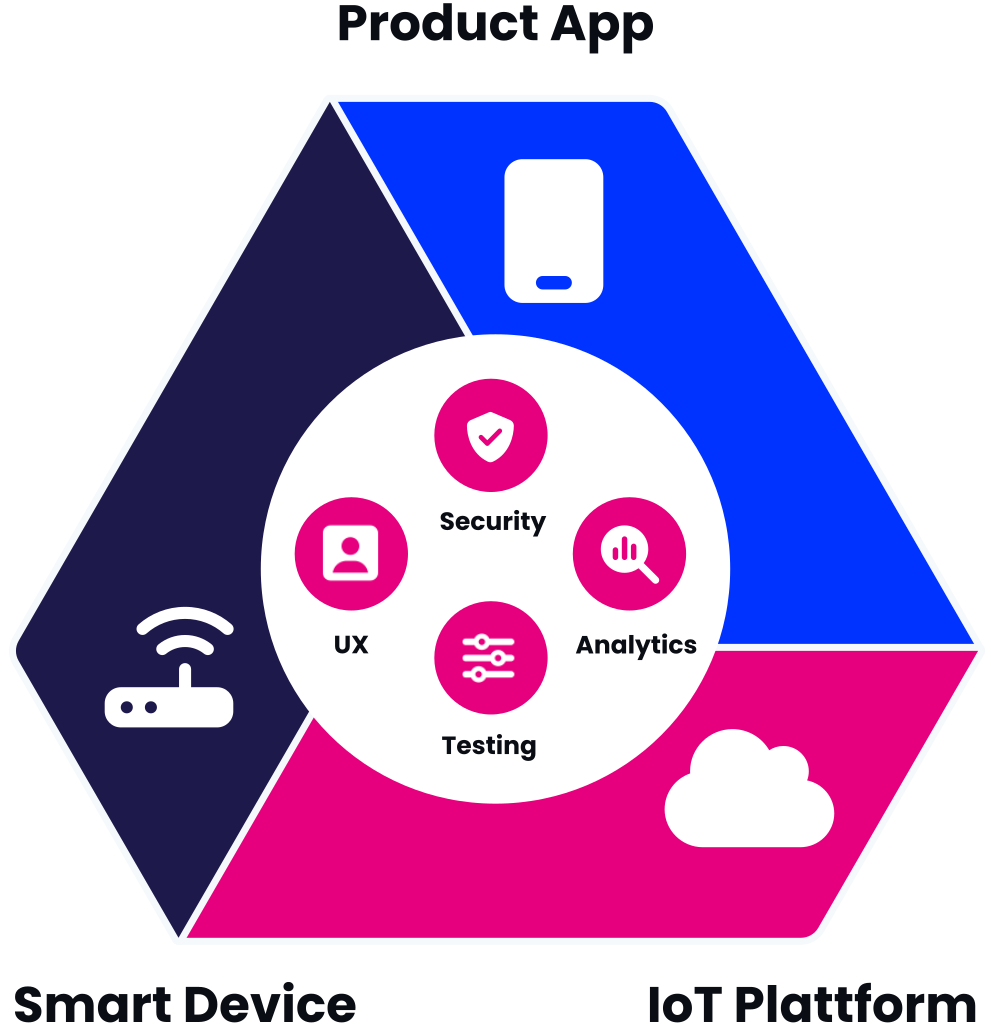
A smart device isn’t just the result of good hardware or well-designed software—it’s the result of the well-thought-out interaction of all components: hardware, software, IoT platform, customer app, security, and user experience. That’s exactly what we’ve had in mind from the very beginning.
Our cross-functional teams systematically bring all components together—methodically, transparently, and with the goal of breaking down silos. “The core problem here often lies in the lack of interaction between systems. When software solutions do not communicate seamlessly, humans must act as the interface.” (MaibornWolff Study on Technology Efficiency, 2026)
The following two diagrams illustrate our holistic approach to integration: on the one hand, from the software perspective, and on the other, from the hardware perspective.
Whether it’s unstable systems, legacy solutions that have evolved over time, or interface conflicts—many companies are reaching their limits when it comes to embedded system integration. In fact, 33% of respondents to our study cite the lack of integration between different systems as one of the main causes of technological complexity within their organizations. (MaibornWolff Study on Technology Efficiency, 2026). Added to this are often insufficient testability, missing security concepts, unclear requirements, or simply a lack of expertise in the embedded sector.
That’s exactly where we come in, providing structure, reliability, and sustainable solutions. Our approach: no quick-and-dirty fixes, but meaningful integration—in line with industry standards, backed by a strong sense of ownership, expertise, and foresight.
"Inefficiency arises specifically when systemic shortcomings must be compensated for by manual workarounds or when data is entered redundantly into different tools." (MaibornWolff Study on Technology Efficiency, 2026)
Industry Context – Integration Risks: Recent industry studies show that 40% of embedded defects are caused by interface mismatches between hardware and software. 45% of system failures are attributable to inadequate validation procedures. Proper requirements gathering can save 15–30% of project costs.
An example says more than many words: that is why we are showing a specific project here in which embedded systems integration has produced measurable results. The example project shows how it works in practice - with clearly measurable benefits for the product and the business behind it.
Digital twin for control unit development & testing in cars
Virtualization of control units & AWS cloud integration
Setup of virtual cars & control units without expensive hardware setups, worldwide & distributed testing
Control center for the technical monitoring of driverless trucks
UX design, product strategy, data structure, vehicle data visualization
Monitoring, remote support, mission management, reports for commercial autonomous transport solutions
IoT gateway (MAX Box) for data connection between elevator & IoT platform
Examination of code quality, architecture, operations & organization
Optimization of IoT gateway connectivity & digitalization of elevators
Knee training simulator for technology-supported medical education
Mixed reality application combined with a haptic knee model, interactive training environment
Diagnostics on the human knee without simulated patients, simulation of various pathologies, real-time visualization of motion sequences
Customized assistance robots for people with physical disabilities in production
Integration of AI for automated adaptation of robots to people's capabilities
Effective empowerment of people with physical disabilities
Protection of digitalized trucks against virtual attacks
Risk analysis based on 4x6 methodology, ThreatSea, ISO21434
Quick identification of relevant threats for immediately effective security measures
Further development of the IoT platform for connected home appliances
Container-based architecture, open standards, modular design
Quick availability & scalability of digital services, high added value for users
Experience a futuristic outdoor environment in the headset while inside a real vehicle interior
Real-time 3D application, Unreal development, XR technology, game design, smart devices
High-performance processing of vehicle signals for precise motion mapping for an immersive driving experience without motion sickness
Easy & intuitive web UI for product control
Development of HMI components & modules using Scrum
High user-friendliness, reliable operation, fast scalability & extensibility
Control and configuration of the robotic mower via smartphone
Development of app, web, cloud platform and direct Bluetooth communication
Digital benefits for users, app controllability, remote software updates
Fully integrated remote access in the IoT platform
Full stack cloud application, RUST-based clients, UX design
Analysis of sensor data from production as a basis for sustainable decisions for customers
Live monitoring platform for visualizing connected warning devices
Automation & cloud services (MS Azure), API management
Alarms visible worldwide within seconds, multi-tenant system
Software upgrades without the need to visit a service center
Backend system for over-the-air communication with the vehicle, 24/7 support
IT security, more comfort, on-demand provision of new features
We actively involve customer teams in our projects - both professionally and personally. Whether as a co-development team, with an on-site presence or through integration into existing development processes: We work agilely, transparently and at eye level. We rely on scrum approaches, regular dailies and clear communication structures.
“Digital projects often fail not because of the software itself, but because of the invisible barriers between CRM, ERP, and proprietary siloed solutions.” (MaibornWolff Study on Technology Efficiency, 2026)
Embedded systems are used in almost all industries today - from automotive to medical technology. The requirements vary greatly, but the demand for stable integration remains the same. We deliver tailor-made solutions that precisely address your industry-specific challenges.
Scalability and reliability are what count in these areas. We integrate systems that communicate decentrally and remain controllable at all times.
Embedded systems are used in almost all industries today - from automotive to medical technology. The requirements vary greatly, but the demand for stable integration remains the same. We deliver tailor-made solutions that precisely address your industry-specific challenges.
Scalability and reliability are what count in these areas. We integrate systems that communicate decentrally and remain controllable at all times.
Smart features and secure updates across a wide range of products (e.g., connected vacuum cleaners, smart washing machines)
Rugged, low-latency systems for sensor technology, control systems, and drive systems—even in existing manufacturing environments
High-performance, scalable embedded components for smart meters, control units, and specialized standalone devices
Regulatory requirements (MDR), system stability, and reliable support for critical processes
Numerous control units, strict safety requirements, and complex communication architectures—even when real-time performance is required
Absolute reliability in safety-critical applications – stable and controllable under extreme conditions
Industry Context – Smart Manufacturing in Germany: The German smart manufacturing market is projected to generate approximately $22.5 billion in revenue by 2025 and grow to an estimated $57.2 billion by 2033 (CAGR 11.8%). 84% of German manufacturers plan to invest in smart manufacturing annually. Automotive, mechanical engineering, electronics, and metal processing are the main drivers.
Regulatory requirements for connected products are becoming increasingly stringent. For companies with embedded systems, the EU Cyber Resilience Act (CRA) and IEC 62443 are particularly relevant. We incorporate these requirements as early as the integration phase—security by design rather than compliance as an afterthought.
EU Cyber Resilience Act – Timeline for Embedded Manufacturers
| Date | Milestone |
|---|---|
| Dec. 10, 2024 | CRA has taken effect |
| June 11, 2026 | Conformity assessment bodies must be established |
| September 11, 2026 | Mandatory reporting of vulnerabilities: Initial reporting within 24 hours for actively exploited vulnerabilities |
| Dec. 11, 2027 | Full implementation: All products containing digital components must be CRA-compliant (CE marking, SBOM) |
Strafen: Bis zu 15 Mio. EUR oder 2,5 % des globalen Jahresumsatzes. Security by Design ist keine Option mehr, sondern Voraussetzung für den Marktzugang.
Unternehmen, die bereits IEC 62443 (Teil 4-2 für Embedded-Komponenten) einhalten, haben einen Vorsprung bei der CRA-Compliance. Wir arbeiten mit Threat Modeling, Security by Design und führen bei Bedarf Penetrationstests durch.
„Eine statische Integration führt über kurz oder lang zu neuen technologischen Schulden, wenn sie nicht proaktiv an neue Gegebenheiten angepasst wird.“ (MaibornWolff Studie Technologieeffizienz, 2026)
We combine in-depth know-how in software development with our expertise in the field of embedded systems & robotics. With over ten years of experience and more than 30 successfully completed projects, we offer you experienced and structured support for your embedded challenges - from the smallest module to the entire networked system.
Our study outlines the following approach: “By standardizing communication channels early on, business logic is decoupled from user interfaces, enabling the parallel development of various digital services.”
(MaibornWolff Study on Technology Efficiency, 2026)
Industry Context – Skills Shortage: Germany currently faces a shortage of over 391,000 qualified professionals (IW, June 2025), including approximately 99,470 in engineering professions (VDI, Q3 2025). The embedded sector is particularly affected – vacancies are remaining unfilled for increasingly longer periods. MaibornWolff offers experienced teams that are ready to start immediately.
Was M2M bedeutet, wie es funktioniert und wo es in der Praxis eingesetzt wird.
Seize opportunities, manage risks—and make informed decisions.
AI governance allows you to establish a framework for the use of AI in your organization.
Successful AI implementation requires expertise and a clear roadmap.
Streamline processes, structure interfaces, and implement automation where it makes sense.
Stabilise processes, reduce complexity, make results measurable.
Simplify processes, identify potential, and use automation in a targeted manner.
Stabilize processes, reduce complexity, create measurable benefits.
How to bring your AI system into line with applicable laws and ethical standards.
How AI is making the automotive industry more efficient, smarter, and more competitive.
How AI works explained in simple terms—from data to models to benefits.
How data can help you make clear decisions.
AI is more than just hype: it is already being used today - in everyday life, in business, for society.
You automate, analyze, decide - and make your business fit for the future.
Discover how cloud-native applications can support you in your digital transformation.
Understanding and using LLMs: What they can do, where they can help – and how to get started.
Use generative intelligence strategically, securely and with clear added value.
QT or Flutter? Embedded frameworks compared: performance and licensing reviewed.
Descriptive analytics explained – definition, process, benefits and specific examples.
Predictive maintenance explained: making maintenance more predictable, efficient and smarter.
Using AI correctly: data, opportunities, challenges and concrete solutions.
Potential and areas of application for AI, tips and examples for sustainability.
Understanding artificial intelligence simply: applications, impact and future opportunities.
Whisper on the Pi? It works – but not everything. Practical insights from Marno Janetzky.
How AI is driving innovation, efficiency and new technologies in industry.
Better estimate customer demand: definition, methods and added value of demand forecasting.
How predictive quality helps increase customer satisfaction and reduce production costs.
AI in practice: use cases from sales to production, with opportunities and obstacles.
While classic system integration often uses external middleware, embedded system integration links components directly within an embedded system - i.e. very close to the hardware. It requires a deep understanding of the target platforms, strict resource control and special test procedures.
Embedded Systems Integration works by embedding integration capabilities directly into an application or platform, rather than relying on external tools or middleware. This approach allows users to seamlessly connect different systems and applications within their existing workflows without having to switch between different interfaces or environments.
At MaibornWolff, security is an integral part of every integration project - not as an afterthought, but right from the start. We work with threat modeling, rely on security by design and carry out penetration tests if required. In this way, we ensure that embedded components function reliably even in security-critical contexts. Starting in September 2026, the reporting requirement under the EU Cyber Resilience Act for actively exploited vulnerabilities (24-hour deadline) will also take effect.
According to recent industry studies, 40% of embedded defects stem from interface mismatches between hardware and software. Furthermore, the MaibornWolff study (2026, n=305) shows that 33% of respondents cite poor integration as the main cause of technological complexity. Key factors for success include a solid requirements analysis (68% prioritize this), early hardware-software coordination, and structured testing procedures.
Our teams adopt a technology-agnostic approach and work with a wide range of target systems: ESP32 (including S3, C6, P4), Nordic Semiconductor (nRF54 series), NXP (MCX, S32K), ARM Cortex MCUs (M55, M85), single-board computers, and system-on-modules. For cloud connectivity, we work with Azure, STACKIT, Google Cloud, and AWS.
The CRA applies to all products with digital components—including embedded systems. Starting in September 2026, the vulnerability reporting requirement will take effect; by December 2027, all products must be fully CRA-compliant (including CE marking and a software bill of materials). Penalties can amount to up to 15 million EUR or 2.5% of annual turnover. We integrate Security-by-Design right from the development phase.