Was M2M bedeutet, wie es funktioniert und wo es in der Praxis eingesetzt wird.
Scalable IoT solutions for future-proof products

Do you want your products to function reliably - no matter how complex the technology behind them is? Embedded system design is the key to ensuring that everything works together smoothly. From the initial idea to operation - without any headaches.
MaibornWolff supports you end-to-end: from conception and architecture to prototyping, implementation, and commissioning. AI-supported embedded system design services accelerate decision-making, ensure quality, and lead to productive embedded solutions on your target hardware.
We combine an understanding of the cloud, software and hardware - and always wear software glasses. No rose-colored glasses, but a clear view of performance, stability and scalability - including IoT/cloud connection if it brings real benefits.
Our embedded system design ranges from viable architecture design to PoC and implementation to commissioning on your target hardware—pragmatic, resilient, and measurably effective.
Less Technology. Better Business.
We do not design standard products, but only embedded architectures that match your personal use case - as precisely as a tailor-made suit.
Our "software glasses" ensure scalable, maintainable and future-proof systems - clearly thought out and consistently designed for quality and sustainability.
Faster to market with reduced effort: Embedded design reduces costs, accelerates releases, improves maintainability and creates competitive advantages.
iSAQB CPSA-certified architects guarantee methodical quality and viable design decisions - well-founded, comprehensible and state of the art.
We bring embedded products to life faster and more securely: agile system design, targeted implementation, and a smooth transition to operation—without technical baggage. We address typical stumbling blocks such as heterogeneous hardware, tough real-time requirements or long release cycles with clear architecture, automation and a test-driven approach. This creates a resilient basis for development, integration and operation.
We design and implement embedded software: System and interface design form the basis, after which we implement the solution—from efficient low-level drivers to device UI. The result is embedded computing system design that runs productively in the field.
We design, configure, and integrate the appropriate platform—e.g., embedded Linux (Yocto, Buildroot, Elbe, ROS) or RTOS such as Zephyr, FreeRTOS, embOS—including board support and drivers in your product environment.
We consider your engineering setup from the outset – so that your team can significantly increase its development capacity and work without friction losses. CI/CD, process optimization, and AI-supported testing and architecture analysis are not just “someday” goals for us, but fundamental components of our approach. Our AI checks design decisions early on for consistency and recommendation quality – for an embedded computing system design that dynamically adapts to changes.
Instead of rigid V or waterfall models, we rely on an agile understanding of architecture: system design is created in such a way that it can be flexibly adapted to new requirements and conditions.
We consider quality right from the start: test-driven development and automated testing at all levels (unit, integration, HIL/SIL) and AI-based test case and review generation ensure stable releases. AI continuously checks architectural dependencies and code quality. This allows errors to be detected before they incur costs.
Once development is complete, the device's life cycle is just beginning. Safe and robust operation is the basis for this. That's why we include remote access and secure OTA updates in our planning. AI-supported monitoring detects anomalies and provides early warnings and potential failures. This ensures that your embedded products remain robust and maintenance-friendly in the long term.
Security is an integral part of our approach. With threat modeling and secure design patterns, we take security aspects into account right from the start and create a robust basis for stable systems. We consider regulatory requirements such as the Cyber Resilience Act and use AI to continuously update security checks and threat analyses. This means that security risks become visible at an early stage and compliance remains verifiable.
Our projects speak for themselves: they show that well thought-out architecture and clever platform selection result in robust systems - not just gray theory, but measurable results.
Digital twin for control unit development & testing in cars
Virtualization of control units & AWS cloud integration
Setup of virtual cars & control units without expensive hardware setups, worldwide & distributed testing
Control center for the technical monitoring of driverless trucks
UX design, product strategy, data structure, vehicle data visualization
Monitoring, remote support, mission management, reports for commercial autonomous transport solutions
IoT gateway (MAX Box) for data connection between elevator & IoT platform
Examination of code quality, architecture, operations & organization
Optimization of IoT gateway connectivity & digitalization of elevators
Knee training simulator for technology-supported medical education
Mixed reality application combined with a haptic knee model, interactive training environment
Diagnostics on the human knee without simulated patients, simulation of various pathologies, real-time visualization of motion sequences
Customized assistance robots for people with physical disabilities in production
Integration of AI for automated adaptation of robots to people's capabilities
Effective empowerment of people with physical disabilities
Protection of digitalized trucks against virtual attacks
Risk analysis based on 4x6 methodology, ThreatSea, ISO21434
Quick identification of relevant threats for immediately effective security measures
Further development of the IoT platform for connected home appliances
Container-based architecture, open standards, modular design
Quick availability & scalability of digital services, high added value for users
Experience a futuristic outdoor environment in the headset while inside a real vehicle interior
Real-time 3D application, Unreal development, XR technology, game design, smart devices
High-performance processing of vehicle signals for precise motion mapping for an immersive driving experience without motion sickness
Easy & intuitive web UI for product control
Development of HMI components & modules using Scrum
High user-friendliness, reliable operation, fast scalability & extensibility
Control and configuration of the robotic mower via smartphone
Development of app, web, cloud platform and direct Bluetooth communication
Digital benefits for users, app controllability, remote software updates
Fully integrated remote access in the IoT platform
Full stack cloud application, RUST-based clients, UX design
Analysis of sensor data from production as a basis for sustainable decisions for customers
Live monitoring platform for visualizing connected warning devices
Automation & cloud services (MS Azure), API management
Alarms visible worldwide within seconds, multi-tenant system
Software upgrades without the need to visit a service center
Backend system for over-the-air communication with the vehicle, 24/7 support
IT security, more comfort, on-demand provision of new features
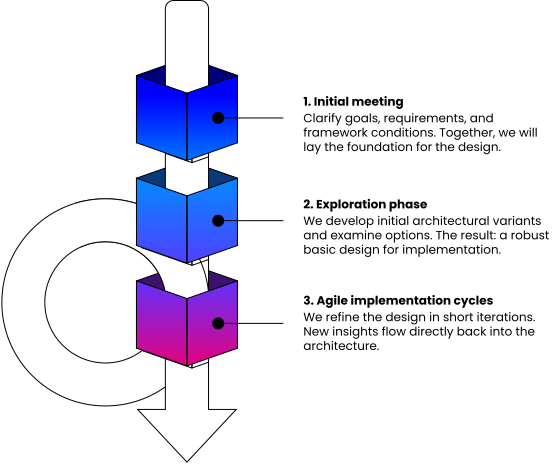
Every embedded design project we undertake follows a clear step-by-step process—from the initial consultation to go-live. This allows us to maintain an overview at all times. Transparent, traceable, and without any unpleasant surprises.
System design for embedded systems is at the heart of modern, networked products. It creates clarity in the architecture, shortens development cycles and lays the foundation for scalability and maintainability.
From smart washing machines to connected vacuum cleaners: we design, implement, and operate customized embedded solutions—with intelligent functions and reliable OTA updates, even for a wide range of models.
Production environments require high-precision, robust, and low-latency systems. We implement architectures that combine sensor technology, control systems, and drive technology—including integration into existing OT/IT and production implementation in manufacturing.
Whether smart meters, control units, or specialized systems: we implement embedded systems across the board—from design and implementation to testing and commissioning—with high performance in decentralized structures and scalable networks.
Every detail counts here. Our embedded designs meet the strictest regulatory requirements, ensure system stability and form the basis for solutions that reliably support vital processes.
Numerous control units, strict safety requirements and complex communication architectures - welcome to the automotive industry. We create designs that provide real-time capability and functional safety without making your head spin.
Absolute stability is required in security-critical defense applications. Our delivery approaches provide robust and controllable systems—including integration, hardening, and rollout. The result: rapid market readiness, manageable risks, and predictable series releases.
We support new developments as well as redesigns – with workshops on requirements analysis, model-based architecture, proof of concepts, and clearly defined interfaces. We work closely with your teams, integrate ourselves into existing processes, and consider IoT, cloud, and data connectivity as well as the targeted use of AI technologies right from the start. Whether edge inference or predictive maintenance – AI becomes a functional part of your architecture.
The result: faster time to market, lower risks, reliably plannable releases.
AI accompanies the entire lifecycle: variant searches and reviews in design, interference at the edge in the product, monitoring during operation. Embedded system design software helps us to implement architectures more quickly and keep them reliable.
Complex systems, tight schedules, growing demands: sound familiar? Many companies stumble over scaling problems, integration errors, or security gaps. Often, they lack expertise and clear structures, which leads to poor maintainability, long development cycles, and high costs throughout the entire lifecycle. We help to elegantly remove these hurdles.
With over ten years of experience, we combine embedded know-how with excellent software practice. Architecture, security, automation - everything is considered right from the start. We don't develop hardware, but we make sure that your product lasts longer than many a fridge.
Was M2M bedeutet, wie es funktioniert und wo es in der Praxis eingesetzt wird.
Seize opportunities, manage risks—and make informed decisions.
AI governance allows you to establish a framework for the use of AI in your organization.
Successful AI implementation requires expertise and a clear roadmap.
Streamline processes, structure interfaces, and implement automation where it makes sense.
Stabilise processes, reduce complexity, make results measurable.
Simplify processes, identify potential, and use automation in a targeted manner.
Stabilize processes, reduce complexity, create measurable benefits.
How to bring your AI system into line with applicable laws and ethical standards.
How AI is making the automotive industry more efficient, smarter, and more competitive.
How AI works explained in simple terms—from data to models to benefits.
How data can help you make clear decisions.
AI is more than just hype: it is already being used today - in everyday life, in business, for society.
You automate, analyze, decide - and make your business fit for the future.
Discover how cloud-native applications can support you in your digital transformation.
Understanding and using LLMs: What they can do, where they can help – and how to get started.
Use generative intelligence strategically, securely and with clear added value.
QT or Flutter? Embedded frameworks compared: performance and licensing reviewed.
Descriptive analytics explained – definition, process, benefits and specific examples.
Predictive maintenance explained: making maintenance more predictable, efficient and smarter.
Using AI correctly: data, opportunities, challenges and concrete solutions.
Potential and areas of application for AI, tips and examples for sustainability.
Understanding artificial intelligence simply: applications, impact and future opportunities.
Whisper on the Pi? It works – but not everything. Practical insights from Marno Janetzky.
How AI is driving innovation, efficiency and new technologies in industry.
Better estimate customer demand: definition, methods and added value of demand forecasting.
How predictive quality helps increase customer satisfaction and reduce production costs.
AI in practice: use cases from sales to production, with opportunities and obstacles.
AI supports both the functions of the end product and the architectural design. It can be used in architectural reviews, automatically generate documentation, and thereby increase transparency. We also consider AI technologies early on in the design process in order to solve specific customer problems—whether through the integration of edge models or preparation for AI-based enhancements.
Embedded system design encompasses architecture and design, PoC, and implementation through to commissioning—including AI-supported reviews and tooling with embedded system design software. PCB design is covered by partners; we assist with hardware selection and integration.
A clear architecture, clean interfaces and tests that don't just come at the end. Plus security by design and automation - in short, everything that makes systems maintainable and updatable tomorrow instead of making them look old today.