Software for the Energy Industry
Navigating the Energy Transition with the Right Software.
Software for Energy Providers—The Key to Transformation
The energy industry is undergoing more fundamental changes than ever before. Generation is becoming more decentralized, markets more volatile, and processes more data-driven. At the same time, pressure is mounting from all sides: regulatory requirements—such as the smart meter rollout, Section 14a of the Energy Industry Act (EnWG), and NIS-2 —are placing demands on your company, as are rising operational burdens. Furthermore, competition demands that you evolve from a pure utility provider into a digital service provider. Software is no longer merely a tool but a key lever for controllability, efficiency, and security of supply.
This requires solutions that fit your processes and your existing system landscape. As a neutral IT service provider, MaibornWolff supports energy suppliers, grid operators, and municipal utilities through precisely this transformation. We develop customized software for the energy sector, integrate it into your existing systems, secure it in accordance with critical infrastructure standards, and keep a close eye on industry regulations.
Your Partner for Software Solutions in the Energy Industry
In the energy industry, you need solutions that work today and are also sustainable for tomorrow. This is exactly where we come in: MaibornWolff combines custom software development with a genuine understanding of the energy sector and its unique characteristics. These principles shape our work:
We are vendor-neutral and develop custom software rather than off-the-shelf products. We seamlessly integrate our customized solutions into your existing system infrastructure.
We develop only what you really need—well-designed, streamlined, and reliable. Instead of over-engineered solutions, you get software that drives your business forward. Our motto: Less Technology. Better Business.
With over 800 large-scale systems successfully implemented and more than 10,000 person-years of experience in high-end software engineering, we reliably implement even large, complex IT landscapes.
As a KRITIS operator, you face significant risks. That’s why securing your software is an integral part of our development process from the very beginning. This way, you won’t have to incur the high costs of retrofitting your software to ensure compliance, and you’ll be on the safe side from a regulatory standpoint.
Simone Hooge, Head of Marketing Services, LEW
These companies already rely on our expertise
How Your Company Can Benefit from Software in the Energy Industry
Software for the energy industry delivers value throughout the entire value chain—from sales and the grid to generation and trading. Depending on your market role, you’ll benefit in different ways:
With smart portals and automated processes, you can offer your customers a seamless digital experience. Software solutions for the energy industry reduce your service costs and prevent errors in billing and when switching providers.
Software provides the transparency needed to manage loads in a manner that benefits the grid and to comply with the requirements of Section 14a of the Energy Industry Act (EnWG) and Redispatch 2.0. This ensures a reliable supply, prevents bottlenecks and penalties, and makes it easier to plan your grid expansion.
Specialized software for the energy industry makes your smart meter rollout predictable and scalable. Your meter-to-cash processes run automatically, and you can be sure to meet regulatory requirements.
With the right software, you can reliably connect your decentralized systems and monitor their operation. This allows you to increase availability and optimize your power generation.
More accurate forecasts reduce costs for procurement and balancing energy.
In addition, you can tap into new revenue streams, such as through PPAs or flexibility trading.
An integrated, vendor-neutral software environment connects the electricity, gas, water, and heating sectors and makes them more efficient.
Whether it’s sales, the grid, meter reading operations, or retail: every market role comes with its own set of challenges. Together, we’ll find the right software solution for your company and get your IT ready for the energy transition.

Software for Energy Utilities: Our Services & Expertise
Electrification, decentralized generation, storage, electric mobility, and heat pumps are also creating an increasing number of controllable assets.
As a result, the energy industry is evolving from a predominantly process-oriented IT market to a data- and control-oriented IT market.
The requirements in the energy sector thus range from digital customer services to grid control and secure, modern IT architectures. As a specialized IT service provider, we develop the right software for all these tasks:
Customer Portals, Apps, and Digital Self-Service Options
Today, customer portals and apps are the most important point of contact between utilities and customers.
- Self-service applications: contracts, meter readings, usage, and dynamic rates—intuitively accessible to your customers.
- AI chatbots and voice assistants: Automated communication for better service quality.
- UX design and accessibility: User-friendly interfaces that meet the latest standards, including accessible access in accordance with the BFSG. Development of design systems to support multi-brand capabilities.
Smart Grids, Grid Control, and Energy Management
To enable real-time monitoring and control of generation, distribution, and consumption, we integrate the physical grid infrastructure with intelligent software:
- Grid Control and Load Management: Software for real-time control of your grid.
- IoT connectivity: Networking of equipment, sensors, and control systems for a smart grid.
- Energy Management Systems (EnMS) according to ISO 50001: Transparency regarding load profiles, consumption, and costs in industry and commerce.
Data Platforms, Data & AI
Throughout the entire value chain, large volumes of data are generated, often stored in separate systems. We bring them together and turn them into a usable foundation:
- Data platforms: Evaluating your data maturity through data assessment, establishing governance with clear responsibilities and quality standards, preparing clean data products, and scalably consolidating your data in the cloud.
- AI and Machine Learning: Automation of routines, real-time analyses, and insights for informed decisions.
- Forecasts and Analysis: Precise load and generation forecasts, early anomaly detection, and energy data presented in an easy-to-understand format.
- VR/AR Visualization: Experience complex energy data immersively in 3D to intuitively grasp scenarios.
System Integration and IT Modernization
Many energy providers and grid operators work with IT infrastructures and legacy systems that have evolved over the years. We make them future-proof without disrupting operations:
- Targeted analysis: A detailed assessment of existing systems to determine their modernization and continued use.
- Targeted system modernization: Integration of existing legacy and standard systems with modern technologies.
- Scalable cloud architectures: Seamless transition to the cloud and elimination of data silos.
Cybersecurity, KRITIS, and Regulatory Compliance
As operators of critical infrastructure, energy providers are subject to particularly strict security requirements. We deliver solutions that are reliable and compliant with legal requirements:
- Security by Design: Security built in from the start, from threat and risk analysis with ThreatSea to penetration testing.
- Regulatory Compliance: Compliance with requirements such as the NIS 2 Directive—traceable and audit-proof.
- Data Protection: Reliable protection of your systems, measurement data, and customer data.
Quality, Architecture, and Agile Development
Software in the energy industry must operate reliably for years while also being adaptable to new market regulations. Our engineering approach ensures this:
- Clean Architectures: Modern, maintainable solutions as a stable foundation.
- Quality Engineering: Quality integrated from the start rather than verified afterward.
- Agile Methods: Scrum and Kanban for short iterations and rapid adaptation.
Case Studies: Software for the Energy Industry in Practice
The best way to see what we can do is to look at what we've already accomplished. Take a look at a selection of projects from the energy sector and see for yourself.
-
To the LEW referenceLechwerke: Brand4Future - Digital platform for the brand presenceDigital Design/UX DesignEnergyTo the LEW referenceRenewal of the digital brand presence for LEW, ÜWK & LVN
To the LEW referenceMulti-brand design system, headless CMS (Umbraco Cloud) & Next.js frontend, UX concept, uniform information architecture, usability tests
To the LEW referenceConsistent brand presence, efficient content maintenance, short loading times, better SEO visibility & accessibility
-
To the NETZSCH referenceNETZSCH: Development of an IoT platformCloudData/Data PlatformsIoTTo the NETZSCH referenceUnified IoT platform for 3 business units, harmonization of existing IoT solutions
To the NETZSCH referenceIoT device connectivity, visualization software for data analysis, cloud infrastructure, operations
To the NETZSCH referenceQuick testing in the cloud infrastructure, fast integration of use cases such as predictive maintenance, process optimizations, etc.
-
See referenceApple Vision Pro for city plannersDigital Design/UX DesignData/Data PlatformsAppsSee referenceImmersive 3D visualization of complex energy data on the Apple Vision Pro
See referenceAugmented reality, spatial computing, 3D map with detailed data & KPIs
See referenceFoundation for intuitive understanding of energy scenarios & well-informed decisions
-
See Bayernwerk referenceBayernwerk: Knowledge management via teamsCloudIT Consulting & StrategyIT ModernizationSee Bayernwerk referenceTeams app for service technicians
See Bayernwerk referenceUser-centered, intuitive UX/UI design
See Bayernwerk referenceIdentification & utilization of implicit knowledge within the company
-
See referenceA data platform for the Azure Cloud in the energy sectorCloudData/Data PlatformsIT Consulting & StrategySee referenceData-based information for planning & implementing the climate transition for the public sector & energy providers
See referenceScalable foundation data platform on MS Azure for migrating & automating differently formatted geo-data into a structured data schema
See referenceQuality-checked data, provision in the form of the target data model, robust, scalable database & infrastructure
-
See SMA referenceSMA: Development of a Web UI for ennexOS platformDigital Design/UX DesignIoTWeb & Portal PlatformsSee SMA referenceCreation of a unified customer experience across all products, smooth generational transition for customers, secure, agile operation
See SMA referenceWebUI for the digitalization & automation of energy management processes, open-source solution for energy flow visualization
See SMA referenceEnergy flow & cost optimization, operational reliability, customer-friendliness
-
See Weidmüller referenceWeidmüller: Progression of the Industrial Service PlatformCloudIoTWeb & Portal PlatformsSee Weidmüller referenceCreation of a centralized, intuitive, expandable portal as the foundation for industrial applications (remote access, data visualization, ML)
See Weidmüller referenceExploration, setup & further development of the base platform for industrial services
See Weidmüller referenceInnovative portal for end-to-end solutions, MVP in just 7 months
Our Journey with You: From Concept to Operation
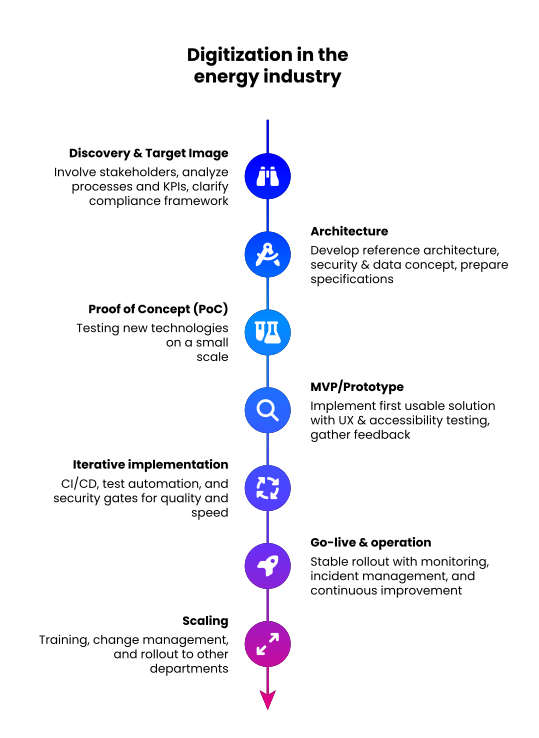
In the energy sector, new software is very rarely introduced into a blank slate; instead, it is integrated into established systems, ongoing operations, and strict regulatory frameworks. Our approach is designed precisely for this: We clarify compliance frameworks and architecture early on, test new solutions on a small scale first, and then safely integrate them into operations.
Ready to take the first step?
As an ISO 27001-certified IT service provider with over 35 years of software engineering experience, MaibornWolff has firsthand knowledge of the requirements of grid operators and energy utilities. We support you not only strategically but also in the practical implementation: vendor-neutral, security-oriented, and with a clear focus on measurable results. Together, we develop software solutions for the energy industry that make your processes more secure, efficient, and future-proof.
FAQ: Frequently Asked Questions About Software in the Energy Industry
Why is off-the-shelf software often insufficient for energy providers?
Energy suppliers, municipal utilities, and grid operators have very specific processes: from market communication and balancing group management to their market roles as suppliers, grid operators, or metering point operators. Standard software usually only partially supports these processes. Added to this is the existing infrastructure: core processes often run on outdated ERP systems that hinder the implementation of new applications. Custom software solutions, on the other hand, can be tailored precisely to a company’s specific system landscape, market role, and organizational structure.
Which processes in the energy industry can be effectively modeled using software?
Typical examples of software applications in the energy industry include:
- Customer service processes (moving, start/end of service, meter reading, rate plan changes)
- Billing and Meter-to-Cash
- Energy data management
- Redispatch 2.0
- Load forecasting
- Asset and Maintenance Management
- Field Service Apps
- Safety Training
- Dashboards and reporting for consumption and generation data, and much more
Which modules are appropriate depends on your market role and existing system landscape.
What regulatory requirements must software in the energy sector meet?
Depending on the specific application, relevant regulations include, among others, the Energy Industry Act (EnWG) (including Section 14a on controllable consumption devices), the Metering Point Operations Act (MsbG), Redispatch 2.0, the EEG, and BSI guidelines such as TR-03109 for smart meter gateways. For every project, we assess early on which requirements are relevant and develop a solution that is KRITIS-secure, BSI-compliant, and future-proof.
How does the replacement of a legacy system work in practice?
We rarely replace everything at once. It often makes more sense to modernize monolithic legacy systems in stages while ensuring that operations continue to run smoothly. We use interfaces to connect ERP, CRM, billing systems, IoT devices, and new modules into a consistent, integrated system. This allows us to avoid data silos and manual duplication of effort without jeopardizing ongoing operations.
How much does custom software for energy providers cost?
It's hard to say in general terms. The price depends on several factors: the scope of the project, the complexity of your processes, the chosen development model, the team composition, and the technology stack used. We’d be happy to provide you with an initial estimate after an initial consultation—and a reliable estimate once your specific requirements are on the table.