Data Engineering Services
Your Foundation for Reliable Data, Analytics, and AI
Before AI can deliver results, the data has to be right
AI and analytics projects stand or fall on the quality of the data. When numbers contradict each other, platforms remain half-empty, and pipelines run without testing, even the best model won’t help.
We lay the foundation: integrated, quality-assured data that’s reliably available —operated in production rather than as a proof of concept gathering dust in a drawer.
Less Technology. Better Business.
Engineering That Makes a Difference in Production
Full-scale implementation instead of a pilot project
About 70% of our projects result in a fully operational platform—with tested code and senior engineers on board from day one.
Architecture Without the Clutter
Our Medallion Reference Architecture supports the use case with 20–30% fewer components—it’s lean, maintainable, and free of over-engineering.
Manufacturer depth without commitment
Certified on Snowflake, Databricks, Microsoft, and AWS, but with no commission—we recommend what your use case needs, never what’s best for our bottom line.
Costs from the very beginning
We incorporate FinOps from day one: tagging, right-sizing, and alerts typically reduce your cloud costs by 20–40% compared to standard practices.
Even during the MVP's testing phase, it became clear that our dashboard was providing significant added value for our sales team.
Data Engineering Services: The Foundation of Analytics and AI
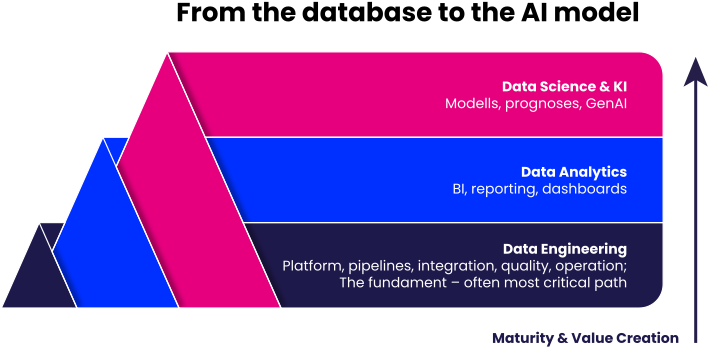
Data engineering services encompass the expertise and infrastructure that ensure your data is reliably available, integrated, quality-assured, and usable —including platforms, pipelines, modeling, and operations. They form the foundation upon which analytics and AI can be built in the first place, and are therefore almost always the critical path. As a data engineering consulting firm, we combine strategy, architecture, and tool selection.
Within Data Engineering Services, we focus on the data foundation—the bedrock. Our sister teams in Data Science, AI, Analytics, and Governance Consulting handle the models built on top of it, BI reporting, and comprehensive governance programs, so you get everything from a single source. There’s only one thing we deliberately avoid: pure tool licensing and reselling—this ensures our recommendations remain unbiased.
Data Engineering, Analytics, or Data Science—Which Comes First?
If your data isn't flowing reliably, data engineering is the first step. If the data is there but no one understands it, data analytics takes over. If you have data and reporting but are missing only the predictions, data science comes into play. In practice, these three often run in parallel —the data foundation remains the critical path.
DWH Consulting, DWH Services, and Data Integration—three specialized services
Three terms that are often used interchangeably actually have different meanings:
- Data Warehouse Consulting: the conceptual side—modeling and architecture.
- Data Warehouse Services: the implementation side—setup and operation.
- Data Integration Services: the specific task of connecting source systems and consolidating data.
Whether ETL or ELT, data lake or lakehouse, data mesh or streaming—we classify these terms as needed. ELT dominates in modern cloud and lakehouse architectures, while ETL remains relevant in regulated or legacy scenarios.
Here's How We Build Your Data Platform
A data platform is not an off-the-shelf product. We build it using carefully coordinated components —from the initial assessment to ongoing operations—and deliberately choose the simplest architecture that meets the need.
Six interlocking building blocks
We deliver production-ready, scalable platforms rather than isolated proof-of-concepts. These six building blocks are interconnected:
-
Strategy & Assessment: Maturity Level, Target State, Prioritized Roadmap with Business Case.
-
Architecture & Design: Target architecture based on Lakehouse, data warehouse, or streaming; data model and security concept.
-
Platform Architecture: Cloud-native, with Infrastructure as Code, CI/CD, a data catalog, and observability.
-
Pipeline Development & Integration: heterogeneous sources, batch and streaming, with built-in quality checks.
-
Migration & Modernization: Moving a Legacy Data Warehouse to a Cloud Lakehouse—Low-Risk and in Phases.
-
Operations & Optimization: Run, SRE Mindset, FinOps, and Performance Tuning.
In our day-to-day work, we use Azure and AWS, Snowflake, Databricks, and Microsoft Fabric, Airflow and dbt, Kafka and Flink—the choice depends on your use case.
DWH Modernization: Replacing Legacy Systems Without a "Big Bang"
We’re phasing out Oracle, Teradata, and SAS in favor of cloud lakehouses—Snowflake, Databricks, or Fabric. Instead of a risky “big bang” approach, we’re using the Strangler Fig pattern with parallel operation: the old and new systems run side by side for a while, reconciliation tests ensure data consistency, and the cutover takes place step by step.
Data Integration: Reliably Connecting Heterogeneous Sources
SAP via OData, CDC, and BW extraction, plus Salesforce, ServiceNow, IoT telemetry, and legacy databases: Our Data Integration Services connect what belongs together. Our approach is always consistently robust—source profiling, a “CDC-first” approach wherever possible, binding schema contracts, and a quality gate before data flows to the destination.
When Building a New Home Is Worth It—and When It Isn't
Most projects start from one of four scenarios. AI or GenAI is planned, but the data isn’t ready—it lacks quality, integration, or a governed platform. A legacy data warehouse like Oracle, Teradata, or SAS is expensive, slow, and at the end of its lifecycle.
Data silos produce conflicting figures, and reporting loses credibility. Or a cloud migration is hampered by growing data volumes and increasing regulatory requirements—DORA, NIS2, and the EU AI Act are ramping up the pressure for traceability.
-
Building a new system is worthwhile if your current system is demonstrably at its limit, if several demanding use cases are on the horizon, or if data volumes are growing significantly.
-
We advise against this if the actual problem lies in data quality, ownership, or modeling; if only a single report is affected; or if, ultimately, you are simply looking for a new tool.
In the second case, it is often sufficient to optimize the existing system, set up a targeted data mart, or gradually modernize individual domains.
From the CDO to Executive Management
The decision to adopt a data platform usually involves several stakeholders—each with different priorities. We address each one with the argument that matters most to them:
Faster, more reliable data for analytics and AI, as measured by time-to-insight.
Stability and manageable costs through an SRE mindset, automation, and FinOps.
Finally, reliable data and self-service—no more waiting on hold with IT.
Investment security through a clear business case, ROI, and cost of delay.
Four industries in which we excel
Through our own projects, we are familiar with the recurring data challenges and regulatory considerations in each of these industries. This saves time in the planning phase because your platform is built on proven models, and industry-specific requirements are factored in from the very beginning.
Energy Industry & Utilities
Smart meter data, market communication, and time series processing on KRITIS-compliant platforms—with the rollout under the MsbG, these will become massive time series that place high demands on performance and governance.
Typical use cases: feed-in and load forecasts for solar and wind, grid utilization analyses, and asset monitoring. The higher the share of volatile generation, the more forecast accuracy and grid stability depend on reliable real-time data.
Manufacturing & Industry
MES, shop floor, and sensor data; OT/IT integration via OPC UA and MQTT; plus streaming and edge connectivity.
This gives rise to specific use cases: predictive maintenance, OEE and scrap analyses, track & trace, and the digital twin of a plant. The true added value comes from combining years of machine history with real-time data streams—the foundation for reliable predictions rather than isolated dashboards.
Insurance
Claims and contract data models, actuarial data flows, and BCBS 239- and DORA-relevant data lineage—with IFRS 17 and Solvency II, the demands on data volume and quality are increasing even further.
This gives rise to use cases such as fraud detection in claims, underwriting and pricing analytics, and reliable reserve data. Because this data has historically been stored in separate systems, its clean integration is a prerequisite for each of these analyses.
Automotive & Mobility
Telematics and connected vehicle data with high volume and streaming requirements, increasingly regulated by the EU Data Act and the GDPR. These data are used for fleet management, the analysis of driving and ADAS data in development, and for Mobility-as-a-Service. As the fleet grows, the architecture determines whether telemetry data can continue to be analyzed in real time or whether it becomes overwhelmed by the sheer volume of data.
During the free initial consultation, we’ll clarify your priorities—with no obligation and in concrete terms.
Four Phases to a Productive Platform
We develop data platforms iteratively and with a focus on risk management—without a “big bang” approach and with an eye toward measurable results. Four clearly defined phases take us from the initial consultation through the proof of value to stable, long-term operation.
Phase 1: Diagnosis & Target State
In one to two weeks, we’ll talk with your stakeholders, assess your resources, current state, and maturity level, and refine your vision. The result will be a prioritized roadmap with a business case and initial quick wins—a clear roadmap instead of a mountain of concepts.
Phase 2: Architecture & First Breakthrough
During the architecture design phase (three to four weeks), we define the target architecture, tool selection, data model, and security and FinOps concepts. The PoC then runs an end-to-end process—including tests and a catalog—with the first run typically completed in four to six weeks.
Phase 3: Development & Integration
Over a period of three to nine months, we scale up to include additional sources and domains and migrate legacy systems in phases. Depending on the project, we work on a fixed-price basis, on a time-and-materials basis, with a dedicated team, or—most commonly—with a hybrid team, supplemented by south-shoring with senior management oversight.
Phase 4: Operation & Optimization
After go-live and hypercare, we can take over day-to-day operations upon request: Run, SRE mindset, FinOps, and tuning—either as a managed service or as part of the customer’s team. We are guided by hard KPIs—time-to-insight, pipeline reliability, data quality, cloud costs, and ROI.
For one insurer , the time-to-insight dropped from 11 to 2 days, reliability rose from about 90% to over 99%, and cloud costs fell by about 35%—even as data volume doubled.
Platforms currently in production
Our data platforms are integral to our customers’ day-to-day operations—across a wide range of industries, from the public sector to the energy industry and insurance.
-
About the ifm ReferenceGlobal Supplier Evaluation with Azure AIAI & MLCloudIndustry 4.0About the ifm ReferenceStreamline global supplier evaluation in procurement instead of relying on individual search strategies that require a lot of manual work
About the ifm ReferenceA chat-based AI assistant built on Azure OpenAI and AI Search that aggregates ERP data, website information, and internal reviews
About the ifm ReferenceMVP up and running in 11 weeks; new employees can get started without a lengthy onboarding process; Azure AI Platform as the foundation for additional use cases
-
To the WIRKSTATT referenceWIRKSTATT: Business Intelligence for the sales forceCloudData/Data PlatformsAppsTo the WIRKSTATT referenceAggregation of internal customer data & external data in a single web application
To the WIRKSTATT referenceData bundling & analysis with Amazon Bedrock
To the WIRKSTATT referenceIntuitive user interface for sales, 88% reduced preparation time before customer visits
-
To the MAN referenceMAN - ATLAS L4. Control Center for the autonomous truckCloudData/Data PlatformsAppsTo the MAN referenceControl center for the technical monitoring of driverless trucks
To the MAN referenceUX design, product strategy, data structure, vehicle data visualization
To the MAN referenceMonitoring, remote support, mission management, reports for commercial autonomous transport solutions
-
To the NOW referenceNOW: National Organization for Change in Mobility: development of a data warehouse systemCloudData/Data PlatformsIT Consulting & StrategyTo the NOW referenceData foundation for nationwide charging infrastructure in Germany
To the NOW referenceCloud data warehouse for integration & analysis of many diverse data sources (AWS)
To the NOW referenceSolid architecture, single point of truth ensures data-based evaluation of charging station demand
-
To the NETZSCH referenceNETZSCH: Development of an IoT platformCloudData/Data PlatformsIoTTo the NETZSCH referenceUnified IoT platform for 3 business units, harmonization of existing IoT solutions
To the NETZSCH referenceIoT device connectivity, visualization software for data analysis, cloud infrastructure, operations
To the NETZSCH referenceQuick testing in the cloud infrastructure, fast integration of use cases such as predictive maintenance, process optimizations, etc.
-
To the TÜV Nord referenceTÜV NORD: IT system for damage assessmentsData/Data PlatformsWeb & Portal PlatformsBanking/Insurance/FSITo the TÜV Nord referenceHolistic, flexible IT system to support expert assessors
To the TÜV Nord referenceDigitalization of the inspection & damage process from order creation to invoicing
To the TÜV Nord referenceMore efficient creation & billing of damage assessments & vehicle valuations, at least 2 days time savings
-
To the Health.exe referenceHealth.exe: AI-supported platform creates training plans for patientsCloudData/Data PlatformsAppsTo the Health.exe referenceAI-supported service for orthopedic & sports medicine practices
To the Health.exe referenceCloud-based web application for doctors for the automated, evidence-based creation of individually tailored patient training plans
To the Health.exe referenceNew revenue source without fixed costs, higher patient retention, AI-supported & guideline-based
-
See Siemens referenceSiemens: AI demand prediction platform for industrial production planningCloudData/Data PlatformsIndustry 4.0See Siemens referenceMachine learning for time series forecasting
See Siemens referenceAutoML for automated adaptation of models to different data
See Siemens referenceUnified, scalable solution, optimized inventory costs, efficiency gains
-
See VW referenceVW: Digitization of key production figures with the iProcess appData/Data PlatformsAppsIndustry 4.0See VW referenceReplacement of analog, error-prone activities with a digital app solution
See VW referenceDigital design, cloud-native technologies, UX concept, UI design, front- & backend
See VW referenceMore transparency in production processes, higher production OEE, across plants
-
See referenceApple Vision Pro for city plannersDigital Design/UX DesignData/Data PlatformsAppsSee referenceImmersive 3D visualization of complex energy data on the Apple Vision Pro
See referenceAugmented reality, spatial computing, 3D map with detailed data & KPIs
See referenceFoundation for intuitive understanding of energy scenarios & well-informed decisions
-
See referencePlanning systems: Optimizing the capacity utilization of pressing plantsData/Data PlatformsIndustry 4.0ManufacturingSee referenceCentralized planning of component manufacturing for cost- & resource-optimized production capacity worldwide
See referenceConversion from local processing with fat clients to a client-server application, migration to the cloud
See referenceData-based planning & calculation of different manufacturing scenarios & site-specific production costs
-
See referenceGlobal workforce planning systemCloudData/Data PlatformsPublic/AdministrationSee referenceCentralized web-based IT system to replace individual isolated solutions
See referenceEvent sourcing for planning & analytics, domain-driven design, cloud migration
See referenceEasy updates, expansion, maintenance, optimized security
-
See KUKA referenceKUKA: UI/UX design for an app for load data analysis for industrial robotsDigital Design/UX DesignData/Data PlatformsAppsSee KUKA referenceWeb app to replace legacy systems for easier interaction between users & system
See KUKA referenceConversion from local processing with fat clients to a client-server application & migration to the cloud
See KUKA referenceData-based planning & calculation of different manufacturing scenarios & site-specific production costs
-
See referenceA data platform for the Azure Cloud in the energy sectorCloudData/Data PlatformsIT Consulting & StrategySee referenceData-based information for planning & implementing the climate transition for the public sector & energy providers
See referenceScalable foundation data platform on MS Azure for migrating & automating differently formatted geo-data into a structured data schema
See referenceQuality-checked data, provision in the form of the target data model, robust, scalable database & infrastructure
-
To the FinOps referenceSupply chain management: Reducing cloud operating costs by 50 percent with FinOpsCloudData/Data PlatformsIT Consulting & StrategyTo the FinOps referenceReduction of costs caused by over-dimensioning & manual processes, establishment of transparency
To the FinOps referenceTargeted process modernization, automation & rightsizing
To the FinOps referenceAnnual cloud operating cost reduction: 400,000 EUR, scalability, reliability
In two weeks, you'll know where you stand
Before you invest, we provide clarity. Our Data Engineering Assessment delivers an assessment of your current state, a maturity level, and a prioritized roadmap—including a business case—in about two weeks, with minimal effort required from your team. You decide whether to use the results to guide implementation or to safeguard your existing systems.
We review the data landscape, sources, pain points, and existing platform.
Lakehouse, DWH, or streaming—the tool selection is made in a vendor-neutral manner based on an evaluation grid.
Quick Wins, Cutover Strategy, and the Next Steps—with or without subsequent implementation.
Let's talk about your data foundation
Without a reliable, integrated data foundation, analytics and AI won’t work—it’s almost always the critical path to any data-driven initiative. If you lay a solid foundation from the start, you won’t have to spend a fortune later on data quality and migration.
This is exactly where we come in: as engineers who deliver platforms designed for productive operations— vendor-neutral, with FinOps, and a proven migration playbook.
We'll get your database up to speed—let's talk about where you stand.
Frequently Asked Questions About Data Engineering Services
Snowflake or Databricks—which platform is right for us?
We decide this together using an evaluation grid rather than based on a preferred platform: dominant use cases, existing team skills, current cloud setup, data volume, latency, compliance, and cost patterns. We’re certified for both and aren’t tied to any commission—often, a combination of the two or Microsoft Fabric is the better solution.
How much does a data engineering project cost—and at what point does it pay off?
We’ll kick off with a business case in about two weeks. The cost of delay and unoptimized cloud costs are usually more expensive than the project itself; built-in FinOps typically reduces cloud costs by 20–40%. Depending on the project, billing is either a fixed-price package or a time-and-materials model.
Can't we set this up ourselves in-house?
You can—though doing it in-house usually takes twice as long. We provide proven templates and access to vendors, and hand over the platform fully configured so your team can continue managing it on its own.
How do you ensure data privacy and compliance in data pipelines?
We incorporate compliance as a gate in the pipeline, not as a downstream audit. This includes quality testing with dbt, Great Expectations, and Soda; a data catalog with automated lineage; access control models using RBAC and ABAC; tag-based masking and PII classification; as well as GDPR-compliant pseudonymization and data erasure strategies. We factor in the Data Act, NIS2, and the EU AI Act from the very beginning.
How does data engineering fit into our AI strategy?
AI is only as good as the data it’s based on. For GenAI today, even unstructured data—such as documents and texts—must be usable, classified, and tagged with lineage. That’s why we’re designing the platform from the ground up to handle both structured and unstructured data, ensuring the data readiness that models can rely on.