AR & VR App Development
Custom solutions for Extended Reality (XR).

AR & VR App Development: Immersive Applications for Real-World Business Cases
With a professional augmented reality or virtual reality app, you can bring complex content to life, accelerate learning processes, and create new forms of digital interaction. Whether for training, simulation, product visualization, or industrial applications: immersive apps help you convey information more clearly, map processes in a practical way, and actively engage users.
MaibornWolff brings extensive expertise in the development of AR, VR, and MR apps. We work with state-of-the-art devices, integrate technology and user experience from the very beginning, and develop applications that seamlessly integrate into your existing processes and systems. This results in extended reality interfaces that not only impress but also solve specific challenges in your daily work.
Why MaibornWolff Is the Right Partner for Your XR App Development
An AR or VR app that works technically is a good start. One that inspires your users, integrates seamlessly into your processes, and creates long-term value is the ultimate goal. MaibornWolff develops XR apps that meet these standards—with technical depth, creative flair, and the experience gained from challenging projects across a wide range of industries.
Our developers identify use cases with measurable benefits. We don’t offer off-the-shelf solutions; instead, we create custom AR/VR apps tailored to your specific needs.
We are not tied to any particular platform or framework. We choose the technology that best suits your use case, your IT environment, and your users.
We approach AR and VR app development, UX design, and system integration as an integrated whole from the very beginning. After all, an XR app can only reach its full potential when all its components work together seamlessly.
A well-designed and scalable architecture ensures that your AR/VR app remains expandable over the long term and that new features, devices, or use cases can be integrated more easily.
Experience, not just explain: Real-world XR projects
Immersive technologies are most effective when you see them in action. Get a sense of how we bring XR projects to life—and what the results are for our clients!
Our Services in XR App Development
Whether you're just getting started or already know what you want to develop, we'll support you exactly where you need us. Our range of services in MR, AR, and VR app development includes:
App Strategy & Technology Consulting
Do you see the potential of immersive technologies for your business but aren’t sure where to start? We’ll work with you to determine which XR app is best suited for your use case. In the process, we’ll clarify your goals, target audiences, platforms, devices, and technical requirements.
VR App Development
Our virtual reality app development is designed for companies that want to create immersive training experiences, simulations, product presentations, or collaborative work environments. Users of VR apps navigate fully digital scenarios and experience complex situations in a lifelike manner.
AR App Development
Augmented reality apps allow you to overlay real-world environments with digital information, 3D objects, or interactive instructions. This supports maintenance, service, sales, marketing, and training right where the application is used.
MR App Development
Mixed-reality apps seamlessly integrate real-world and digital elements. Digital objects can be spatially anchored, edited, and integrated into real-world work processes—such as assembly, planning, or remote support.
Digital Content Creation & 3D Production
XR applications stand or fall on the quality of their content. We produce 2D and 3D content specifically for use in real-time applications. Whether it’s interactive 3D objects, animations, or AI-generated content: We ensure that your XR app not only works but also looks great.
Architecture, Integration & Scalability
We develop your XR app using a technical foundation that remains reliable, maintainable, and scalable. We take existing systems, data sources, and platforms into account from the very beginning.
Quality, Safety & Continuous Improvement
Through testing, robust development processes, and security by design, we create a stable application ready for production use. Even after launch, your app can continue to be developed and adapted to meet new requirements.
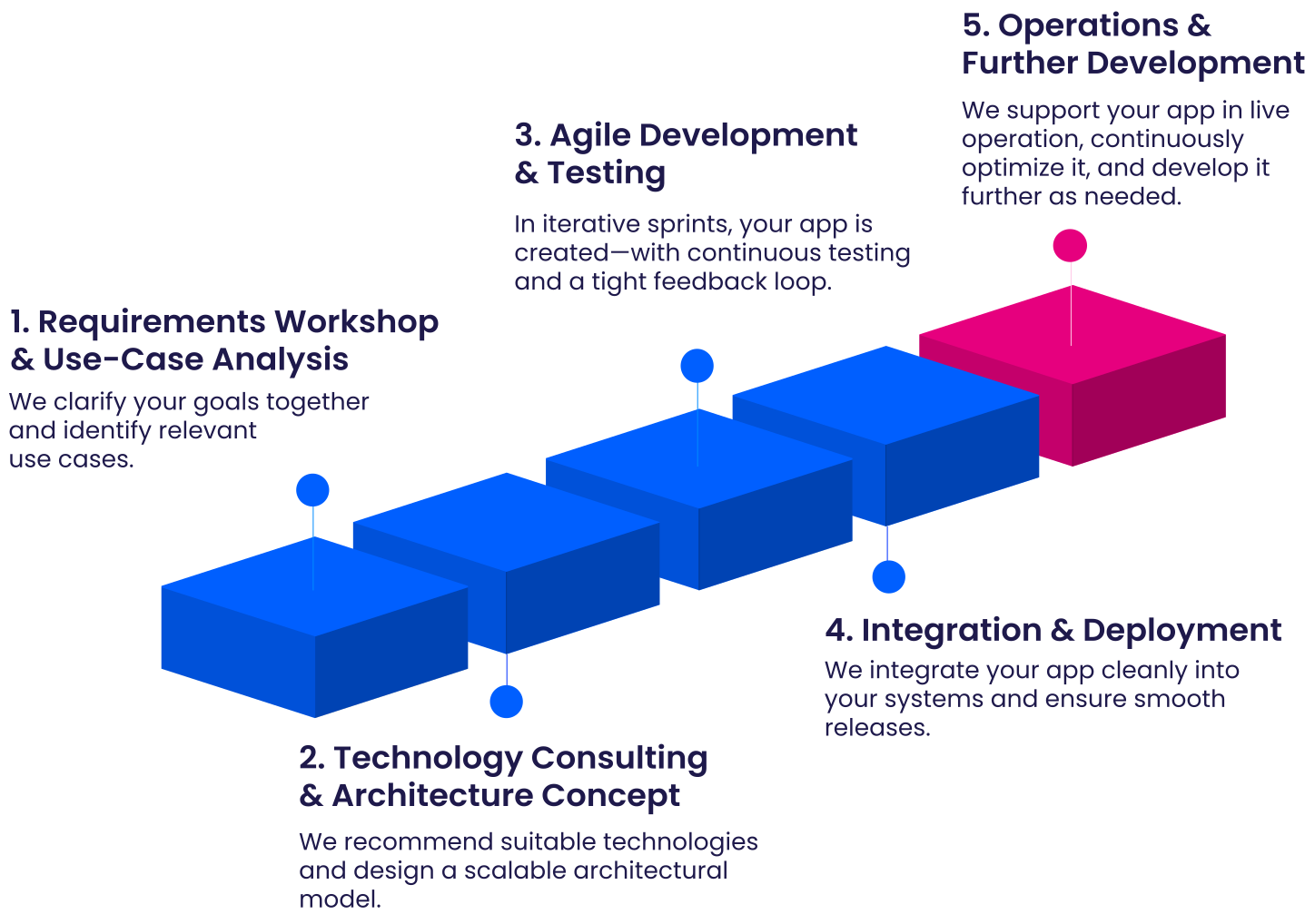
Developing a VR or AR App: 5 Steps to a Ready-to-Use Solution
Every AR and VR app is different. But the approach that gets the job done often isn’t. We rely on a proven development process that adapts flexibly to your needs and actively involves you at every stage.
Our tech stack for your immersive app project
Whether it’s MR, VR, or AR app development: We take a technology-agnostic approach and use the tools that best align with your vision and goals. These include, among others:
- Real-time engines: Unreal, Unity, Godot
- WebXR: PlayCanvas
- Digital content creation: Blender, Maya, MotionBuilder
- AI-Generated Content: Veo3, Seadance 2.0
- Programming languages: C++, C#, Python
- Cloud: AWS, Azure
Benefit from our extensive technical expertise in software development, app engineering, and UX/UI design.
Our References & Projects in the Field of Virtual and Augmented Reality
From an MR knee training simulator to a virtual experience of the vehicle design process: Our VR and AR projects are as diverse as the companies we develop them for. What they have in common is that they are created in close collaboration with the people who use them and the processes in which they are embedded. See for yourself!
-
To the Mixed Reality referenceUniversity Medicine Frankfurt - Mixed reality for the training of doctorsDigital Design/UX DesignAppsEmbedded Systems & RoboticsTo the Mixed Reality referenceKnee training simulator for technology-supported medical education
To the Mixed Reality referenceMixed reality application combined with a haptic knee model, interactive training environment
To the Mixed Reality referenceDiagnostics on the human knee without simulated patients, simulation of various pathologies, real-time visualization of motion sequences
-
See digikoo referencedigikoo GmbH: Apple Vision Pro for city plannersDigital Design/UX DesignData/Data PlatformsAppsSee digikoo referenceImmersive 3D visualization of complex energy data on the Apple Vision Pro
See digikoo referenceAugmented reality, spatial computing, 3D map with detailed data & KPIs
See digikoo referenceFoundation for intuitive understanding of energy scenarios & well-informed decisions
-
See BMW referenceMixed reality: driving a real car in a virtual worldDigital Design/UX DesignAppsEmbedded Systems & RoboticsSee BMW referenceExperience a futuristic outdoor environment in the headset while inside a real vehicle interior
See BMW referenceReal-time 3D application, Unreal development, XR technology, game design, smart devices
See BMW referenceHigh-performance processing of vehicle signals for precise motion mapping for an immersive driving experience without motion sickness
-
See BMW Group referenceBMW Group: Virtual reality brings vehicle design to lifeDigital Design/UX DesignAppsVR/ARSee BMW Group referenceUnified platform for AR, VR & 3D real-time use cases: from planning to manufacturing
See BMW Group referenceDesign & virtual product experience, plugin-based process support
See BMW Group referenceVehicle experience already at an early stage, location-independent, cross-functional collaboration on the virtual model, savings on hardware prototypes
Applications of XR Apps: Where AR, VR, and MR Deliver Real Value
Many people are familiar with virtual or augmented reality primarily from the world of gaming. But XR technologies offer much more than just entertainment: they make complex content easy to understand, bring products to life, and make processes tangible. Depending on the industry, AR, VR, and MR apps help convey knowledge in a practical way, make processes safer, and improve decision-making.
Industry & Manufacturing
In industry and manufacturing, XR apps help make complex equipment, machines, and work processes easier to understand. Employees can practice procedures virtually before working on real systems. AR applications provide support directly at the machine with step-by-step instructions or on-screen information.
Automotive
XR apps support the automotive industry across the entire value chain: from virtual vehicle presentations in sales to AR-assisted repairs in the workshop. Vehicles, components, and processes can be interactively displayed, tested, and explained. This makes product presentations more vivid, training more practical, and service processes more efficient.
Medicine & Healthcare
In the healthcare sector, XR apps can convey knowledge in a clear and engaging way and make practical training safer. Medical procedures, anatomy, and treatment scenarios can be simulated realistically without putting patients at risk.
Construction, Architecture & Real Estate
XR apps allow users to experience planned buildings, rooms, and technical details at an early stage. Through virtual tours of spaces and buildings, developers, design teams, investors, and buyers can get a realistic sense of the properties and better assess their proportions, materials, and spatial effects.
Retail, Marketing & Sales
For sales and marketing, AR and VR apps create interactive product experiences. For example, customers can use AR to place a piece of furniture in their own home or view a machine as a 3D model from every angle. In VR, digital showrooms, trade show experiences, or product worlds can be created that function independently of location and space.
Education, Training & Onboarding
XR apps are particularly well-suited for learning and training situations where real-world relevance is crucial. New employees can familiarize themselves with machines, workflows, or safety rules in a virtual environment before being deployed in actual operations. In VR training, critical situations or customer interactions can be simulated realistically and repeated as often as needed—without risk, without downtime, and regardless of available equipment or trainers.
Even complex content becomes easier to understand through interactive 3D visualizations and is better retained in memory. This creates learning environments that not only impart knowledge but also bring it to life.
Do you have a vision for an AR or VR app? We'll make it ready for use
Some content is difficult to explain effectively through slides, videos, or traditional apps. It needs to be experienced, tried out, or understood in a spatial context. This is exactly where XR apps come in: they make training more realistic, products more tangible, and processes easier to understand.
MaibornWolff develops custom applications instead of off-the-shelf solutions. To do this, we combine expertise in mobile engineering, UX, software architecture, and system integration with experience in immersive technologies. Together, we refine your idea, explore practical use cases, and develop an app that runs smoothly, is intuitive to use, and can scale with your needs.
FAQ: Frequently Asked Questions About VR App Development and AR App Development
What is the difference between XR, VR, AR, and MR?
Extended Reality (XR) is the umbrella term for all immersive technologies that bridge the digital and physical worlds. These include, in particular, virtual reality, augmented reality, and mixed reality.
- VR (Virtual Reality) fully immerses users in a digital environment. The real world is blocked out, typically via a VR headset.
- AR (Augmented Reality) supplements the real world with digital content such as 3D objects, information, or instructions—visible via a smartphone, tablet, or AR glasses.
- MR (Mixed Reality) takes it a step further: Digital objects are spatially anchored in the real environment and can interact with it.
The key difference lies in the degree of immersion and interaction with the real world. We’ll work with you to determine which technology makes the most sense for your specific use case.
For which companies and industries is AR or VR app development worthwhile?
AR and VR apps can be used across a wide range of industries and are particularly useful in situations where complex concepts need to be explained, dangerous scenarios need to be simulated, or spatial relationships need to be made tangible. Typical applications can be found in manufacturing, the automotive industry, healthcare, architecture, as well as in retail and marketing.
What hardware is required for XR apps?
That depends on the use case. VR apps typically run on VR headsets such as the Meta Quest or HTC Vive. In industrial settings, high-resolution devices like the Varjo XR-3 and XR-4 are widely used. Mixed reality headsets like the Apple Vision Pro are also becoming increasingly important for businesses.
Depending on your requirements, AR apps can be run on smartphones, tablets, or specialized AR glasses like the Microsoft HoloLens.
We provide technology-neutral advice and recommend the hardware that best fits your use case and budget. Do you already have a device in use and are looking for the right application? We’re happy to help with that, too!
How long does it take to develop an AR or VR app?
The amount of time required to develop a VR or AR app depends on the scope and complexity of the project. An initial prototype can often be developed within a few weeks. However, for a production-ready application, sufficient time should be allocated for concept development, UX, 3D design, development, testing, integration, and optimization. During an initial consultation, we’ll provide you with a realistic estimate for your specific project.
What types of training scenarios are XR apps suitable for?
XR apps are particularly well-suited for training scenarios where hands-on experience, spatial awareness, or realistic workflows are important. These include, for example, machine training, safety and emergency training, medical simulations, onboarding programs, or soft skills training such as customer interactions.
The major advantage: Employees can practice complex scenarios in a controlled digital environment without causing real-world risks, downtime, or high material costs.