
Data Strategy Consulting
From Business Objective to Prioritized Data Roadmap













What "Data Strategy Consulting" Means at MaibornWolff
Many companies have a data strategy, but only on paper. In practice, it almost always lacks the same three things: an operating model, designated responsible parties, and measurable goals. That’s exactly where it gets stuck.
At MaibornWolff, Data Strategy Consulting means deriving from your business goals exactly which data, architectures, roles, and investments you’ll need over the next 18 to 36 months—and describing them in a way that allows implementation to begin immediately.
As an independent consulting and engineering firm with over 35 years of engineering experience, we deliver more than just a vision: We think it through all the way to the architecture and domain boundaries. Strategy and implementation come from a single source.
Less Technology. Better Business.
Four Reasons to Choose Our Data Strategy Consulting Services
Consulting Meets Implementation
The engineers who will later build the system are involved in developing the strategy from the very beginning. Experience has shown that about seven out of ten strategy projects at our company move directly into implementation—without changing suppliers and without any disconnect between plan and practice.
"Senior" Instead of "Pyramid"
We have senior professionals with real hands-on experience working on your project from the very beginning—not just during the pitch. Instead of a traditional consulting hierarchy made up of junior staff, your strategy is developed by experts who understand the subject matter from their own projects.
Tool Selection with No Commission
We are certified by Snowflake, Databricks, Microsoft, and AWS, but we are not bound by any commission agreements. This ensures our recommendations remain unbiased: You’ll get the architecture that supports your project, not the one with the highest vendor margin.
In-depth industry coverage included
Our focus is on finance, manufacturing, automotive, insurance, energy, e-commerce, the public sector, and pharmaceuticals, with a team of senior professionals from these very sectors. This means we speak your technical and regulatory language—rather than having to learn it from scratch once the project begins.

The workshop helped us tie up a lot of loose ends and showed us which areas require our special attention.
When a Data Strategy Becomes Important
Most projects don't start with a textbook approach, but rather out of a specific need. If you recognize any of these situations, it's worth having a conversation:
-
An AI or BI program has failed and is under pressure to explain itself.
-
Compliance or an audit is required, for example, under the EU AI Act, DORA, NIS2, or BaFin.
-
New leadership in the data or IT department has been tasked with finally turning data into value.
-
A cloud migration is underway, but it lacks a sound data strategy to support it.
-
Two data environments are to be integrated, for example, following an acquisition.
In everyday practice, these services are often conflated. However, they address different aspects, and each answers its own key question:
- Data Strategy serves as the overarching framework: Which of these services do you need, when, in what order, and with what level of investment?
- Data Analytics: How can I get a better view of my numbers? In other words, reporting, self-service, and dashboards.
- Data Science: What predictions do I need? That is, forecasting, segmentation, and optimization.
- Data Mesh: How do I distribute data responsibility across business domains?
- Data Products: What should ultimately be usable in practice? That is, the defined, reusable data unit that a business domain provides as a fully-fledged product for the entire company.
Here’s how the five interconnect: Data Products are the goal—the WHAT that should ultimately be produced. The Data Strategy defines the HOW to get there. Data Mesh clarifies who bears responsibility within the business domains, and Analytics and Data Science rely on the finished data products.
What Our Data Management Consulting Services Include
We build your data strategy using coordinated building blocks, from maturity assessment to a 90-day plan. For an enterprise data strategy spanning multiple business domains and locations, these same building blocks scale accordingly. They are included in every project:
-
Maturity Analysis: An assessment across eight dimensions as the starting point for the roadmap.
-
Target Vision and Business Alignment: The data goal derived from your business objectives.
-
Architecture Blueprint: the architectural framework without which a strategy remains non-binding. This is where our Data Architecture Consulting comes in.
-
Roadmap and 90-day plan: prioritized by value and effort, with designated responsible parties and goals.
-
An Overview of the Governance Framework: Roles and Responsibilities as a Starting Point.
And these are added depending on the project:
-
Data Culture and Enablement: optional, highly recommended for larger programs.
-
FinOps strategy: optional if cloud and data costs are already a burden.
During day-to-day operations, these roles translate into specific controls, data catalogs, and approval processes. We implement these as part of our data governance consulting services and keep them up to date on an ongoing basis.
Here's how a project works at our company
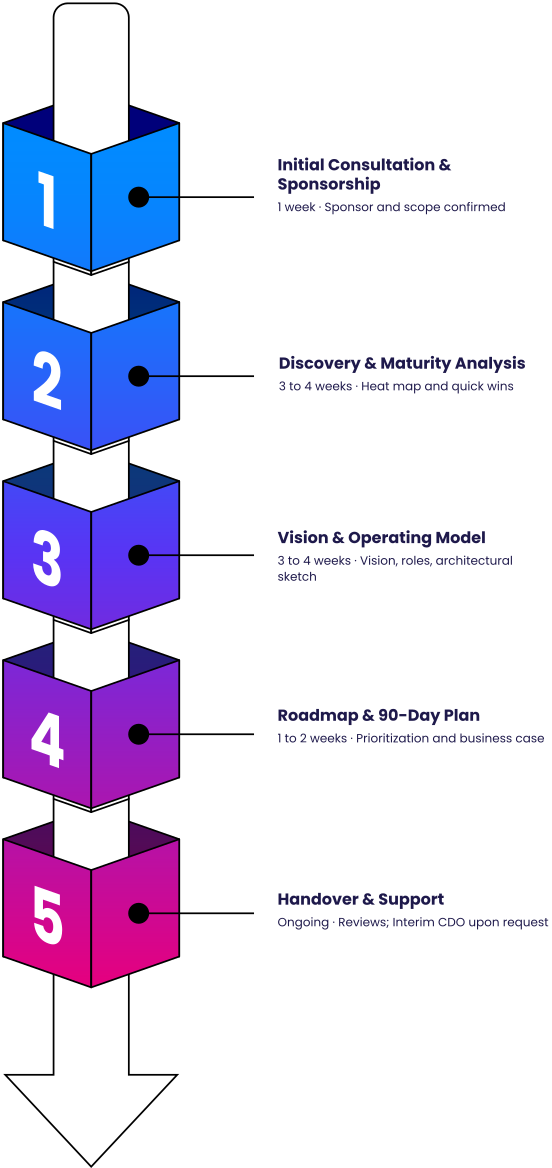
A project typically gets underway within two to three weeks and follows five clearly defined phases. The result is a 90-day plan that identifies responsible parties, sets goals, and secures leadership commitment.
Five Phases, One Common Thread
The sponsor, scope, and stakeholder map have been finalized.
Heat map, vulnerabilities, and quick-win options prioritized by value and effort.
Vision statement as a one-pager, architectural sketch, roles.
Prioritization, Business Case, and Objectives.
Owner mapping, quarterly reviews, and an interim CDO upon request.
Four Approaches, from Testing to a Full Strategy
These four are standalone entry points, not sequential steps: The Quick Scan and Maturity Analysis cover the same discovery and maturity phase as the full project—one as a streamlined health check, the other as a comprehensive assessment—but as a complete package. The Full Data Strategy encompasses all five phases.
A specific recommendation for the next steps.
A health check of an existing strategy, involving fewer interviews and a smaller sample size. The results include a heat map, five to seven recommendations, and a 90-day roadmap.
A comprehensive assessment covering all eight dimensions, including 20 to 25 interviews and a draft roadmap.
Target Vision, Operating Model, Architecture, Roadmap, and 90-Day Plan.
Architectural Approach and AI Readiness as a Strategic Decision
A strategy without architectural decisions will remain non-binding in 2026. That is why we integrate Data Architecture Consulting directly into the strategy: as a strategic decision, not as an operational issue. This includes determining whether a centralized model or data products per domain are appropriate, and what level of AI readiness the target state requires—ranging from unstructured data to AI governance.
A strategy only takes effect once it is embedded in operations. In our data governance consulting, we establish the roles, responsibilities, and controls necessary to achieve this.
A little preparation makes it easier to get started later on, and you won't waste any time:
- Assign names to the most important data objects, including the system, domain, and person in charge.
- Assign a specific data owner for each important domain.
- Formulate a quick-win use case with a goal: “In 90 days, we want to measure X using Y.”
This lays the foundation. We’ll then work with you to handle the actual work—from the maturity level to the operating model to the architecture.
Turning Data into Value: Using a Plan Instead of Gut Feelings
A data strategy is a directed investment decision. Those who understand their maturity level, tackle the quick wins first, and align every measure with a specific goal will extract value from their data instead of just buying the next tool. The fact that focusing on impact rather than technology pays off is also the focus of our 2026 Technology Efficiency Study.
This is exactly where we come in: vendor-neutral, with senior-level professionals on the project, and a 90-day plan that’s ready to go from day one.
During a free initial consultation, we'll give you our honest opinion on whether a data strategy is worth it.
Frequently Asked Questions About Data Strategy Consulting
When it comes to data strategy consulting, does MaibornWolff handle the implementation as well, or just the design of the data strategy?
At Data Strategy Consulting, MaibornWolff handles both the design and implementation under one roof. Our engineers are involved in shaping the strategy from the very beginning—and they’re the ones who will later build it. After handover, we continue to support the implementation upon request, providing our own implementation roadmaps, an interim CDO for three to nine months, and quarterly reviews.
What methodology does MaibornWolff use to develop a data strategy?
MaibornWolff develops a data strategy based on established standards and its own approach: DAMA-DMBOK 2 as the technical foundation, DCAM in the financial sector, and ISO/IEC 38505 as a governance reference. Our Data Strategy Framework is built upon this in five phases (Discover, Assess, Design, Plan, Anchor). It scales across multiple domains and locations as an Enterprise Data Strategy.
How does data strategy consulting fit into an existing AI and cloud roadmap?
Data strategy consulting is essential for AI and the cloud to succeed. We factor in AI readiness from the very beginning: unstructured data as separate data sets, the appropriate vector architecture, and AI governance—including clearly defined data rights. A dedicated consulting team from MaibornWolff manages the AI projects themselves; we provide the underlying data foundation.
Is it worth hiring a data strategy consultant if a data strategy already exists?
Yes, data strategy consulting is often worthwhile even if you already have a strategy in place. Bring your existing data strategy with you: In a brief health check, we’ll review your operating model, the specificity of your roadmap, and how well your goals are anchored. Experience shows that these three elements are most often missing when a strategy exists but isn’t making progress.
How much does data strategy consulting cost?
The cost of data strategy consulting varies depending on the depth and scope of the project. The Quick Scan, offered at a fixed price, serves as a low-threshold entry point, followed by a maturity analysis and a comprehensive strategy. Before any major investment is made, a business case is developed that weighs the benefits against the costs of inaction.
How does MaibornWolff handle your company data during the project?
MaibornWolff handles your company data confidentially and in a data-minimalist manner. Our analyses are primarily based on interviews and document reviews; we collect data samples only when necessary and in accordance with clearly agreed-upon rules. Classification, access controls, and a data retention policy are integral parts of every data management consulting project we undertake. For us, data protection is an obligation, not an option.