
Customer portal development
Digital Experience Platforms, Securely Integrated and Personalized









A customer portal that delivers in everyday use
A robust customer portal proves its worth in everyday use. Your customers can navigate it immediately, handle their requests on their own, and are happy to return.
That’s exactly how we develop customer portals—as a Digital Experience Platform that consolidates all channels into a single platform, rather than as yet another siloed solution alongside your existing systems. We start by putting the end users first, long before the first line of code is written. Their needs determine the structure, features, and technology.
Less Technology. Better Business.
Your Benefits as a MaibornWolff Portal Partner
A Holistic Approach All the Way Through to Operation
From user guidance to development to day-to-day operations, everything comes from a single source—instead of many separate interfaces.
Proven Knowledge
Our experience from numerous portal projects goes into your solution: built to your specific needs and vendor-neutral, rather than trying to force off-the-shelf tools to fit your requirements.
GDPR-Compliant AI
Personalization and AI features run on a segregated infrastructure that complies with the GDPR, without using customer data for training.
Enterprise-proven
Over 35 years of corporate experience and a certified security stack comprising ISO 9001, ISO 27001, and TISAX for security-critical portals.

Our new baby is here! It was a roller-coaster ride filled with sweat and blood. With this launch, we’ve created a scalable and future-proof e-commerce platform. After a phase of stabilization and iterative refinement, we’ll use it to continue our growth trajectory next year. A milestone!
Why Many Customer Portals Fail in Practice
A customer portal is the central, secure access point through which your customers can manage their personal data, transactions, and service requests on their own. In practice, we see four recurring areas for improvement in portals that are already in use:
-
Legacy portals at their limit: difficult to scale, expensive to maintain, or no longer up to date with modern security and compliance requirements.
-
Fragmented Customer Journeys: There are multiple paths to a single goal, and these paths are inconsistent or cut off halfway through.
-
Generic, one-size-fits-all content: All customers see the same thing and don't feel that it speaks to them.
-
Untapped AI Potential: Data is stored in silos, and without a comprehensive AI strategy, its potential remains technically present but untapped.
Self-service and personalization build customer loyalty
Features only retain customers if they offer tangible added value. That’s why we focus on a “Minimal Lovable Product”—a streamlined portal that provides value early on—rather than a minimal product that barely works.

Self-Service: What Your Customers Can Do Themselves
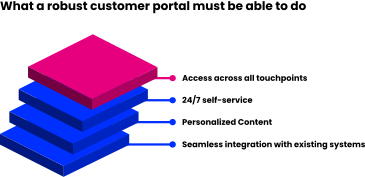
With self-service, customers can manage their own issues without having to go through your support team: they can update their personal information and address, view invoices and contracts, submit inquiries, schedule appointments, or place orders.
Each of these features reduces the workload on your service team and gives customers control around the clock. Many users will look for an answer on the portal first when they have a question, before picking up the phone—and this is exactly where a well-designed self-service portal comes in.
Meaningful AI Personalization
One-size-fits-all content doesn’t truly reach anyone. We tailor content to you —all the way to hyper-personalization using AI. An insurance portal can thus suggest the right coverage based on context—such as accident insurance for a ski vacation you’ve already planned.
To achieve this, we set up a dedicated, isolated AI infrastructure for your portal that follows the principle of our Trusted Zone. The AI models run in an isolated environment; your customer data never leaves this protected environment and is not used for training. The result is AI that delivers real value, rather than just another run-of-the-mill chatbot.

One codebase, all touchpoints: Architecture and Integration
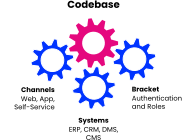
A portal will only feel like a cohesive whole to your customers if everything works together seamlessly behind the scenes. Our core principle is a shared codebase across the web and app, rather than separately maintained systems—consistent and easy to maintain. We integrate existing and new systems such as ERP, CRM, DMS, and CMS into a seamless portal, complete with authentication and a role-based model for differentiated access.
This shared codebase is our recommended approach—but if you need a separate native app, we’ll develop that for you as well.
-
Mobile first: The portal is just as easy to use on a smartphone as it is on a desktop, with the same features.
-
Security with a sense of proportion: We protect what matters, to the extent necessary.
-
Data protection from an architectural perspective: We incorporate GDPR compliance into the structure; hosting in Germany or the EU is possible.
-
Accessibility: As of June 28, 2025, the Accessibility Enhancement Act requires many customer portals to be accessible. We systematically bring portals up to the required standard—quickly and in a predictable manner.
B2B Portals, Self-Service, and Typical Applications
Customer portals serve a wide variety of purposes. We encounter three areas of application particularly often:
Spare parts and ordering processes, product configurators, and differentiated roles and pricing for business customers. Here, a well-designed B2B portal directly contributes to efficiency.
Accounts, contracts, support, and bookings for end customers: traditional customer portal development focused on reducing the customer’s workload and fostering loyalty.
Personalized offers in the insurance sector, AI-powered planning in travel and tourism, and portals for industry, energy, and retail.
Here's How We Develop Your Customer Portal
Before we begin development, we work with you to determine your needs. We have our own workshop formats designed for this purpose. Whether it’s a new build or a replacement for an existing portal, we work in phases rather than all at once.
New Development: From Concept to a Fully Functional Portal
Once a solution has been identified, we move on to UX and UI engineering using our own design library. Our senior architects establish the basic architecture and build a blueprint feature that serves as a guide for the team. The team then grows incrementally— allowing you to start small with a portal that already delivers value.
Replace the existing portal—without a "big bang"
We take over an existing portal through shadowing and reverse shadowing: a structured knowledge transfer rather than a clean break. Our architects analyze the codebase, architecture, and technical debt, and prioritize the most critical areas for improvement. Modernization is carried out iteratively, in clear steps rather than through a risky complete overhaul.

Custom software that goes beyond the portal, tailored precisely to your processes.

Modernize outdated systems with minimal risk and without a "big bang" approach.

Have your portal tested to see if it complies with the legal accessibility requirements (BFSG).
Your Next Step Toward the Customer Portal
A customer portal only pays off if your customers actually use it. To achieve this, in addition to the technology, you need, above all, well-designed user guidance, seamless integration , and features that provide tangible benefits.
This is exactly where we come in. We develop customer portals holistically —vendor-neutral, with GDPR-compliant AI, and an architecture that remains maintainable. Substance over hype—or, in short: Less Technology. Better Business.
Frequently Asked Questions About Customer Portal Development
How much does it cost to develop a customer portal?
The cost of a customer portal depends on the scope of functionality, interfaces, and level of integration. The team setup also plays a role: whether a team consists solely of MaibornWolff staff or is a mixed team that includes your developers, and where it is located (onshore, nearshore, or offshore). Instead of an expensive all-out approach, we start small and expand in phases so that the investment is spread out over time. Billing is either a fixed price or based on actual effort.
How long will it take before our customer portal is up and running?
A first usable version is usually available within a few weeks to a few months. The key factors are how many legacy systems need to be integrated and how clearly defined the requirements are. Because we start with a lean core and expand it iteratively, you’ll see results early on rather than having to wait until a major rollout at the end of the project.
Is it worth developing a custom solution, or is a standard solution sufficient?
Our focus is on custom development because off-the-shelf software often falls short when it comes to that critical percentage of your requirements . We use proven building blocks, such as a content management system, where they truly make sense. Especially with AI-powered implementation, custom development often makes more sense today than purchasing a tool that never quite fits.
Can we operate the customer portal in Germany in compliance with the GDPR?
Yes. Hosting in Germany or the EU is standard and can be contractually guaranteed. For your portal’s AI features, we build a dedicated, isolated infrastructure where the models run in isolation and your customer data never leaves the protected environment. We build data protection into the architecture from the start, rather than adding it as an afterthought.Does our customer portal need to be accessible?
As of June 28, 2025, many customer portals are subject to accessibility requirements under the Accessibility Enhancement Act—whenever they offer consumer services such as contract conclusion, appointment scheduling, or account management. For existing services, a transition period is in effect through 2030. We’ll assess the status of your portal and systematically bring it up to the required standard.What technologies and programming languages do you use?
We select the tech stack that best fits your system architecture and requirements, rather than forcing every portal into the same mold. On the front end, we typically work with React/Next.js, Vue, or Angular; on the back end, with Java and Spring Boot or C# and .NET Core. Maintainability and future-proofing are the key factors—not the latest technology for its own sake.