White computer keyboard on a blue background; a bright pink cloud of digital circuits rises from the keyboard, connected by fine conductors/wire lines.

Replace legacy system

We transform your legacy systems into flexible, future-proof solutions.

BMW Group Logo
DeutscheBahn_logo-2
Creditreform Logo
DERTOUR
jochen-schweizer
Dräger Logo
kuka
BMW Group Logo
DeutscheBahn_logo-2
Creditreform Logo
DERTOUR
jochen-schweizer
Dräger Logo
kuka
ProSieben_Logo_2015-2
Mercedes
Volkswagen Logo
DEKRA
stihl
Sonax_logo
Weidmüller logo
Das Logo der Bundesagentur für Arbeit
ProSieben_Logo_2015-2
Mercedes
Volkswagen Logo
DEKRA
stihl
Sonax_logo
Weidmüller logo
Das Logo der Bundesagentur für Arbeit
HomeServicesIT ModernizationReplace legacy system

Why you should replace your legacy system

IT systems that have grown over the years form the backbone of central processes in many companies and at the same time are increasingly becoming strategic brake blocks. These so-called legacy systems are based on outdated technologies, code that is difficult to maintain and rigid structures. Legacy systems often fulfill their core function, but reach their limits as soon as new requirements for data availability, security or integration arise.

With MaibornWolff, you can make the change: we develop individual strategies to replace your legacy systems strategically, with AI support and low risk. We modernize mature IT landscapes, combine old and new technologies and thus create the basis for your long-term digital development.

Replace your old system: Your advantages with MaibornWolff

Implementation at the right pace

We offer customized solutions that are established at a pace that suits the customer.

Step-by-step modernization

We modernize legacy systems step by step and ensure stable operation throughout.

Continuous quality assurance

In each phase, the results are compared between the old and new systems, especially in production-critical environments.

Extensive understanding of technology

We combine in-depth technology expertise with experience from complex transformation projects in various industries.

When should I replace my legacy system?

A legacy system does not lose its performance overnight. However, subtle warning signals increase over time. The following tips will show you when it is time to take a closer look and act in good time.

Technical signs

  • The system reacts noticeably slower, fails more frequently or displays error messages.
  • Frameworks, databases or programming languages used are no longer supported.
  • Interfaces to other applications are outdated or do not exist at all.
  • New technologies, AI services or cloud services can only be integrated with great effort.
  • Security updates are missing and the system is becoming increasingly vulnerable to attacks.

Functional signs

Organizational signs

Representation of an iceberg, representing in-depth analysis of a software during the software health check.
Gain clarity with the Software Health Check

Are you unsure whether your system is still viable or whether there is already a need for action? Our Software Health Check gives you a well-founded assessment of the current status of your software landscape.

Why it's worth switching to the latest IT systems

Replacing outdated legacy systems as part of a software modernization creates the basis for a flexible, scalable and secure IT landscape that keeps pace with your company's growth. When you replace your legacy systems, you benefit from the following advantages:

  • Reduce costs: The elimination of old hardware and inefficient processes significantly reduces maintenance costs, license costs and operating costs.
  • Increase agility: Modern system architectures make it possible to develop new functions more quickly and adapt them flexibly.
  • Improve data quality: Standardized interfaces and up-to-date data models create the basis for transparent, reliable information.
  • Increase security: Current software and cloud solutions offer modern security mechanisms, automatic updates and clear compliance structures.
  • Strengthening innovative strength: A modern IT landscape creates space for new digital services, AI applications, intelligent automation and data-based business models.

A small selection of our customers

Replace your old system: Our approach

From analysis and architecture to go-live: we combine a deep understanding of technology with AI-supported analysis and modernization processes as well as experience from complex transformation projects. Our goal is to replace legacy systems in a secure and controlled manner without jeopardizing ongoing operations. In doing so, we follow clear guiding principles that have proven themselves in numerous projects.

Understanding before change

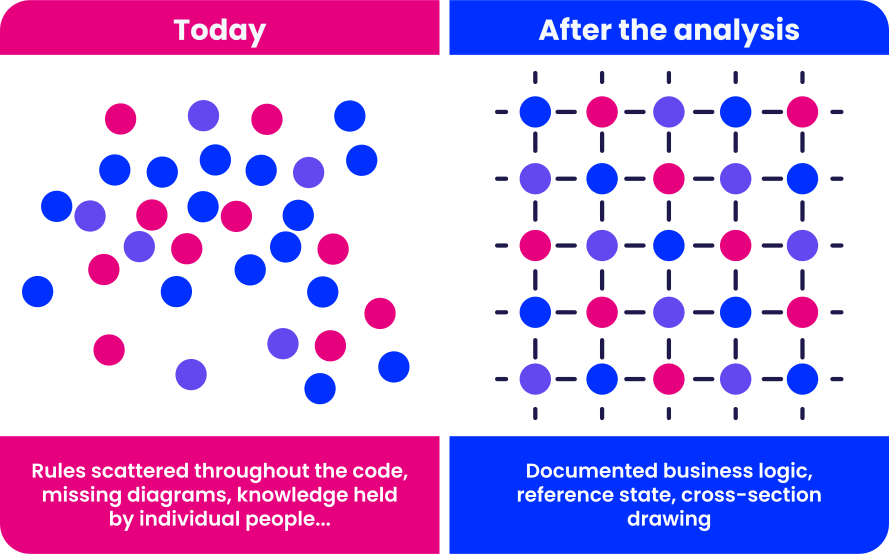
Every legacy system is unique. We analyze the code base, data flows and interfaces to understand technical risk and business dependencies. We make targeted use of AI and use Agentic Domain Discovery to gain a very deep understanding of your legacy system. This forms the basis for a robust migration strategy.

Gradual modernization instead of big bang

We migrate in stages and initially run the old and new systems in parallel. This allows us to continuously compare results, validate data and safeguard functions. This approach reduces the risk of failure and enables a smooth transition.

Architectures with a future

Our solutions follow modern principles such as domain-driven design, hexagonal architecture and microservices. We create clear interfaces and ensure that systems remain scalable and maintainable in the long term.

Targeted renewal of technology

Whether migrating monolithic applications to container-based environments with Docker and Kubernetes, switching from old DB2 databases to PostgreSQL or building modern web front-ends with React or Angular: We modernize in a targeted manner where it brings real added value. Our customers benefit from our expertise in the latest AI-supported techniques and technologies. This significantly reduces the migration time.

Quality through continuous validation

Automated tests, monitoring and regular comparisons between the old and new systems safeguard every development step. Entire systems can be validated using AI-supported tests, creating a wide-ranging safety net. This makes the new solution not only functionally identical, but also more efficient, stable and future-proof.

Cooperation at eye level

Technical transformation can only succeed through dialog. We work closely with specialist departments, IT and management. We translate complex interrelationships into comprehensible decisions and accompany the entire process.

Two people discussing a project on a laptop.
Do you still have questions about replacing legacy systems?

Arrange a non-binding consultation today.

Our references and projects

How can a legacy system be replaced while safeguarding business operations? Our references provide an insight into projects in which mature structures were turned into powerful, future-proof systems.

FAQs: Frequently asked questions about replacing legacy systems

  • What is a legacy system?

    A legacy system, also known as an old system, is an IT solution that has grown over the years and still controls important business processes, but is no longer technically up to date. Such systems are often based on outdated technologies, are difficult to maintain and lack flexibility. They cause high costs and make it difficult to integrate modern applications. Replacing a legacy system means gradually modernizing these structures and thus creating the basis for future-proof IT.

  • How can AI support us in modernizing legacy systems?

    Today, AI is an indispensable part of any modernization. It accompanies the entire process when it comes to replacing a legacy system: From a deep understanding of the existing legacy systems, the development of domain knowledge and the creation of tests through to implementation. Our employees use AI consciously and efficiently. This not only makes the modernization of your legacy system more predictable and secure, but also significantly faster.

  • What challenges are there when replacing legacy systems?

    The main challenges are secure data migration, integration into existing processes and avoiding downtime. There is often a lack of documentation and up-to-date system knowledge, which makes planning more difficult. Technical dependencies and coordination between specialist departments and IT also make the replacement process complex.

  • How long does it take to replace a legacy system?

    The duration of a replacement depends heavily on the size of the company, the complexity of the existing system and the scope of the data to be migrated. While smaller applications can often be modernized within a few months, the replacement of extensive or production-critical legacy systems takes several years. Old and new systems often run in parallel for a while or the new systems are introduced gradually, for example initially at central locations.

Why MaibornWolff?

As one of the most innovative IT service providers with a great passion for AI, we focus entirely on the project business and individual software development - without our own products. To stay at the forefront, we continuously invest in our team of digital technology engineers and develop digital solutions that are well thought-out, efficient and reduced to the essentials.

Our principle: simplicity instead of complexity. We only develop what is really needed - tailor-made, useful and reliable. Our results speak for themselves. With over 800 large-scale systems and more than 10,000 person-years of experience in high-end software engineering, we are one of the few who can reliably implement even the largest and most complex IT landscapes. Thanks to close partnerships with leading hyperscalers, our customers operate their solutions in today's most modern and powerful environments.

Less technology. Better Business.

Find what suits you best
Refine your search
clear all filters