
Skip to content

Frequently Searched

Tap to search.

Direct Contact

info@maibornwolff.de
Small sandbox with light blue sand containing a model building under a glass dome, next to a pink toy shovel

AI needs assessment for manufacturing

Ask the data first, then decide what comes next.

BMW Group Logo
DeutscheBahn_logo-2
Creditreform Logo
DERTOUR
jochen-schweizer
Dräger Logo
kuka
BMW Group Logo
DeutscheBahn_logo-2
Creditreform Logo
DERTOUR
jochen-schweizer
Dräger Logo
kuka
ProSieben_Logo_2015-2
Mercedes
Volkswagen Logo
DEKRA
stihl
Sonax_logo
Weidmüller logo
Das Logo der Bundesagentur für Arbeit
ProSieben_Logo_2015-2
Mercedes
Volkswagen Logo
DEKRA
stihl
Sonax_logo
Weidmüller logo
Das Logo der Bundesagentur für Arbeit
HomeServicesData & AIAI needs assessment for manufacturing

Your data shows where AI pays off in your production

Predictive maintenance, visual inspection, an assistant for maintenance documentation: there is no shortage of AI ideas for manufacturing. What is often unclear is where your production is losing efficiency and money today. That is why an AI needs assessment for manufacturing starts with the data your machines have been generating all along.

The sheer choice does not make things easier: in our study on technology efficiency (German), 47% of respondents say they feel overwhelmed by the volume and frequency of new AI applications. With us, you bring the data you already have, even if it is incomplete. We explore it, analyze it with agentic AI, test your assumptions and derive concrete recommendations for action.

Less Technology. Better Business.

Why manufacturers clarify their AI needs with MaibornWolff

Bring your own data

Your data, as it is: you bring your existing machine and production data, even if it has gaps. We take a look and show you what it reveals.

Questions or assumptions as a starting point

You have an assumption? We test it. You only have open questions? We look for patterns in downtime and machine utilization.

One expert with an AI sparring partner

An expert carries out the analysis and works with you iteratively, supported by an AI sparring partner.

Protected sandbox environment

The analysis runs in MaibornWolff's AI Trusted Zone, a protected sandbox environment for evaluating your data.

An abstract illustration shows a human figure made of geometric shapes in a pink and purple color scheme.
The most important success criterion for this machine learning project: it offers a standardized and scalable solution. It not only takes into account the diversity of our products, but also plants that previously planned manually, and integrates them effectively.
Dr. Daniel Patrick Kilian, Senior Key Expert Data Science & AI, Digital Industries IT at Siemens

Two ways into the analysis: open questions or concrete assumptions

Starting pointOpen questionConcrete assumption
SituationYou don't know exactly where the problem lies yet.You have a hunch that you want to prove.
Typical examplesWhat patterns show up in downtime? How is machine utilization distributed across shifts and sites?At one site, older machines cause more scrap than at another. The sensor and event logs are sufficient for a reliable predictive maintenance model for critical machines.
RiskNoise: many anomalies carry no meaning.Blind spots: whatever your assumption does not cover goes unnoticed.

What production data typically reveals

Production data keeps turning up similar findings. Only the analysis shows which of them are in your data:

  • Organization: Equipment performance varies between shifts and days. Individual sites have their own peculiarities.
  • Quality: Material and batch effects occur, as do correlations that only become visible across the entire process.
  • Disruptions: A disruption propagates along the line. Early indicators signal upcoming failures.
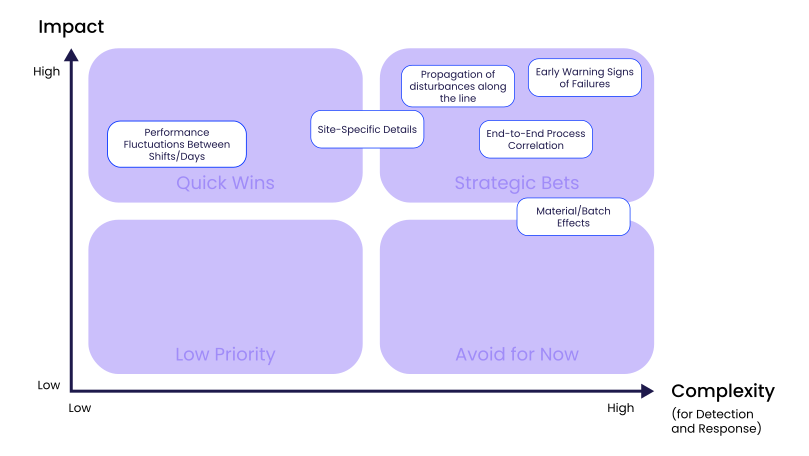
Typical findings: impact vs. complexity
Four-quadrant matrix with the axes impact and complexity and the quadrants Quick Wins, Strategic Bets, Low Priority and Avoid for Now, with use cases placed in them

Not every finding pays off right away. The findings differ in impact and complexity, that is, in benefit and in the effort required for detection and response. Fluctuations between shifts are typically a quick win with low complexity, whereas early indicators of failures are a larger undertaking with high benefit.

How the initial data analysis works

Five steps take you from your data to a well-founded recommendation for action.

Abstract lines
Kickoff

We clarify whether the analysis starts with open questions or with concrete assumptions.

Data access
Model development
Live demo
Recommendations for action

A typical scope is up to two production assets. The final results are available about two weeks after data access; we agree on the exact scope with you in a preliminary meeting.

Needs assessment, readiness check or data integration?

The AI Readiness Check assesses how well prepared your entire organization is for AI, across six dimensions from strategy to change management. The needs assessment starts with the production data from your equipment and shows which patterns and use cases it contains. If machine and SAP data first need to be connected and consolidated, that is usually a separate, considerably larger project, for example with an IIoT platform. If your team wants to build foundational knowledge first, the AI workshop is the right place to start.

What you get at the end

  • Interactive analysis results: In HTML reports, you explore the results, the behavior of the models and the key insights yourself.
  • Reusable code: It lets you repeat and extend the analysis on new data. Depending on what we agree, we provide it via a private Git repository or as an archive, for example a ZIP file.
  • Recommendations for action: The recommendations set out concrete next steps, such as expanding the data basis, adjusting or extending the Unified Namespace and context model, building the right data and infrastructure foundations, or a proof of concept in the production environment.

After the analysis: the next steps

The decision on the next step is yours. If the data basis is not sufficient for the desired use case, we are happy to support you through the process and provide our OT (operational technology) experts. If a clear candidate emerges, a proof of concept in the production environment can follow, and later the rollout.

The findings often point to several paths, such as less scrap or AI-based defect detection right at the line. If your machines are already connected, AIoT solutions for manufacturing add AI to this connectivity, for example with predictive maintenance that forecasts downtime and maintenance intervals and shortens stoppages.

The possibilities go further: anomaly detection, root cause analysis, digital twins, supply chain management and forecasting, dynamic production planning, energy optimization and control, and waste reduction. We are happy to advise you on your challenges and implement larger projects as industrial AI solutions.

Our case studies and projects
  • Header_Weigerstorfer_2_small
    Weigerstorfer GmbH: Project Management Platform for Building Services Engineering
    About the Weigerstorfer Reference
    AI & MLData PlatformsIT Modernization

    Unified Project Management Platform for Office and Construction Site Use in Building Services Engineering

    About the Weigerstorfer Reference

    Process digitization, mobile-first app, GAEB integration, AI-powered data migration (Azure)

    About the Weigerstorfer Reference

    250,000 orders migrated in four months, paperless maintenance, overview of 3,000 maintenance contracts

    About the Weigerstorfer Reference
  • Header_ifm-Supplier_Evaluation
    ifm: Azure AI strengthens global procurement capabilities
    About the ifm Reference
    AI & MLCloudIndustry 4.0

    Streamline global supplier evaluation in procurement instead of relying on individual search strategies that require a lot of manual work

    About the ifm Reference

    A chat-based AI assistant built on Azure OpenAI and AI Search that aggregates ERP data, website information, and internal reviews

    About the ifm Reference

    MVP up and running in 11 weeks; new employees can get started without a lengthy onboarding process; Azure AI Platform as the foundation for additional use cases

    About the ifm Reference
  • A robotic arm places precise digital data in a futuristic, dark room.
    Physical AI: Retaining Physically Impaired Workers in Manufacturing
    See robotics reference
    AI & MLEmbedded & RoboticsIndustry 4.0

    Customized assistance robots for people with physical disabilities in production

    See robotics reference

    Integration of AI for automated adaptation of robots to people's capabilities

    See robotics reference

    Effective empowerment of people with physical disabilities

    See robotics reference
  • Close-up of colorful puzzle pieces floating in the air, each piece engraved with a different insurance symbol.
    STARTRAIFF: AI-powered analysis supports insurance sales
    To the STARTRAIFF reference
    AI & MLCloudData Platforms

    Aggregation of internal customer data & external data in a single web application

    To the STARTRAIFF reference

    Data bundling & analysis with Amazon Bedrock

    To the STARTRAIFF reference

    Intuitive user interface for sales, 88% reduced preparation time before customer visits

    To the STARTRAIFF reference
  • Two orthopaedic surgeons view a transparent 3D hologram of the skeleton and musculature on an elegant tablet interface, surrounded by floating UI panels.
    Health.exe: AI-supported platform creates training plans for patients
    To the Health.exe reference
    AI & MLCloudData Platforms

    AI-supported service for orthopedic & sports medicine practices

    To the Health.exe reference

    Cloud-based web application for doctors for the automated, evidence-based creation of individually tailored patient training plans

    To the Health.exe reference

    New revenue source without fixed costs, higher patient retention, AI-supported & guideline-based

    To the Health.exe reference
  • A technician in a green Siemens jacket sits in front of a computer on a factory floor with industrial equipment in the background.
    Siemens: AI demand prediction platform for industrial production planning
    See Siemens reference
    AI & MLCloudData Platforms

    Machine learning for time series forecasting

    See Siemens reference

    AutoML for automated adaptation of models to different data

    See Siemens reference

    Unified, scalable solution, optimized inventory costs, efficiency gains

    See Siemens reference
  • Two women are standing in a workshop. One woman is holding a tablet in her hands.
    TÜV NORD GPT: Development of AI assistance
    See TÜV NORD reference
    AI & MLAppsWeb & Portals

    Secure operation of AI in the European MS Azure cloud environment

    See TÜV NORD reference

    Frontend & backend via MS Azure App, "Chat with your PDF" for TÜV employees

    See TÜV NORD reference

    Quick implementation of new technologies (AI), strengthening knowledge management

    See TÜV NORD reference
  • Large rollers on conveyor belt in factory.
    Planning systems: Optimizing the capacity utilization of pressing plants
    See reference
    AI & MLData PlatformsIndustry 4.0

    Centralized planning of component manufacturing for cost- & resource-optimized production capacity worldwide

    See reference

    Conversion from local processing with fat clients to a client-server application, migration to the cloud

    See reference

    Data-based planning & calculation of different manufacturing scenarios & site-specific production costs

    See reference
  • Header_Global-Requirements-Planning-System-for-Workforce-2-16-9
    Global workforce planning system
    See reference
    AI & MLCloudData Platforms

    Centralized web-based IT system to replace individual isolated solutions

    See reference

    Event sourcing for planning & analytics, domain-driven design, cloud migration

    See reference

    Easy updates, expansion, maintenance, optimized security

    See reference

An AI use case only makes sense under certain conditions. We are happy to discuss in detail which ones apply in your case in a meeting.

A person in a bright, modern room holding a phone to their ear, reflected in a glass wall.
What is in your production data?

Together with you, we clarify in advance what data is available, what goals you are pursuing and whether the analysis starts with open questions or assumptions.

Frequently asked questions about the AI needs assessment for manufacturing

  • What is an AI needs assessment for manufacturing?

    An AI needs assessment for manufacturing shows where AI can add value in your production. At MaibornWolff, it starts with the data you already have. We explore it, test your hypotheses with agentic AI and derive recommendations for action.

  • Do we need clean production data for an AI needs assessment?

    No, you bring the data you already have, even if it is incomplete. We look at what can be derived from it and, where there are gaps, recommend expanding the data basis. If the data still lacks assignments and context such as shifts or downtime, we can also prepare it. Connecting machines and SAP and consolidating the data first is a separate, considerably larger project.

  • How much does an AI needs assessment for manufacturing cost?

    An AI needs assessment for manufacturing costs between €30,000 and €50,000. Where your project falls within this range depends on the data situation and the question at hand. A sample offer covers up to two production assets.

  • How long does an AI needs assessment for manufacturing take?

    The final results are available about two weeks after data access. This applies to the sample offer with up to two production assets. We agree on the exact timeframe with you in a preliminary meeting, as it depends on the data situation and the question at hand.

  • Does MaibornWolff commit to specific programming languages for AI projects in manufacturing?

    No, MaibornWolff does not commit to any one programming language. The language follows the question and the solution being built, and is a matter of detail. What counts for you is that the code in the repository is reusable and that the analysis can be repeated and extended on new data.