HMI design: When man and machine harmonize perfectly
Are you developing machines or devices where digital user interfaces make all the difference? Then human-machine interface (HMI) design is the key to user interfaces that users really understand and can use safely.
MaibornWolff provides you with interdisciplinary support through all phases - from analysis, concept and prototyping to implementation and integration. User-centered, efficient and tailored to your hardware.
Less technology. Better Business.
Why HMI design determines your success
We design HMIs so that tasks are clear, fast and accessible. To do this, we analyze the context of use and derive interaction concepts that reliably support users.
To avoid critical errors, we rely on clear information structures and robust dialog processes. Safety and security requirements are incorporated into every HMI concept right from the start.
We consistently think along with interfaces and processes. This allows your HMI to fit neatly into existing IT and OT landscapes: without media disruptions, without unnecessary detours and with an integration effort that remains predictable and manageable.
An HMI also communicates your brand to the outside world. If desired, we take design guidelines into account and develop a visual system that creates recognition and works reliably across devices, variants and languages.
For whom HMI design makes the difference
Whether it's a large industrial plant, a high-tech vehicle or a smart household helper: wherever people interact with machines on a daily basis, a good HMI design counts. When user interfaces determine everyday working life, their design determines cycle times, error rates, service costs and the brand experience.
MaibornWolff supports manufacturers and operators in developing new interfaces or modernizing existing solutions. We combine user research, design and engineering to create a coherent whole that fits into your architecture and remains scalable. The result: faster familiarization, fewer errors, more satisfied users - and a shorter time-to-market.
This is where HMI Design delivers a particularly big impact:
-
Groups with complex device fleets
-
Product areas with high safety and compliance requirements
-
Teams that want to scale or modernize existing HMIs
We have the well-coordinated team you need for this - without complicated handovers or silo thinking. Together, we define goals, prioritize the scope and deliver viable prototypes.
How do we solve typical HMI design challenges?
Complexity? Established structures? Systems that have to react reliably and within fixed time frames? We know them, and we bring order to them. HMI initiatives often come up against established structures and tough real-time requirements.
We encounter the following challenges particularly often:
We don't start with the technology, but with the people who will later stand in front of the machine. With research, interviews and usability tests, we ensure that central tasks can be completed quickly, clearly and without barriers - even under time pressure. Clear information hierarchies, comprehensible user guidance and clearly defined statuses as well as safety and security concepts reduce operating errors and protect the operator, system and data.
We think beyond pure function: How does the operation feel? How well does it fit into your users' everyday lives? Based on real usage scenarios, we design flows that are logical, comprehensible and pleasant - from the first contact to routine operation. This creates a user experience that not only works, but also makes you want to use the system regularly.
We translate your brand into a robust HMI design system: colors, typography, icons, layout and microinteractions interlock like gears and can be applied consistently across machines, series and languages. Your advantage: every new interface fits in seamlessly, looks as if it has been cast from a single mold - and your brand stays in the mind, not stuck in the style guide.
Instead of cumbersome functional specifications, we rely on a clearly structured but flexible process: a shared product vision, prioritized requirements, prototypes that are tested early on and iterative implementation in short loops. Your specialist departments, design and development work together in interdisciplinary teams. This allows you to remain agile, react to new findings and avoid expensive surprises shortly before the go-live.
HMI design projects at MaibornWolff at a glance
-
To the LEW referenceLechwerke: Brand4Future - Digital platform for the brand presenceDigital Design/UX DesignEnergyTo the LEW referenceRenewal of the digital brand presence for LEW, ÜWK & LVN
To the LEW referenceMulti-brand design system, headless CMS (Umbraco Cloud) & Next.js frontend, UX concept, uniform information architecture, usability tests
To the LEW referenceConsistent brand presence, efficient content maintenance, short loading times, better SEO visibility & accessibility
-
To the Mixed Reality referenceUniversity Medicine Frankfurt - Mixed reality for the training of doctorsDigital Design/UX DesignAppsEmbedded Systems & RoboticsTo the Mixed Reality referenceKnee training simulator for technology-supported medical education
To the Mixed Reality referenceMixed reality application combined with a haptic knee model, interactive training environment
To the Mixed Reality referenceDiagnostics on the human knee without simulated patients, simulation of various pathologies, real-time visualization of motion sequences
-
See digikoo referencedigikoo GmbH: Apple Vision Pro for city plannersDigital Design/UX DesignData/Data PlatformsAppsSee digikoo referenceImmersive 3D visualization of complex energy data on the Apple Vision Pro
See digikoo referenceAugmented reality, spatial computing, 3D map with detailed data & KPIs
See digikoo referenceFoundation for intuitive understanding of energy scenarios & well-informed decisions
-
See BMW referenceMixed reality: driving a real car in a virtual worldDigital Design/UX DesignAppsEmbedded Systems & RoboticsSee BMW referenceExperience a futuristic outdoor environment in the headset while inside a real vehicle interior
See BMW referenceReal-time 3D application, Unreal development, XR technology, game design, smart devices
See BMW referenceHigh-performance processing of vehicle signals for precise motion mapping for an immersive driving experience without motion sickness
-
See KUKA referenceKUKA: Web interface for a new Human Machine InterfaceDigital Design/UX DesignEmbedded Systems & RoboticsWeb & Portal PlatformsSee KUKA referenceEasy & intuitive web UI for product control
See KUKA referenceDevelopment of HMI components & modules using Scrum
See KUKA referenceHigh user-friendliness, reliable operation, fast scalability & extensibility
-
See KUKA referenceKUKA: UI/UX design for an app for load data analysis for industrial robotsDigital Design/UX DesignData/Data PlatformsAppsSee KUKA referenceWeb app to replace legacy systems for easier interaction between users & system
See KUKA referenceConversion from local processing with fat clients to a client-server application & migration to the cloud
See KUKA referenceData-based planning & calculation of different manufacturing scenarios & site-specific production costs
-
See SMA referenceSMA: Development of a Web UI for ennexOS platformDigital Design/UX DesignIoTWeb & Portal PlatformsSee SMA referenceCreation of a unified customer experience across all products, smooth generational transition for customers, secure, agile operation
See SMA referenceWebUI for the digitalization & automation of energy management processes, open-source solution for energy flow visualization
See SMA referenceEnergy flow & cost optimization, operational reliability, customer-friendliness
-
See BMW Group referenceBMW Group: Virtual reality brings vehicle design to lifeDigital Design/UX DesignAppsVR/ARSee BMW Group referenceUnified platform for AR, VR & 3D real-time use cases: from planning to manufacturing
See BMW Group referenceDesign & virtual product experience, plugin-based process support
See BMW Group referenceVehicle experience already at an early stage, location-independent, cross-functional collaboration on the virtual model, savings on hardware prototypes
Ready for HMI design that really works?
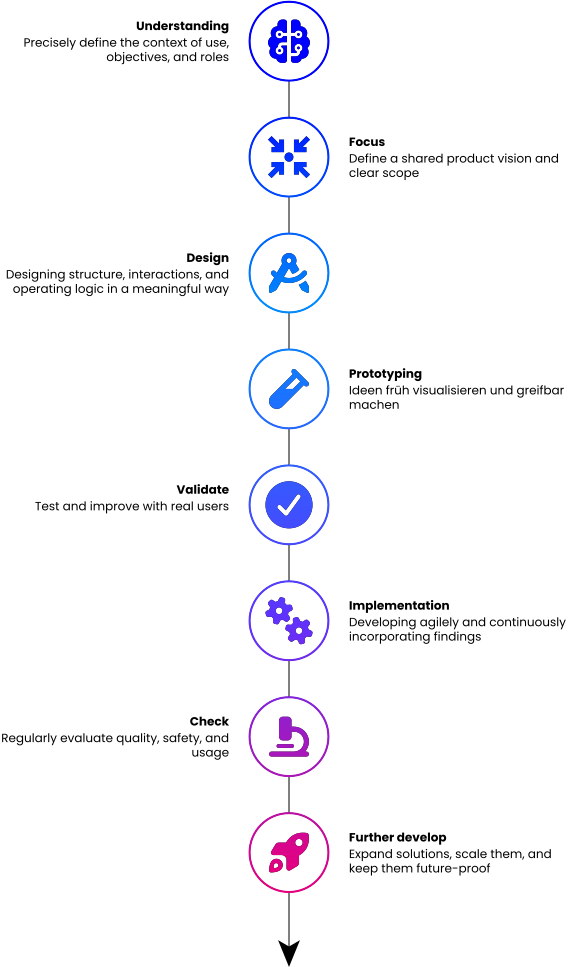
A good HMI is not created by chance, but in clear, comprehensible steps. Our process ensures that technology does not overwhelm, but supports: from a well-founded vision to well thought-out interaction concepts and agile implementation. The result is an interface that really helps people to complete their tasks - efficiently, safely and pleasantly.
From understanding to further development
Our HMI design expertise
A strong HMI is created where technical understanding, user focus and clear design come together. We translate complex machine logic into interfaces that your teams can operate safely, efficiently and without detours. If you want to modernize your existing HMI or develop a new system, we will accompany you from the initial concept to the market-ready product - pragmatically, interdisciplinary and with exactly the technical depth that you really need.
Talk to us about how we can make your next HMI project faster, clearer and more user-friendly.
Frequently asked questions about HMI Design
Why develop HMI design with MaibornWolff?
Because we offer strategy, design and technology from a single source and only use technology where it provides real benefits. Our experts combine user-centered HMI design with embedded, cloud and integration expertise. The result: quickly validated concepts, clean implementation, measurable impact - and a partner who provides independent advice.
What role does AI play in HMI design?
AI supports research, brainstorming, prototyping and testing - for example through pattern recognition in data or automated accessibility checks. In the product, AI ensures smart assistance functions and more robust processes, for example, where it has proven benefits.
What distinguishes HMI design from UI design?
HMI design addresses the interface between humans and physical machines - including the environment, safety and operating logic. Classic UI design usually focuses on purely digital products such as websites or apps. The context makes the difference.How does MaibornWolff deal with safety in HMI design?
We take safety, security and rights concepts into account right from the start. Clear statuses, warnings and feedback reduce errors. Tests and reviews are an integral part - in agile cycles, with documented decisions.