Skip to content

Frequently Searched

Tap to search.

Direct Contact

info@maibornwolff.de
Miniature robotic arm with a pink gripper on a circuit board, next to two tiny figures of people

AIoT: AI That Makes Decisions on the Device

From connected kitchen appliances to robots on the assembly line: we bring AI to where your product operates – even when no cloud is within reach.

BMW Group Logo
DeutscheBahn_logo-2
Creditreform Logo
DERTOUR
jochen-schweizer
Dräger Logo
kuka
BMW Group Logo
DeutscheBahn_logo-2
Creditreform Logo
DERTOUR
jochen-schweizer
Dräger Logo
kuka
ProSieben_Logo_2015-2
Mercedes
Volkswagen Logo
DEKRA
Sonax_logo
Weidmüller logo
Das Logo der Bundesagentur für Arbeit
ProSieben_Logo_2015-2
Mercedes
Volkswagen Logo
DEKRA
Sonax_logo
Weidmüller logo
Das Logo der Bundesagentur für Arbeit

Why AI Belongs on the Device, Not Just in the Cloud

Many decisions have to be made where the cloud cannot reach: in a dead zone, on a shop floor that is deliberately disconnected from the network, or at volumes where data transmission simply does not pay off. Yet the decision still has to be made – within milliseconds, reliably and on hardware with limited computing power. On top of that, there is a familiar pattern: what impresses as a demo in the lab often fails to make the leap into series production.

With AIoT, we bring AI directly onto your device or onto an edge computer on site. This ranges from compact models on microcontrollers and physical AI in robotics and autonomous systems to automated quality inspection on the line. We develop for series production from the very start, not for the demo. And we keep an eye on what actually pays off at your volumes.

Less Technology. Better Business.

Where AIoT Comes In for You

AIoT covers three very different starting points. Find the entry point that matches your role and your task:

For Your ProductFor Your ManufacturingFor Your Data

Trigger:


• New operating concepts, assistance functions or more autonomy are needed.

• Cloud dependency, latency or data protection are holding back previous AI approaches.

• The product must also work reliably and securely offline.

Trigger:


• Quality problems are detected too late.

• There are not enough skilled workers at the inspection stations.

• Scrap and rework are on the rise.

Trigger:


• Production generates thousands of data points every day, but nobody can say for sure why the line performed worse last week than the week before.

• There are dashboards, reports and Excel analyses – but no reliable recommendations for action.

• The same causes are discussed over and over again.

Solution:


AI directly in the product or on an edge device – from microcontrollers to controllers, ready for series production and updatable throughout the product lifetime.

Solution:


Use AI where production happens – systems that perceive and act physically, from robotics to in-cycle quality inspection.

Solution:


Turn data into better decisions: combine production know-how with data analytics and AI. Instead of just visualizing KPIs, we uncover influencing factors, patterns and levers for improvement.

What AIoT Is – and How It Relates to Edge AI and Physical AI

The term is new, combines AI and IoT and is used inconsistently in the market. This is how we define it: AIoT connects networked devices with artificial intelligence. The difference from classic IoT lies in the role of the device. An IoT device captures and reports – it collects measurements and passes them on. An AIoT device interprets and decides – it assesses the situation and derives an action from it. The decision is therefore made on the device, no longer in a system behind it.

Edge AI and physical AI define two different directions within it:

TermWhat it definesExample
AIoTThe product decides for itself.A robotic lawn mower detects an obstacle and chooses a new path.
Edge AIWhere the processing happens: locally instead of in the cloud.The model runs on the chip of the edge computer in the factory hall.
Physical AIWhat the AI does: perceive, plan, act physically.Gripping, driving, avoiding obstacles.

“Edge” is often used for any device that is not located in a data center. To be more precise, three levels need to be distinguished:

LevelWhere the processing happensRole
DeviceIn the product itself: microcontroller, controller or SoC.Decides on its own.
EdgeOn a dedicated on-prem device on site – a gateway or server in the control cabinet, in the hall, plant or vehicle.Aggregates several machines and is the only handover point to the cloud.
CloudIn a provider's data center, accessible only via the network.Only sees what the edge passes on: fleet view, retraining, long-term analysis.

Accordingly, edge AI means that the model runs on one of the two upper levels – on the device itself or on the edge. Which of the two is right depends on whether the decision has to be made in the individual product or whether several machines need to be considered together.

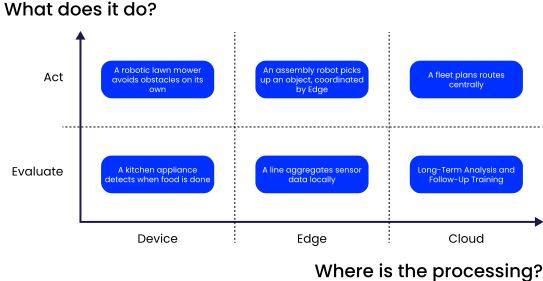
Edge AI and physical AI are independent of each other. An automated guided vehicle acts physically but receives its routes from a fleet management system in the data center. A camera in quality inspection decides locally between good and bad parts without moving an inch.

Matrix with the axes “What does it do?” (act, evaluate) and “Where is the processing?” (device, edge, cloud) and six examples of AI applications

Things get demanding where both come together: a device that acts physically and is on its own has to decide within a few milliseconds on limited hardware – without asking back and without human approval. A wrong decision cannot be corrected with a second attempt, because the movement has already happened. The requirement thus shifts from model quality to the behavior of the overall system.

That is why we define two things for every AI function: how the device recognizes that its assessment is uncertain (confidence, plausibility limits, input data outside the trained range) – and what it does then: stop, continue more slowly, fall back on simple rule-based behavior or hand over to a human.

Where the Term Physical AI Comes From

In research, this field has been called embodied AI for years. “Physical AI” is the industrial term that has been shaped mainly by chip and platform providers since 2025. The term is new, the subject behind it is not. What has shifted is something else: where robots used to execute programmed motion sequences, today they work with trained models that can also handle situations nobody described in advance. This removes the limit that automation used to run up against: small batch sizes, changing variants and parts without an exact position become economically viable. The price for this is that the system's behavior can no longer be fully specified in advance.

When No Cloud Is Available, None Is Allowed or It Doesn't Pay Off

“This has to work without the cloud, too” – we hear this sentence in many customer conversations. Behind it are three very different motivations.

  • No connection available. A robotic lawn mower at the far end of the garden, a machine under a reinforced concrete ceiling, a vehicle in a dead zone: here, losing the connection is the norm, not a malfunction. It does not change the task – the machine still has to sort out the defective part, the vehicle still has to brake.
  • No connection allowed. In many German plants, the shop floor is deliberately separated from the internet – for operational safety and to protect know-how. This separation will not be lifted just because someone wants to use AI. Cloud-bound AI functions therefore rarely fail because of the technology, but because of IT security approval.
  • Connection possible, but not economical. This is the rule with high-frequency data – vibration and current measurements in the kilohertz range, camera images at production cycle speed, sensor streams from dozens of machines. Anyone who permanently pushes such raw data into the cloud pays three times: for transmission, storage and analysis – continuously, per machine and per device. Yet the vast majority of this data is unremarkable normal operation.

In all three cases, the computing stays local – on the device or on an edge computer on site. Only the result goes out: the detected anomaly, the condensed metric, the inspection verdict. That is the difference between a permanent stream of raw data and a few bytes per event. The benefits:

  • no data leakage,
  • no latency over the network,
  • no ongoing costs for transmission, storage and inference,
  • no dependency on a provider's availability – and the function keeps working when the connection is lost.

This is certainly more demanding than the cloud route: limited memory, limited computing power, an energy budget that has to be met, and an update path that lasts for years. This very work is our core business – we have been developing embedded software for decades and connected products for more than ten years. Where a connection exists and makes sense, we use it: for fleet view, retraining and central analysis, via the edge as the only controlled gateway. But your product's core function does not depend on it.

These Companies Already Trust Our Expertise

Three Fields We Work In

Abstract lines

AI on the Device (Edge AI)

The model runs in the product itself – on a microcontroller or controller – or on a dedicated edge device on site that combines the data of several machines. Both are edge AI: measurements are analyzed where they are generated. At most, the result goes out, via the edge as the only handover point. Four requirements typically lead down this path: a response within a few milliseconds, data transmission that is too expensive, data that must not leave the site, or a device that simply has to work without a connection.

We bring models to the existing hardware – from microcontrollers to embedded Linux systems with AI accelerators (a chip that computes neural networks many times faster and more efficiently than the main processor). If the hardware has not yet been decided, we support you in selecting it and measure in advance what the target system can actually deliver. And the models remain updatable throughout the product lifetime.

Systems That Act Physically (Physical AI)

Automated Quality Inspection

Classic applications such as Predictive Maintenance, Condition Monitoring and Smart Maintenance build on the same foundations.

Our Case Studies and Projects

The best way to see what AIoT looks like in practice is through completed projects. Our examples show the wide range of possible applications.

  • Header_Weigerstorfer_2_small
    Weigerstorfer GmbH: Project Management Platform for Building Services Engineering
    About the Weigerstorfer Reference
    AI & MLData PlatformsIT Modernization

    Unified Project Management Platform for Office and Construction Site Use in Building Services Engineering

    About the Weigerstorfer Reference

    Process digitization, mobile-first app, GAEB integration, AI-powered data migration (Azure)

    About the Weigerstorfer Reference

    250,000 orders migrated in four months, paperless maintenance, overview of 3,000 maintenance contracts

    About the Weigerstorfer Reference
  • Header_ifm-Supplier_Evaluation
    ifm: Azure AI strengthens global procurement capabilities
    About the ifm Reference
    AI & MLCloudIndustry 4.0

    Streamline global supplier evaluation in procurement instead of relying on individual search strategies that require a lot of manual work

    About the ifm Reference

    A chat-based AI assistant built on Azure OpenAI and AI Search that aggregates ERP data, website information, and internal reviews

    About the ifm Reference

    MVP up and running in 11 weeks; new employees can get started without a lengthy onboarding process; Azure AI Platform as the foundation for additional use cases

    About the ifm Reference
  • A robotic arm places precise digital data in a futuristic, dark room.
    Physical AI: Retaining Physically Impaired Workers in Manufacturing
    See robotics reference
    AI & MLEmbedded & RoboticsIndustry 4.0

    Customized assistance robots for people with physical disabilities in production

    See robotics reference

    Integration of AI for automated adaptation of robots to people's capabilities

    See robotics reference

    Effective empowerment of people with physical disabilities

    See robotics reference
  • A person wearing a high-visibility vest stands in front of a lit industrial facility at night in the fog; a reflection on the wet ground.
    Dräger: Improved workplace safety in industrial facilities thanks to the cloud
    About the Monitoring Reference
    CloudIoTCybersecurity

    Cloud Platform for Live Monitoring and Management of Mobile Gas Detectors

    About the Monitoring Reference

    Cloud-native microservices, IoT gateway, scalable Kubernetes backend (Azure)

    About the Monitoring Reference

    Real-time alerts worldwide in under 10 seconds, 140,000+ devices

    About the Monitoring Reference
  • A microcontroller lies under a magnifying glass
    Virtualization of software testing for control units in the AWS cloud
    To the BMW reference
    CloudMobilityEmbedded & Robotics

    Digital twin for control unit development & testing in cars

    To the BMW reference

    Virtualization of control units & AWS cloud integration

    To the BMW reference

    Setup of virtual cars & control units without expensive hardware setups, worldwide & distributed testing

    To the BMW reference
  • Close-up of colorful puzzle pieces floating in the air, each piece engraved with a different insurance symbol.
    STARTRAIFF: AI-powered analysis supports insurance sales
    To the STARTRAIFF reference
    AI & MLCloudData Platforms

    Aggregation of internal customer data & external data in a single web application

    To the STARTRAIFF reference

    Data bundling & analysis with Amazon Bedrock

    To the STARTRAIFF reference

    Intuitive user interface for sales, 88% reduced preparation time before customer visits

    To the STARTRAIFF reference
  • A fleet of self-driving trucks from MAN on a spacious test site.
    MAN - ATLAS L4. Control Center for the autonomous truck
    To the MAN reference
    MobilityCloudData Platforms

    Control center for the technical monitoring of driverless trucks

    To the MAN reference

    UX design, product strategy, data structure, vehicle data visualization

    To the MAN reference

    Monitoring, remote support, mission management, reports for commercial autonomous transport solutions

    To the MAN reference
  • Two people in white protective suits stand in front of a pipeline through which green glowing data streams are pumped
    NETZSCH: Development of an IoT platform
    To the NETZSCH reference
    CloudIoTData Platforms

    Unified IoT platform for 3 business units, harmonization of existing IoT solutions

    To the NETZSCH reference

    IoT device connectivity, visualization software for data analysis, cloud infrastructure, operations

    To the NETZSCH reference

    Quick testing in the cloud infrastructure, fast integration of use cases such as predictive maintenance, process optimizations, etc.

    To the NETZSCH reference
  • A modern high-rise building with an eye-catching orange-purple color gradient featuring a central, transparent exterior elevator unit.
    TK Elevator: Health Check Connectivity for the IoT gateway of elevators
    To the TKE reference
    CybersecurityIoTEmbedded & Robotics

    IoT gateway (MAX Box) for data connection between elevator & IoT platform

    To the TKE reference

    Examination of code quality, architecture, operations & organization

    To the TKE reference

    Optimization of IoT gateway connectivity & digitalization of elevators

    To the TKE reference
  • A person stands on a platform at sunset with digitally superimposed graphics.
    inCTRL Solutions: Modernization of the IoT platform for water treatment plants
    To inCTRL reference
    CloudIoTIT Modernization

    IoT & software modernization, integration of new functions

    To inCTRL reference

    Data warehouse setup, integration of microservices, automated quality assurance, Continuous Integration & Continuous Deployment (CI/CD)

    To inCTRL reference

    Improved resilience, maintainability & further development capability of the platform

    To inCTRL reference
  • A woman wears VR goggles and lifts a silicone leg
    University Medicine Frankfurt - Mixed reality for the training of doctors
    To the Mixed Reality reference
    Digital & UX DesignAppsEmbedded & Robotics

    Knee training simulator for technology-supported medical education

    To the Mixed Reality reference

    Mixed reality application combined with a haptic knee model, interactive training environment

    To the Mixed Reality reference

    Diagnostics on the human knee without simulated patients, simulation of various pathologies, real-time visualization of motion sequences

    To the Mixed Reality reference
  • Two orthopaedic surgeons view a transparent 3D hologram of the skeleton and musculature on an elegant tablet interface, surrounded by floating UI panels.
    Health.exe: AI-supported platform creates training plans for patients
    To the Health.exe reference
    AI & MLCloudData Platforms

    AI-supported service for orthopedic & sports medicine practices

    To the Health.exe reference

    Cloud-based web application for doctors for the automated, evidence-based creation of individually tailored patient training plans

    To the Health.exe reference

    New revenue source without fixed costs, higher patient retention, AI-supported & guideline-based

    To the Health.exe reference
  • A red MAN truck drives along an empty road under a clear night sky with shining stars.
    MAN: Efficient threat analysis for control units
    See MAN reference
    CybersecurityIoTEmbedded & Robotics

    Protection of digitalized trucks against virtual attacks

    See MAN reference

    Risk analysis based on 4x6 methodology, ThreatSea, ISO21434

    See MAN reference

    Quick identification of relevant threats for immediately effective security measures

    See MAN reference
  • A technician in a green Siemens jacket sits in front of a computer on a factory floor with industrial equipment in the background.
    Siemens: AI demand prediction platform for industrial production planning
    See Siemens reference
    AI & MLCloudData Platforms

    Machine learning for time series forecasting

    See Siemens reference

    AutoML for automated adaptation of models to different data

    See Siemens reference

    Unified, scalable solution, optimized inventory costs, efficiency gains

    See Siemens reference
  • Two women are standing in a workshop. One woman is holding a tablet in her hands.
    TÜV NORD GPT: Development of AI assistance
    See TÜV NORD reference
    AI & MLAppsWeb & Portals

    Secure operation of AI in the European MS Azure cloud environment

    See TÜV NORD reference

    Frontend & backend via MS Azure App, "Chat with your PDF" for TÜV employees

    See TÜV NORD reference

    Quick implementation of new technologies (AI), strengthening knowledge management

    See TÜV NORD reference
  • Person uses Miele app in modern kitchen.
    Miele domestic appliances are networked worldwide
    See Miele reference
    CloudIoTEmbedded & Robotics

    Further development of the IoT platform for connected home appliances

    See Miele reference

    Container-based architecture, open standards, modular design

    See Miele reference

    Quick availability & scalability of digital services, high added value for users

    See Miele reference
  • Sports car parked in a colorful desert landscape.
    Mixed reality: driving a real car in a virtual world
    See BMW reference
    Digital & UX DesignAppsEmbedded & Robotics

    Experience a futuristic outdoor environment in the headset while inside a real vehicle interior

    See BMW reference

    Real-time 3D application, Unreal development, XR technology, game design, smart devices

    See BMW reference

    High-performance processing of vehicle signals for precise motion mapping for an immersive driving experience without motion sickness

    See BMW reference
  • Woman with tablet in modern factory hall
    KUKA: Web interface for a new Human Machine Interface
    See KUKA reference
    Digital & UX DesignEmbedded & RoboticsWeb & Portals

    Easy & intuitive web UI for product control

    See KUKA reference

    Development of HMI components & modules using Scrum

    See KUKA reference

    High user-friendliness, reliable operation, fast scalability & extensibility

    See KUKA reference
  • Header_Stiehl-IMOW-16-9
    STIHL: Control iMOW robotic mower via app
    See STIHL reference
    CloudIoTApps

    Control and configuration of the robotic mower via smartphone

    See STIHL reference

    Development of app, web, cloud platform and direct Bluetooth communication

    See STIHL reference

    Digital benefits for users, app controllability, remote software updates

    See STIHL reference
  • Header_ifm
    ifm services: Remote maintenance of systems and machines
    See ifm services reference
    CloudIoTEmbedded & Robotics

    Fully integrated remote access in the IoT platform

    See ifm services reference

    Full stack cloud application, RUST-based clients, UX design

    See ifm services reference

    Analysis of sensor data from production as a basis for sustainable decisions for customers

    See ifm services reference
  • Large rollers on conveyor belt in factory.
    Planning systems: Optimizing the capacity utilization of pressing plants
    See reference
    AI & MLData PlatformsIndustry 4.0

    Centralized planning of component manufacturing for cost- & resource-optimized production capacity worldwide

    See reference

    Conversion from local processing with fat clients to a client-server application, migration to the cloud

    See reference

    Data-based planning & calculation of different manufacturing scenarios & site-specific production costs

    See reference
  • Header_Global-Requirements-Planning-System-for-Workforce-2-16-9
    Global workforce planning system
    See reference
    AI & MLCloudData Platforms

    Centralized web-based IT system to replace individual isolated solutions

    See reference

    Event sourcing for planning & analytics, domain-driven design, cloud migration

    See reference

    Easy updates, expansion, maintenance, optimized security

    See reference
  • The dashboard of a car shows a display with a notification about a remote software upgrade.
    BMW Group: Remote software upgrade for vehicles
    See BMW Group reference
    CloudMobilityCybersecurity

    Software upgrades without the need to visit a service center

    See BMW Group reference

    Backend system for over-the-air communication with the vehicle, 24/7 support

    See BMW Group reference

    IT security, more comfort, on-demand provision of new features

    See BMW Group reference
  • Technician installs solar panel on roof at sunset
    SMA: Development of a Web UI for ennexOS platform
    See SMA reference
    Digital & UX DesignIoTWeb & Portals

    Creation of a unified customer experience across all products, smooth generational transition for customers, secure, agile operation

    See SMA reference

    WebUI for the digitalization & automation of energy management processes, open-source solution for energy flow visualization

    See SMA reference

    Energy flow & cost optimization, operational reliability, customer-friendliness

    See SMA reference
  • A person stands in a modern, abstract room and holds a tablet in their hands.
    Weidmüller: Progression of the Industrial Service Platform
    See Weidmüller reference
    CloudIoTWeb & Portals

    Creation of a centralized, intuitive, expandable portal as the foundation for industrial applications (remote access, data visualization, ML)

    See Weidmüller reference

    Exploration, setup & further development of the base platform for industrial services

    See Weidmüller reference

    Innovative portal for end-to-end solutions, MVP in just 7 months

    See Weidmüller reference
Two colleagues working together on a laptop
Bring Your Data

Even unstructured, even incomplete. Within a few days, you will know which AI use cases your data supports today, where the gaps are and what pays off fastest.

Why Product Manufacturers and Shop Floor Operators Work with MaibornWolff

Domain Knowledge

Production ramp-up, bill of materials costs, certification, service cases, shift operation: we speak the language of your development and your production teams.

Everything from a Single Source

From hardware selection to the cloud in one team. We measure on your target hardware before you commit – no handover gaps between AI boutique, embedded specialist and cloud service provider.

Series Production, Not Demos

Built for continuous operation: more than 30 business-critical IoT platforms, millions of devices in the field.

Your Know-How Stays with You

Mixed teams, ongoing knowledge transfer, and the source code we create is always handed over. Models and data belong to you.

In numbers: more than 10 years of IoT · 30+ IoT platforms · 800+ employees · IT services since 1989 · certified to ISO 27001 and TISAX.

How an AIoT Project Gets Started

We work in verifiable steps. Each one ends with a result on which you can base your decision.

1. AIoT Use Case Workshop

Duration: 3–4 person-days

Your ideas are assessed for benefit and feasibility. You receive a prioritized list and a clear next step.

2a. Bring Your Own Data

Duration: 2–3 weeks

If data is available: we assess which use cases it supports today. The result is a set of prioritized recommendations for action.

2b. Feasibility on Your Hardware

Duration: 3–6 weeks

If the device is the question: a model runs on your target hardware. We measure accuracy, latency, memory and energy requirements.

3. Series Readiness

Duration: from 3 months

Integration into your product or plant – with an acceptance concept, update path and monitoring from the start.

After that, we support rollout and operation for as long as you want.

A person in a bright, modern room holding a phone to their ear, reflected in a glass wall.
Let's Talk About Your Use Case

In a free initial consultation, we clarify whether and how it can be implemented on your hardware.

Frequently Asked Questions About AIoT

  • What Is AIoT?

    AIoT connects networked devices with artificial intelligence. The difference from classic IoT lies in the role of the device: an IoT device captures measurements and reports them. An AIoT device assesses the situation and derives an action – a kitchen appliance recognizes from the camera image when the food is done and reduces the heat, a machine hears from the sound that a tool is getting blunt. The decision is made on the device, not in a system behind it.

  • What Is the Difference Between AIoT, Edge AI and Physical AI?

    At the top level, AIoT means that the product makes decisions itself with the help of AI. Edge AI defines where the processing happens: locally instead of in the cloud, in the product or on an edge device on site. Physical AI defines that the AI perceives, plans and acts physically – in robotics, autonomous vehicles, assistance systems. Edge AI and physical AI are independent of each other; things get demanding where both come together.

  • Does AI on the Device Need an Internet Connection?

    No. A model on the device works completely locally – without the cloud, without a network, without data leakage. This is crucial for devices that are offline at times and for production environments that are deliberately kept separate. A connection is used where it adds value (fleet view, retraining) – but the core function does not depend on it.

  • Is Our Existing Hardware Sufficient for AI on the Device?

    The feasibility phase answers this on your specific hardware. In general, the requirements have dropped significantly: classic anomaly and pattern detection runs on microcontrollers, compact language models on more powerful controllers. Accuracy, latency, memory and energy requirements are measured on your target system before you commit.

  • How Do We Keep an AI Model Up to Date Over the Product Lifetime?

    The same way as firmware: signed updates with rollback and documentation showing which device has been running which model version since when. Models age because materials, environments and failure patterns change – so the update path belongs in the architecture from the very beginning. The Cyber Resilience Act requires secure update paths for connected products over the entire support period anyway. A model on the device is part of the software and follows the same path.

  • How Do We Approve an AI Function That Does Not Always Give the Same Answer?

    Through defined acceptance criteria, guardrails and tests against scenarios instead of individual cases, complemented by monitoring in the field. Classic test procedures require reproducibility and no longer apply here. For every function, we define how the device recognizes uncertainty and what it does then. If an AI function is safety-relevant, for example as a safety component of a machine, additional requirements for traceability and human oversight apply. Which rules apply depends on the use case.

  • What Does AI on the Device Cost Compared to the Cloud?

    The cost structure is different. The cloud route incurs ongoing costs that grow with your success – transmission, storage, every inference. A model on the device costs once, in development and the bill of materials; after that, the computing power is paid for. With high volumes or frequent queries, the calculation usually tips clearly in favor of the device. However, the AI accelerator on the circuit board is a series production decision that has to be made early.

  • What Is the Difference Between Edge and Cloud – and Why Does IT Security Draw the Line There?

    The cloud is a provider's data center, accessible only via the network. The edge is not just any device outside of it, but a dedicated instance at your site that aggregates the data of several machines and is the only handover point to the cloud: whatever is not let through there does not leave the site. That is exactly why IT security and plant security draw the line here – one hardened, monitored instance instead of hundreds of machines with their own internet connection. This needs to be distinguished from the third level, the device itself, on which a model computes directly in the product and works without any connection at all.

  • How Do We Protect Our Model on a Device Located at the Customer's Site?

    A trained model contains your process know-how, and on a delivered device it is physically accessible. Protection comes from the architecture: secure memory areas, encrypted model storage and secure boot. This belongs in the concept phase.

  • Who Owns the Data and the Trained Models?

    To you – data, models and the source code we create. This is not up for negotiation. If the model runs on the device, the raw data stays there anyway. During training, data is brought together; where this happens, who has access and what happens to it after the project ends is agreed in writing beforehand.