
Advantages of Artificial Intelligence
Estimated reading time: 9 minutes

From whiteboard to code in seconds? Automatic, continuous error correction? Such scenarios are now standard practice. But between fascination and skepticism, it’s worth taking a sober look under the hood to understand what the technology is really all about. That’s why we’ll explain the background, analyze potential hurdles, and provide you with a well-founded overview of the measurable benefits of artificial intelligence that will truly help you and your company move forward.
The most important points at a glance
- What concrete benefits does AI offer businesses? Above all, measurable productivity gains. Generative AI speeds up writing and coding tasks by up to 40% and reduces the workload on support teams by intelligently automating routine inquiries.
- How is corporate data kept secure in this process? Through closed enterprise solutions. Technologies such as RAG (Retrieval-Augmented Generation) leverage internal knowledge without data being used to train public models (no-training policy).
- What risks should you be aware of? Technically, it’s about hallucinations (AI making up facts); strategically, it’s about vendor lock-in. If you become too tied to a single provider, you lose flexibility when it comes to pricing and updates.
- Does AI lead to job losses? In most cases, it doesn’t replace the job itself, but rather the routine tasks involved. The focus is shifting: away from simply carrying out tasks, toward orchestrating AI outcomes. This requires targeted upskilling.
- How can the implementation be successful? Hardware is secondary. What matters most is sound governance, clear security guidelines (guardrails), and the choice of a model-agnostic architecture that allows for customization.
What is artificial intelligence?
Today, artificial intelligence (AI) refers to computer systems that no longer simply follow rigid, pre-programmed rules, but learn independently, understand context, and generate new content.
The meaning of the term has evolved. Today, we distinguish between two levels:
- Traditional machine learning (analysis): Identifies patterns and makes predictions (e.g., "Component X will fail soon"). Ideal for optimizing existing processes.
- Generative AI & Foundation Models (Creation): The latest quantum leap. Technologies such as LLMs generate new code, write text, or act as multimodal agents across software boundaries.
Why is this important? Because the role of technology is shifting. AI is no longer just a background analytical tool; it is becoming an active partner in day-to-day operations. It enables companies to massively increase efficiency while creating space for what really matters: genuine innovation and strategic action.
Recommended reading: Would you like to learn more about artificial intelligence? Then take a look at our comprehensive guide on the topic:
-
Artificial Intelligence
- Using Artificial Intelligence
The Benefits of Artificial Intelligence for Businesses
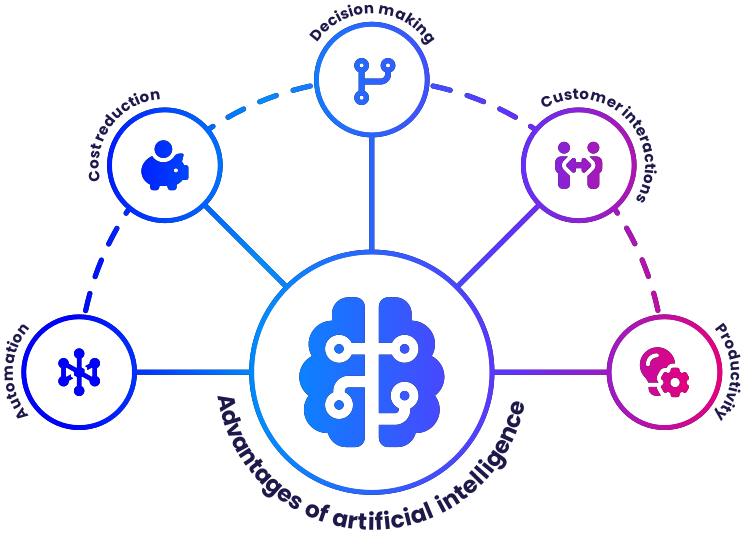
1. Process Automation
AI can handle repetitive tasks such as data entry, scheduling, or invoice processing. This not only saves companies valuable working time but also reduces the workload on their employees. Employees can instead focus on creative or strategic activities that create real added value.
Intelligent automation combines three tools:
-
RPA (Robotic Process Automation): handles repetitive clicking tasks and routine tasks
-
AI chatbots: handle dynamic communication around the clock
-
Workflow orchestration: seamlessly integrates both worlds in the background
2. Cost reduction through proactive planning
The classic approach of predictive maintenance (wear detection via sensors) is being revolutionized by generative AI. When a machine reports a problem, AI today not only provides the error code but also immediately generates the appropriate repair instructions from thousands of pages of manuals and then automatically creates the maintenance report. This minimizes both downtime and administrative overhead.
3. Informed decisions thanks to data analysis
To truly leverage data silos, you need the synergy of two disciplines. The problem: A language model doesn’t know your current business figures. The solution: RAG (Retrieval Augmented Generation).
By connecting the AI directly to your databases, you can “interact” with your live data:
-
Question: “Why did shipping costs increase in Q3?”
-
Answer: The AI immediately provides a precise summary, including sources from your ERP system.
-
Result: Decisions are based on facts rather than gut feelings.

Get a personalized AI consultation today.
4. Personalized customer interaction
The classic “Customers who bought X also liked Y” recommendations are now merely a technical formality. The real value lies in dialogue. Thanks to large language models, systems no longer just interpret clicks—they understand context.
Instead of rigid filters, customers are greeted by a true assistant. For example, someone searching for “running shoes for knee problems” won’t get a random list, but rather personalized advice on cushioning levels, including questions about the type of terrain.
The result? The shopping experience no longer feels like it’s driven by an algorithm, but rather like genuine service. This not only increases the average order value but also fosters long-term customer loyalty, because users feel understood.
5. Increasing productivity
The productivity gains driven by generative AI are already measurable today. Recent studies provide compelling evidence of this:
-
Support & Service: +15% productivity for average teams; new hires reach expert level significantly faster (Stanford study).
-
Writing & office work: up to 40% faster for routine tasks such as text creation—while also delivering 18% higher quality (MIT study).
These figures show that AI is far more than just a tool for minor improvements. It is the lever that frees up resources. Instead of wasting time on repetitive tasks, your teams can focus on what really matters: strategy, innovation, and excellent customer service.
You can learn more about this in the following guides:
Artificial Intelligence – A Comparison of the Pros and Cons
Before we delve into the challenges in detail, it’s worth making a direct comparison. Where are the quick wins, and where are the hidden cost traps? This table compares the most important factors:
| Area | Advantages | Disadvantages |
|---|---|---|
| Efficiency & Processes | Significant time savings on routine tasks (up to 40% for text/code) and 24/7 availability thanks to bots. | Significant initial effort required for governance and architecture; risk of inefficient solutions without a clear strategy. |
| Customer experience | Real conversations instead of rigid filters: Hyper-personalized advice and empathetic service powered by LLMs. | Risk of misrepresentation: If the bot provides incorrect information, it risks losing the customer's trust. |
| Data & Knowledge | “Chat with Your Data”: Instant access to company knowledge via RAG for informed decisions. | Shadow AI & Leaks: When Employees Copy Sensitive Data into Insecure Public Tools. |
| Security | Secure enterprise environments allow for use without data training (no-training policy). | New attack vectors such as prompt injection and lack of transparency in decision-making (black box). |
Focus on Challenges and Risks
We saw the opportunities. But a realistic business case also requires an honest assessment of the challenges. AI is powerful, but it’s not a sure thing. Anyone who wants to use it effectively must understand and manage the technical and organizational risks.
1. Costly and time-consuming implementatio
The main challenge today is less the hardware and more architecture and governance. It’s not enough to simply choose a model; it must be securely integrated. Planning is more important here than the software itself. A secure enterprise architecture requires:
- RAG integration: to ensure that corporate knowledge is accurately incorporated into the AI
- Guardrails: technical safeguards that prevent the chatbot from revealing trade secrets
- Observability: Real-time monitoring to detect issues immediately
2. Security Risks and Data Protection
The risk is twofold: From a technical standpoint, there is a risk of hallucinations (the AI fabricates facts) and prompt injections (attacks on security filters). From an organizational standpoint, shadow AI poses the greatest threat: When employees copy sensitive data into public tools, data protection is compromised.
The solution lies not in bans, but in secure enterprise environments (e.g., via Azure/AWS with EU hosting) that contractually guarantee that your data will not be used to train public models.

Is your current software holding you back? We have the solution.
3. Potential job losses
Generative AI primarily impacts knowledge work (support, coding, marketing). This understandably fuels fears. But the reality is more nuanced: In most cases, AI doesn’t replace the job, but rather the routine within it. The danger lies less in being replaced by AI than in being replaced by someone who uses it more effectively.
For companies, this entails a massive responsibility. It’s not enough to simply purchase licenses; they must invest in upskilling. The focus is shifting from mere creation to evaluation and orchestration. Companies that fail to support their teams with targeted training risk not empty offices, but an overwhelmed workforce flying blind in a technological landscape.
4. Increased reliance on AI & vendor lock-in
AI is here to stay—and it is becoming critical infrastructure. According to a 2024 survey on dependence on digital imports, a full 67% of the companies surveyed in Germany stated that they are dependent on artificial intelligence.
But this dependence has a dangerous economic downside: vendor lock-in. Anyone who tightly ties their business processes to a single model provider (such as OpenAI or Google) puts themselves at that provider’s mercy.
-
Model updates: If the US provider changes the algorithm, your saved prompts will often no longer work.
-
Pricing & Licenses: If API prices change, you have no alternative but to accept it.
The solution: Model agnosticism. Design your architecture so that you can swap out the AI model in the background at any time
Harness the Benefits of Artificial Intelligence – with MaibornWolff
The benefits of artificial intelligence are clear: whether it’s cost reduction, automation, or leaps in innovation, AI is the driving force behind the next phase of growth. But the path from the first pilot project to a stable enterprise solution is not a sure thing.
For AI to truly work in a business, a software license alone is not enough. Modern projects require a clean architecture: from data integration via RAG, through targeted fine-tuning, to continuous evaluation and watertight governance.
This is exactly where we come in. At MaibornWolff, we help you make this complexity manageable. We integrate AI into your processes not just technically, but in a way that makes strategic sense. Contact us—and let’s work together to turn technology into real value.
And take advantage of the many opportunities available.
Frequently Asked Questions About the Benefits of Artificial Intelligence
What is the difference between RPA and AI automation?
RPA (Robotic Process Automation) operates strictly based on rules and repeats defined actions (e.g., “Copy value A to field B”). AI, on the other hand, understands context, unstructured data (such as emails), and learns over time. The most advanced solution combines both: AI understands the problem, and RPA executes the action.What does RAG stand for, and why is it important?
RAG (Retrieval-Augmented Generation) connects AI with your company's internal data. This allows the AI to answer questions about internal contracts or revenue figures without requiring this data to be publicly trained.
What are hallucinations in AI?
This refers to situations where an AI generates a response that sounds plausible but is factually incorrect or entirely fabricated. This is one of the main risks that must be mitigated through human oversight (human-in-the-loop) and fact-checking.
How can I prevent data theft caused by AI?
By opting for enterprise solutions. Public, free tools often use user input for training. Enterprise instances (e.g., via cloud providers) contractually guarantee that your data will not leave your secure environment (no-training policy).
Kyrill Schmid is Lead AI Engineer in the Data and AI division at MaibornWolff. The machine learning expert, who holds a doctorate, specialises in identifying, developing and harnessing the potential of artificial intelligence at the enterprise level. He guides and supports organisations in developing innovative AI solutions such as agent applications and RAG systems.