

Production automation: From planning to digital transformation
Estimated reading time: 9 minutes

Today's manufacturing offers many opportunities to rethink and improve processes in a targeted manner. Our goal is to find manual bottlenecks in your processes and eliminate them in a targeted manner. We examine which steps can be eliminated through AI, IIoT or RPA in order to shorten the path to the result.
Automation in production means more than just making machines run faster. It is about the targeted digitalisation of manufacturing processes with a clear focus on cost-effectiveness and suitability for everyday use. In short, we do not automate because it is technically possible, but because it has a measurable effect on operations.
The most important facts in brief
-
What does production automation mean? Targeted digitalisation of manufacturing processes through networked, semi-autonomous systems to reduce operational complexity in the long term.
-
Why is implementation currently strategically crucial? It serves as a response to skills shortages and cost pressures by enabling more stable processes, higher quality and fact-based decisions.
-
Which key technologies form the foundation? The focus is on cobots, AI-supported maintenance and IIoT solutions based on open industry standards such as OPC UA and MQTT.
-
What does a successful project path look like? Successful companies use the structured DMAIC framework (Define, Measure, Analyse, Improve, Control) to measurably optimise existing processes in iterative loops.
-
What is the biggest technical challenge? The biggest hurdle is the integration of legacy systems. We solve this with retrofits: sensors monitor outdated systems and make them digitally fit.
Production automation: When machines start to think for themselves
Modern production automation does not describe a single technological leap, but rather a fundamental change in the way manufacturing is conceived, controlled and operated.
Networked systems instead of isolated machines
Production environments connect plants, systems and people. Machines make decisions based on real-time data, processes respond flexibly to deviations, and humans intervene where experience and overview are required.
Technology as a tool, not as decoration
Whether automating manufacturing, modernising existing lines or rethinking production: collaborative robots, IIoT, cloud platforms and AI in production act as an integrated toolbox. Their goal is more efficient processes, more stable quality and better decisions – not technology for its own sake.
Making complexity manageable
For us, automating production primarily means analysing data options and tidying up sources. Data is transformed from a by-product into a central working tool. This helps to identify deviations early on and avoid costs – ideally before they arise.
We draw a clear line here: while digitalisation makes information available in the first place, automation uses it to control processes without manual intervention. True optimisation also questions the process itself before technology is used – because automation does not improve a poor process, it only makes it faster.
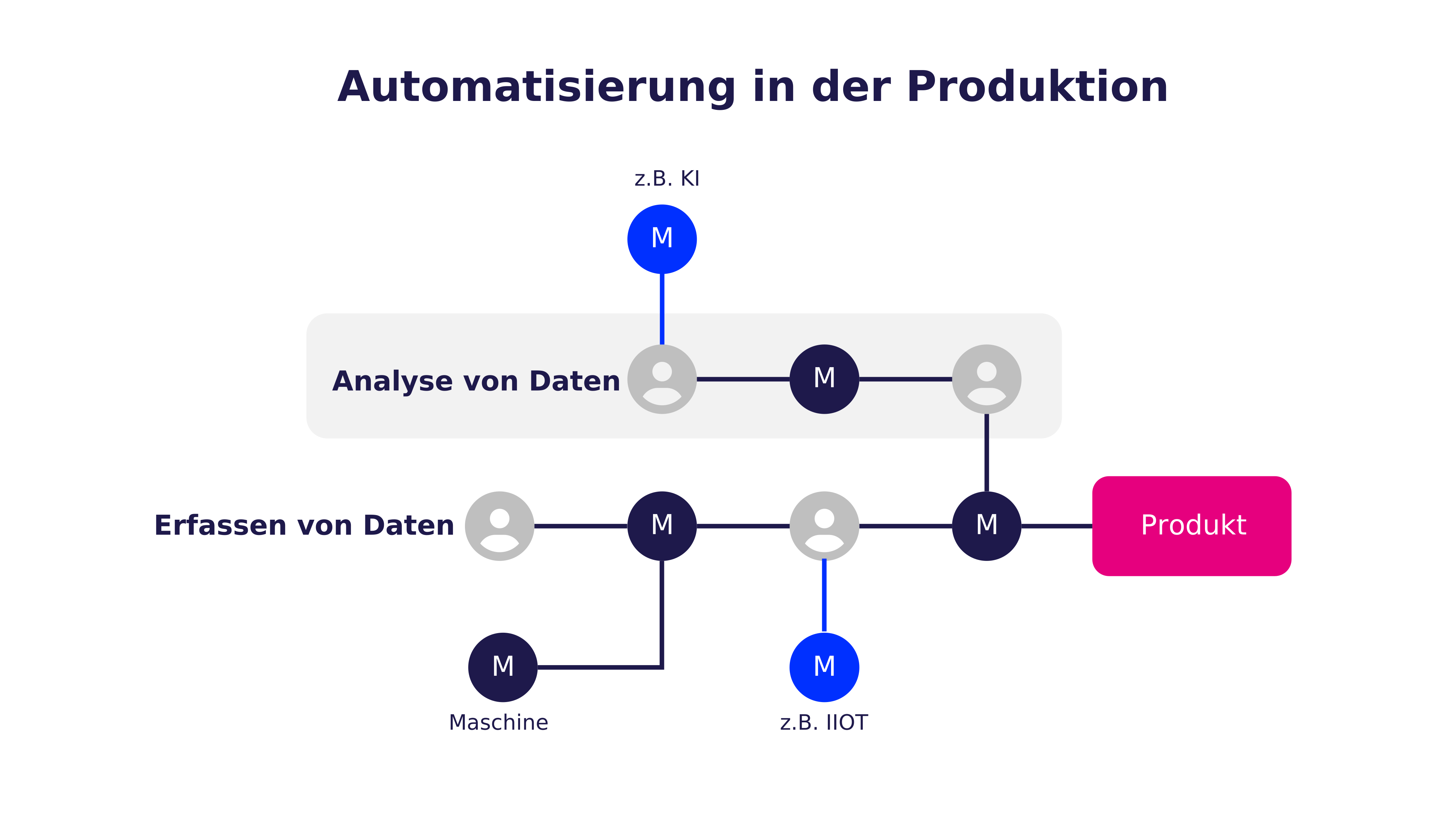
We view your process as a chain of many steps. Our goal is to untangle this chain by identifying which steps can be replaced or completely eliminated through intelligent solutions such as IIoT or AI. The following sketch illustrates this path to direct process output:
Focus on benefits and people
The benchmark for modern automation is not what is technically feasible, but rather the measurable benefits. Artificial intelligence is used specifically where it delivers real added value at a manageable cost. The aim is a humanistic approach: technology relieves the burden of routine tasks and creates space for value-adding activities.
Which key technologies really make your production smart
Production automation is not created by a single technology, but rather by the interaction of several components. The decisive factor is how well they mesh with each other:
-
directly in the process,
-
data-driven in the control system, and
-
consistently across all system levels.
The basis for a future-proof smart factory is a modular architecture that consistently relies on open industry standards: OPC UA (Open Platform Communications Unified Architecture) for platform-independent data exchange, MQTT (Message Queuing Telemetry Transport) for efficient communication with low bandwidth, and TSN (Time-Sensitive Networking) for guaranteed real-time data transmission.
Collaborative robots, known as cobots, work safely alongside humans and take on repetitive tasks. Unlike conventional industrial robots, they are equipped with sensors that enable direct interaction without protective fences. High precision, flexible programming and the absence of traditional protective fences make them space-saving and economical to use.
AI uses real-time production data for predictive maintenance and automated quality assurance. The IIoT (Industrial Internet of Things) also makes existing machines smart: we retrofit old systems with sensors that monitor their operation. This gives us real-time insights without you having to completely replace your machinery. Cloud platforms bundle the data as a basis for fact-based decisions in the smart factory.
SCADA (Supervisory Control and Data Acquisition) systems are used for the direct monitoring and control of processes, while the MES (Manufacturing Execution System) coordinates operational execution. The connection to the ERP (Enterprise Resource Planning) system ultimately integrates this data into business planning. This creates a clear line from the sensor in the machine to the management decision.
How does an automation project work in practice?
Automation projects rarely fail because of technology, but rather due to a lack of clarity, false expectations or trying to do too much at once. We don't think of automation as a linear process, but rather as iterative loops. A structured, pragmatic approach ensures that good ideas are turned into robust solutions.
We work according to the proven DMAIC framework, which fits perfectly with our mantra "Less Technology. Better Business". Why? Because it focuses on optimising and stabilising your existing systems instead of radically reinventing everything. In this way, we achieve maximum business benefit with minimum technological complexity through targeted interventions.
What is the DMAIC framework?
-
D (Define): Definition of business-critical issues and objectives
-
M (Measure): Measurement of the current situation and analysis of data sources
-
A (Analyze): Identification of the real causes and inefficiencies
-
I (Improve): Implementation of the tailor-made solution (as much technology as necessary)
-
C (Control): Permanent safeguarding of results and continuous optimisation
1. Define: Set the framework
It usually starts with you describing a problem you encounter in your everyday work. Together, we define the strategic framework. Production provides the crucial process knowledge, while IT evaluates integration issues. The goal: a robust basis for decision-making instead of automation based on gut feeling.
2. & 3. Measure & Analyse: Establish facts
We take a sober look at the current situation. Existing processes are recorded, weaknesses identified and data sources thoroughly cleaned up. A well-founded feasibility study examines the technical feasibility and evaluates the economic benefits using concrete KPIs – such as reduced throughput times or improved quality.

Integration into existing IT/OT landscapes
Established system landscapes are often the biggest hurdle. Legacy machines and proprietary interfaces require clean integration and OT expertise. Security is considered right from the start. Hybrid cloud approaches combine edge computing with cloud analytics – in line with security and compliance requirements.
4. Improve: Implementation & Testing
Implementation does not follow a big bang principle, but rather an iterative approach in manageable steps. We develop a minimum viable product (MVP) – a lean, functional solution for a specific use case. This is tested under real conditions and gradually expanded. Change management is involved from the outset to ensure that the solution is truly accepted in everyday working life.
5. Control: Regular mode & bonus
After a successful pilot phase, the solution is transferred to regular operation. Continuous monitoring records the key performance indicators. Scaling to additional areas is based on this proven experience.
The MaibornWolff bonus: Once we have completed the project, you will not only have an efficient system. The optimised process framework will remain in your company as a valuable tool, enabling you to manage future optimisations independently.
Common stumbling blocks – and what really helps in practice
First, the good news: the typical stumbling blocks – from resource shortages to vague targets – are old acquaintances. With a pragmatic approach and a focus on the essentials, they can be reliably circumvented before they slow down your project.
Sometimes the solution lies not in technology, but in strategy. If you want to reorganise your processes or your entire vision, our experts at NewSpective will be happy to take a look at the big picture. We understand "design" in its original sense: as the intelligent planning and structuring of your processes – for automation that truly suits your business.
Too little time, too few minds
The need for qualified employees is often underestimated. Production expertise meets IT and automation skills, a combination that is not readily available in everyday life. Targeted further training, interdisciplinary teams and cooperation with specialised partners have proven their worth.
The tandem model is particularly effective: external experts work closely with internal employees and systematically pass on their knowledge. This not only creates a solution, but also sustainable expertise within the company, even after the project has ended.
Technology without a target vision
Automation without clear objectives is like navigation without a destination: lots of movement, little progress. Technology-driven projects quickly lose focus if the business benefits are not clearly defined.
Successful projects start with a robust roadmap and the right methodology. To help you find your way through the jungle of terminology, we rely on frameworks such as DMAIC or Kaizen to make your existing processes more efficient. When it comes to a complete redesign, DMADV or Sigma provide the right framework.
Importantly, we are not dogmatic. We choose the tool that exactly matches your level of maturity – be it Lean Production or the Theory of Constraints. Regular reviews and an iterative approach ensure that course corrections can be made early on.
Compliance as a stumbling block
Regulatory requirements in areas such as NIS-2 or data protection are often considered too late in the process. We rely on a compliance-by-design approach, in which governance requirements are integrated directly into the automation pipelines as 'policy-as-code' to guarantee security and legal compliance right from the start.
Production automation with MaibornWolff
Production automation demonstrates its value through more stable processes and better quality in day-to-day business. The key to this is a consistent focus on specific goals and seamless integration into existing structures.
From the first pilot to scaling: MaibornWolff supports companies from the initial assessment to effective implementation. We manage investments in a targeted manner and ensure that automation is designed to be as sensible as possible, rather than as complex as possible.
Frequently asked questions about production automation
How can I tell whether automation is worthwhile for my company?
The first indicator is not the number of manual activities, but the stability of your processes. High scrap rates, unplanned downtime or highly fluctuating throughput times are often better starting points than pure personnel costs. A rough profitability assessment can usually be made with just a few key figures, even before specific technologies are selected.
What role does data quality play in automation?
Without reliable data, automation quickly reaches its limits. Incomplete or inconsistent production data leads to incorrect decisions, no matter how modern the technology is. That is why it is important to clarify early on which data is really needed and how it can be cleanly collected, maintained and used.
How is automation changing the role of employees in production?
Automation rarely replaces entire roles, but rather shifts tasks. Routine activities are reduced, while monitoring, analysis and optimisation become more important. Companies that involve employees at an early stage make better use of existing knowledge. This is where we encounter the usability paradox: although we reduce manual steps, humans remain in the loop as analysts and decision-makers. User experience (UX) must also be excellent in an automated process. Only if the technology remains intuitive to use will automation bring the desired success.
How flexible do automated production systems remain when product changes occur?
Flexibility depends heavily on architecture. Modular solutions with clear interfaces are much easier to adapt to new products or batch sizes than monolithic systems. That is why it is not only today's requirements that are decisive, but also the question of how often products and processes change.
As a consultant and software designer, Vadim actively shapes the solutions developed by the Pro-Code AI Solutions delivery unit. With a background in digital design and process usability, he focuses on measurably improving business and production processes. In customer projects, he ensures that new solutions can be easily and intuitively integrated into the existing corporate ecosystem without any friction losses.