
AI in the automotive industry
Estimated reading time: 17 minutes

How artificial intelligence is revolutionizing the automotive industry
A robotic arm in car body manufacturing can weld thousands of seams every day. In the past, employees used to check at random whether the weld spots were evenly spaced—a time-consuming and error-prone task. Today, AI-supported camera systems perform this quality control in real time: they detect deviations from the norm with an accuracy of a thousandth of a millimeter, report irregularities immediately, and thus prevent defective components from entering the production cycle in the first place.
For car manufacturers, this means less waste, significantly lower rework costs, and consistently high quality. But the potential doesn't end there: AI optimizes entire production lines, calculates machine wear in advance, better known as "predictive maintenance," and flexibly controls logistics flowsdepending on parts availability.
The automotive industry is currently at a turning point: more and more processes that were previously controlled by experience and human intuition are now being supported by data-based AI systems or completely taken over.
This guide shows you the specific opportunities in production, development, and operations, which international developments are relevant – and which strategic decisions you should make now in order to keep pace with global competition.
What is behind AI in the automotive industry? A clear definition
The example from manufacturing already shows that artificial intelligence is no longer an abstract promise for the future, but a tangible tool that is changing the automotive value creation process. To understand these changes, it is worth taking a look at the basics of automotive AI.
Definition of AI in the automotive industry
Artificial intelligence in the automotive industry refers to systems that perform tasks that traditionally required human intelligence: recognizing patterns, making decisions, learning from data.
Unlike traditional software solutions, AI systems do not just follow rigid rules, but develop dynamically the more data they process. In the automotive context, this encompasses the following three key areas of application:
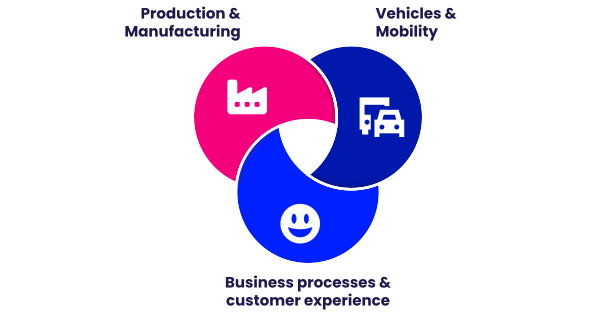
- Production and manufacturing – such as quality control, process optimization, or predictive maintenance.
- Vehicles and mobility – AI in driver assistance systems, autonomous driving, and intelligent navigation.
- Business processes and customer experience – from data-driven marketing and personalized services to new business models.
AI is therefore not just a tool for increasing the efficiency of individual work steps, but a cross-sectional technology that is used at almost all levels of the automotive industry.
Why is AI so crucial for the industry?
As already described, the automotive industry is currently undergoing historic change. For decades, it was characterized by mechanical perfection, increased efficiency through lean management and incremental product improvements.
Today, however, several megatrends are simultaneously affecting one of our most important economic sectors: electrification, digitalization, connected mobility solutions and new competitors from the tech world. In this tense environment , new technology is a decisive factor in ensuring competitiveness and innovative strength. But what specific advantages does AI offer in the automotive industry? Let's take a closer look now:
Efficiency and productivity in manufacturing
Automotive production is complex: hundreds of thousands of components, tightly scheduled supply chains, and highly automated plants. Even the smallest disruptions can cause enormous costs. AI in production is creating a paradigm shift here: production data is analyzed in real time, deviations are detected immediately, and processes are automatically adjusted. The result is higher overall equipment effectiveness (OEE), less waste, and more stable production.
Quality assurance at a new level
In automotive manufacturing, quality is a key success factor. Defective components or recalls can cost billions and cause lasting damage to a brand's image. AI-based image recognition and sensor technology make it possible to identify sources of error in real time – comprehensively, rather than just on a random basis. This shifts quality assurance from a reactive to a proactive discipline.
Speed in research and development
Traditionally, development cycles in the automotive industry are long and expensive. AI significantly shortens these cycles: simulations, data-based tests, and the use of digital twins allow prototypes to be tested and optimized virtually before physical models are created. This significantly accelerates the market launch of new vehicle models and technologies.
Transformation towards data-driven business models
Vehicles are no longer just a means of transportation, but rolling data platforms. Every kilometer traveled provides valuable information about driving behavior, usage patterns, and technical conditions. AI makes this data usable—for personalized services, optimized fleet management, or new mobility offerings. This opens up an additional, scalable source of revenue for manufacturers beyond traditional vehicle sales.
Future security in global competition
The competitive landscape is changing radically: while European manufacturers traditionally excel in precision and quality, American tech companies are driving data-driven innovation, and China is focusing on state-sponsored speed and scale. AI is the key to competitiveness here—not only in production, but also in the development of new mobility concepts and the creation of digital ecosystems.
Regulatory and social pressur
AI also plays a role in meeting climate targets and regulatory requirements. Efficiency gains in production and logistics contribute to reducing CO₂ emissions. At the same time, society increasingly expects vehicles to become safer, more sustainable, and smarter. Without AI, these requirements would be almost impossible to meet.
Consulting for better business.
MaibornWolff creates excellent, sophisticated, and customized software solutions for clients and their users. We advise, code, and test in comprehensive digitization projects. What has been driving us for over 30 years? Complex questions and ambitious projects! With our extensive know-how, we can get your project off the ground.
AI is like a catalyst for the automotive industry, deeply impacting the value chain. They also secure access to new sources of revenue and position themselves as innovation leaders in a market where tech companies and start-ups are putting increasing pressure on established players.
AI is thus no longer an optional tool, but rather a strategic foundation for actively shaping the mobility of the future.

Digital twins – from vision to reality
How digital twins optimize your processes, reduce costs, and open up new opportunities in automotive production.
Automotive AI worldwide: comparing developments
The significance of AI for the automotive industry is evident from the technological possibilities it offers – but it is also evident in the international competition between manufacturers. While the focus in Germany and Europe has long been on perfecting classic production processes, other countries began early on to use AI as a strategic lever in their business processes.
USA: Data-driven innovation and platform economy
In the United States, AI is being driven forward by the tech giants. Companies such as Google (Waymo), Tesla, and Nvidia are investing heavily in autonomous driving and data-based vehicle intelligence. Their focus is less on optimizing manufacturing and more on developing completely new business models – from robot-assisted taxi services to data-driven platform services.
China: Speed and government control
China is pursuing a different approach: government programs and subsidies are systematically driving AI forward in the automotive industry. Numerous pilot regions for autonomous driving have been created, and the close cooperation between manufacturers, tech companies, and authorities ensures rapid scaling. This is particularly evident in areas such as facial recognition in vehicles and urban transport infrastructure, which is directly linked to AI systems.
Germany and Europe: Strengths in production, room for improvement in scaling
German automakers are considered leaders in AI-supported manufacturing and quality control. Predictive maintenance, robotics, and data-driven logistics have long been established in many plants. However, compared to the US and China, Europe is lagging behind in the implementation of large-scale AI infrastructures in vehicles themselves. The reasons for this are complex regulatory requirements, but also a traditionally strong engineering culture that is only gradually integrating software and data solutions.
The international landscape shows that AI is not only a technological issue, but also a geopolitical one. While the US and China score points with speed and scale, Europe's strengths lie in precision, security, and standardization.& nbsp;
For car manufacturers in Germany, this means that they must combine their advantages in production and engineering with data-driven innovations in order to remain competitive internationally.
What opportunities does AI offer car manufacturers?
International analysis clearly shows that those who use artificial intelligence strategically secure competitive advantages. But how can manufacturers make targeted use of these opportunities? At the heart of the various areas are three fields: efficiency, quality, and innovation.
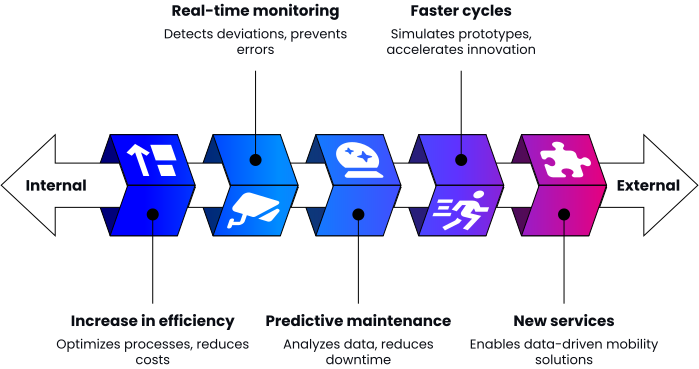
AI helps to optimize processes, identify bottlenecks at an early stage, and reduce costs. While traditional production control is often based on fixed parameters, AI can continuously learn from real-time data and thus respond more flexibly to deviations.
A practical example
Real-time quality control
Where random sampling used to suffice, AI now provides seamless monitoring. Camera systems and sensors detect even the smallest deviations in the welding process or in the material structure. Defective parts can be sorted out immediately or reworked before they reach final assembly. This reduces the number of complaints and strengthens customer confidence in the brand.
Predictive maintenance in manufacturing
Machine failures are among the most expensive risks in production. AI-supported systems analyze vibrations, temperature, and performance data from systems and identify patterns that indicate impending wear. This allows maintenance to be carried out in a targeted and timely manner, drastically reducing downtime.
Faster development cycles
AI is also proving its worth in research and development. Simulation models based on historical data allow engineering teams to test virtual prototypes before physical models are even built. This accelerates the innovation process, saves costs, and reduces the time-to-market for new vehicles.
New business models
In addition to production, AI also opens up opportunities in the area of mobility services. Manufacturers can develop data-driven services – from personalized maintenance offers to intelligent fleet solutions for car sharing. This means that cars are increasingly becoming part of a connected mobility ecosystem that opens up sources of revenue beyond traditional vehicle sales.
The opportunities offered by AI in the automotive industry are not limited to pure efficiency gains. Rather, they mark the transition to a new industrial logic: away from rigid production chains and toward learning systemsthat can respond flexibly to market and customer expectations.
Those who invest in automotive AI today not only build cost advantages, but also establish themselves as designers of new mobility solutions and data-driven business models. Manufacturers who miss out on this development risk seeing their role reduced to pure hardware production – while others control digital value creation.

Get expert advice on the topic of AI!
Our experienced AI experts are happy to help. Schedule a free initial consultation here.
Challenges in the use of AI
The potential of AI for the industry is enormous – but at the same time, its implementation poses complex challenges.
Brands such as Audi, Mercedes, and BMW are facing technological, organizational and regulatory hurdles that must be addressed strategically in order to achieve sustainable advantages. These include, above all:
Data quality and data management
AI systems are only as good as the data they are trained on. Automotive production generates huge amounts of data – from sensor data and manufacturing parameters to vehicle information. Inaccurate, incomplete, or unstructured data can severely limit the efficiency of AI models. Manufacturers should build robust data architectures that systematically combine data collection, storage, and processing.
Integration into existing systems
Many car manufacturers have established IT and production landscapes that are not designed for AI applications. Integrating new AI solutions into existing ERP, MES, or production systems is complex and requires interface management, process adjustments, and often gradual modernization.
Skills shortage and internal competencies
Implementing AI requires experts in data science, AI modeling, and software integration—profiles that are in high demand on the market. At the same time, existing employees must be trained to understand and effectively use AI-based processes. Without this combination, there is a risk of a knowledge gap that can delay projects or reduce their quality.
Regulatory and ethical requirements
AI in vehicles and production is subject to strict legal requirements. The EU AI Act, data protection guidelines, and safety standards such as ISO 26262 define framework conditions that companies must comply with. Violations can not only result in fines, but also undermine the trust of customers and partners.
Acceptance and change management
Looking at the key challenges shows that implementing AI is a balancing act. The major car brands must reconcile technological excellence, organizational adaptation, and regulatory compliance.
Only those who approach these challenges strategically will be able to fully realize the opportunities that we outlined in the previous section.

Is your company AI-ready?
Our AI readiness check helps you gain clarity: structured, efficient, and interdisciplinary.
Technological foundations: Infrastructure for AI in automotive
For artificial intelligence to reach its full potential in the automotive industry, it needs a solid technological foundation. With the a9>suitable platforms, data architectures, and AI models, existing processes can be optimized, new products developed, and digital business models implemented.
Machine learning and deep learning
Machine learning (ML) forms the basis of many AI applications in the automotive industry. ML algorithms recognize patterns in large amounts of data—for example, failure patterns in production machines or typical driving behavior patterns. Deep learning, a subcategory of ML, enables the use of neural networks to perform complex tasks such as image or speech recognition in real time. Examples include visual quality control in production lines or object recognition in driver assistance systems.
Natural Language Processing (NLP) and Generative AI
NLP enables the processing and interpretation of human language. In modern vehicles, NLP is used to understand voice commands and execute them in context. Generative AI (GenAI) goes one step further: it can independently generate content, such as responses in customer service chats or simulations for development planning. For car manufacturers, this opens up new ways to automate processes and customize services.
Data platforms and cloud/edge architectures
AI thrives on data. A powerful infrastructure collects, processes, and analyzes data from various sources—from manufacturing plants and vehicle fleets to customer data. Cloud solutions offer scalability and central analysis platforms, while edge computing enables critical processes directly on vehicles or production lines to minimize latency and guarantee real-time analysis.
Integration into existing systems
A key success factor is seamless integration into existing IT and production landscapes. Enterprise resource planning (ERP) systems, manufacturing execution systems (MES), and other digital tools must be orchestrated in such a way that AI-supported processes run reliably and stably. This integration ensures that analyses do not remain isolated, but directly support operational decisions.
Scalability and security
For car manufacturers, it is crucial that AI solutions are scalable – from pilot projects in a production line to global fleets. At the same time, security and data protection aspects must be taken into account in order to comply with regulatory requirements and ethical standards.
Low scalability | High scalability | |
|---|---|---|
| Low integration | Pilot projects
Pilot projects have low integration and scalability
| Edge computing applications
Edge computing applications enable high scalability with low integration
|
| High integration | ERP system integration
ERP system integration offers high integration but low scalability.
| Cloud-based NLP solutions
Cloud-based NLP solutions offer high integration and scalability
|
The technological infrastructure is the backbone of any AI initiative. By combining ML and deep learning algorithms with modern data platforms, cloud/edge architectures, and systematic integration, you can fully exploit the opportunities offered by AI and successfully overcome the challenges outlined in the previous chapter.
Automotive AI in practice: specific application examples
Now that we have looked at the technological foundations and infrastructure, it is only in practice that we can see how AI is actually used in the automotive industry.
Leading manufacturers are combining machine learning, deep learning, cloud solutions, and data platforms to make manufacturing, vehicle functions, and business processes more efficient and innovative. Let's take a look at some practical use cases.
Efficiency and quality in production
One of the world's largest automotive groups uses AI primarily in manufacturing. Sensors and visual inspection systems detect the smallest deviations in weld seams or paintwork. Predictive maintenance systems analyze machine data, predict failures, and reduce downtime. This automation enables the manufacturer to reduce costs, minimize scrap, and increase production speed at the same time.
Strategic AI integration
A manufacturer that primarily produces in the luxury segment is focusing on a holistic AI strategy. A Chief AI Officer (CAIO) coordinates cross-departmental projects – from research and development to production. Cloud-based data platforms are used to analyze large vehicle fleets in order to improve the performance of assistance systems or make data-based decisions on future designs, for example.
Networked solutions and IoT
One of the industry's most important suppliers is integrating AI into manufacturing, supply chains, and vehicle technologies. IoT sensors continuously generate data from machines and vehicles, which is then evaluated in cloud architectures. This creates networked production systems that can react in real time – for example, by automatically readjusting manufacturing robots or optimizing logistics flows.
Driver assistance and autonomous systems
Beyond production, manufacturers are using AI for assistance systems. Cameras, radar, and lidar sensors provide data that is analyzed in real time by neural networks. Autonomous braking functions, lane departure warning systems, and adaptive cruise control systems are the tangible results that increase safety and driving comfort. These systems are based directly on the machine learning and deep learning technologies described above.
These practical examples show that whether in manufacturing, product development, or autonomous functions, manufacturers who make targeted use of AI benefit from greater efficiency, better quality, and new business opportunities.

AI in industry – rethinking efficiency
Discover how AI makes production smarter: from predictive maintenance to process optimization. Read our guide now!
AI has long been more than just a technical experiment—it is becoming a strategic success factor in the automotive industry.
The analysis of opportunities, challenges and practical examples to date shows that manufacturers must set the course today in order to set the course today in order to remain competitive tomorrow.
Key developments in the automotive industry
The automotive industry is at the beginning of a decade in which technological advances and market changes are taking place at a rapid pace. Artificial intelligence plays a key role in this: it not only shapes the way vehicles are developed, built, and used, but also changes the business models of entire companies.
Manufacturers will see production systems become more interconnected, vehicles gain greater autonomy, and data-based services become important revenue drivers. In this context, it is worth taking a look at the forecasted trends for the next five years:
- Autonomous mobility: Vehicles with greater autonomy are being further developed and are increasingly ready for series production. AI-based assistance systems are becoming standard.
- Networked production systems: Production lines are digitally networked so that machines, robots, and people can communicate with each other in real time.
- Generative AI and data-based services: Predictive maintenance, digital twins, and personalized customer services are gaining in importance.
- Global AI ecosystems: Collaboration between manufacturers, suppliers, and technology companies will be crucial for scaling innovation.
How should manufacturers respond now?
Many decision-makers are faced with the question of how they can sensibly integrate AI into their existing structures while ensuring scalability and future-proofing.
This is where our recommendations for action come in: They highlight the steps manufacturers should prioritize – from initial pilot projects and data strategies to organizational models that will enable AI to become a long-term success factor in your organization.
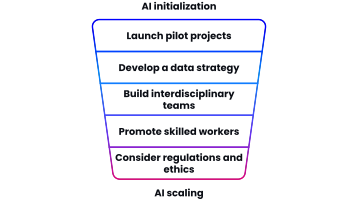
- Launch pilot projects: Small, clearly defined use cases enable rapid learning and demonstrate measurable added value.
- Develop a data strategy: Companies should collect and process data and make it available in a structured format for AI models.
- Build interdisciplinary teams: Production, IT, research, and development must work together on AI initiatives.
- Promoting skilled workers: Training and targeted recruiting ensure long-term expertise within the company.
- Consider regulatory requirements and ethics: Early compliance checks protect against legal risks and strengthen trust.
- Plan scaling: After a successful pilot project, preparations should be made to transfer it to other plants, fleets, or business areas.
Manufacturers who implement AI in a targeted manner not only gain efficiency and quality advantages, but can also tap into new business models. AI is more than a tool; it is a key driver of innovation for the transformation of the entire automotive industry.
Benefit from comprehensive AI consulting.
Selecting suitable areas of application, developing customized AI strategies, or creating a concrete AI roadmap—our experts are here to help!
Conclusion
As the previous chapters show, manufacturers benefit from the use of artificial intelligence through precise production processes, predictive maintenance, optimized supply chains, and data-driven product development.
At the same time, however, the economically successful use of AI also requires strategic planning:
Data management, organizational adjustments, regulatory compliance, and the promotion of professional skills. Companies that master these challenges not only secure competitive advantages, but also lay the foundation for new business models and sustainable, digital mobility.
FAQ: Artificial intelligence in the automotive industry
What is artificial intelligence in the automotive industry?
AI encompasses systems that perform tasks that traditionally required human intelligence. These include pattern recognition, decision-making, and independent learning. In the automotive sector, AI is used in production, vehicle technologies, and business processes.
What advantages does AI offer car manufacturers?
- Increased efficiency in production and logistics
- Real-time quality control
- Predictive maintenance and reduced downtime
- Faster development cycles through simulation and data analysis
- Development of new business models, e.g., digital mobility services
What challenges do manufacturers need to consider?
- High demands on data quality and data integration
- Complex integration into existing IT and production systems
- Skills shortage and necessary further training
- Regulatory requirements and ethical standards
- Acceptance and change management within the company
Which technologies are crucial for AI in the automotive sector?
- Machine learning and deep learning for pattern recognition and autonomous systems
- Natural Language Processing (NLP) and Generative AI for Communication and Simulation
- Cloud and edge architectures for real-time data processing
- Data platforms for consolidating and analyzing large amounts of data
How can manufacturers successfully implement AI?
- Start with clearly defined pilot projects
- Systematically develop data strategy and IT infrastructure
- Involve interdisciplinary teams from production, IT, and R&D
- Targeted training and recruitment of skilled workers
- Consider compliance, data protection, and regulatory requirements
- Plan scaling to additional plants and business areas
How is the use of AI developing internationally?
The US scores with speed and data-driven business models, China with government support and scaling, while Germany and Europe excel in precision manufacturing and quality. Manufacturers must leverage their strengths while adapting international best practices.
Kyrill Schmid is Lead AI Engineer in the Data and AI division at MaibornWolff. The machine learning expert, who holds a doctorate, specialises in identifying, developing and harnessing the potential of artificial intelligence at the enterprise level. He guides and supports organisations in developing innovative AI solutions such as agent applications and RAG systems.