
How does artificial intelligence work?
Estimated reading time: 9 minutes

Artificial intelligence (AI) analyzes huge amounts of data, recognizes patterns within it, and solves tasks autonomously. Unlike conventional software, which stubbornly follows fixed rules, AI learns through machine learning and optimizes itself without us having to dictate every step.
In this guide, you will learn how machines learn, what components are required for this, and how AI can perform different tasks using various approaches.
- Definition: What is AI? Artificial intelligence (AI for short) refers to any machine that exhibits intelligent behavior. AI systems can, for example, solve problems, make decisions, understand language, or recognize patterns—much like humans do.
- Core principle: How does AI work? AI is largely based on machine learning methods. Through repeated training with huge amounts of data, artificial intelligence improves its ability to make predictions or decisions.
- Requirements: What does AI need to function? Three components are essential for powerful AI: huge amounts of high-quality training data, efficient algorithms, and enormous computing power.
- What AI approaches are there? Depending on the area of application, there are various approaches to artificial intelligence to choose from. Today, an intelligent system is characterized by multimodality (processing of text, images, audio, etc.) and the ability to plan and solve open-ended, complex tasks rather than being limited to narrow routines.
How does AI work?
To answer the question "How does artificial intelligence work?", we need to start with the basic principle of AI that gives systems their ability to learn and make decisions: machine learning (ML).
The difference to traditional software
While classical algorithms work deterministically (input A always leads to output B, based on manually written code), AI learns probabilistically. In other words, it recognizes statistical probabilities in training data. AI functionality is therefore based on deriving rules from data itself, rather than having them dictated.
The 3 types of machine learning compared
Depending on the task and objective, we generally distinguish between three types of machine learning:
| Learning method | Functionality | Typical use case |
|---|---|---|
Supervised learning (Supervised Learning) | Training with labeled data (input + desired output). The system learns through target/actual comparisons. | Classification: Spam filter, image recognition (dog vs. cat). |
Unsupervised learning (Unsupervised Learning) | Training with unstructured data without labels. The AI independently searches for patterns and structures. | Clustering: Customer segmentation in marketing, anomaly detection. |
Reinforcing learning (Reinforcement Learning) | Learning through trial and error in an environment. Positive actions are rewarded, negative ones punished. | Optimization: Chess computers, robotics, autonomous control systems. |
ChatGPT, Siri, and Fireflies are now familiar to almost all of us. The list of AI tools is endless today. But what exactly is artificial intelligence? If you would like to learn more about it, we recommend reading our guide on artificial intelligence.

Then put your trust in MaibornWolff
How AI works: 3 basic building blocks
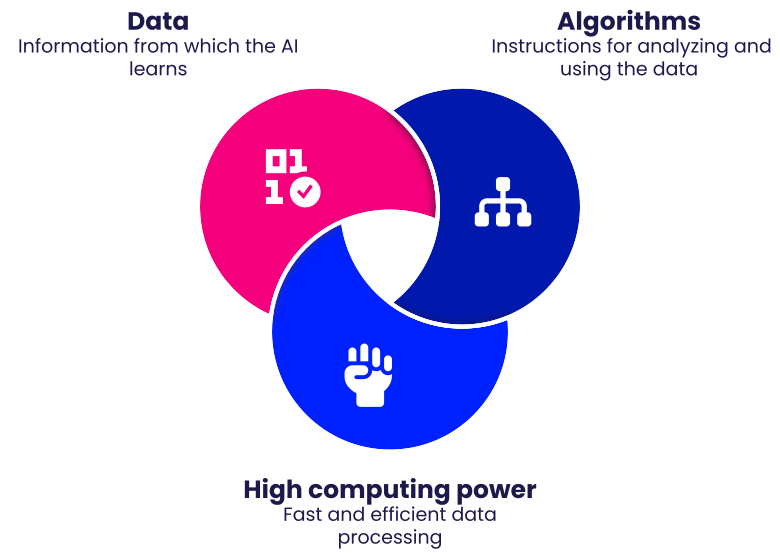
Certain prerequisites must be met for an AI system to function at all. Artificial intelligence requires a total of three basic building blocks in order to deliver the desired results:
Building block 1: Data
AI systems need huge amounts of training data to be able to find solutions independently. This data helps AI recognize patterns and make connections. The old IT rule applies here: garbage in, garbage out. It's not just the sheer volume that matters, but also the quality. Ultimately, AI is only as smart (or biased) as the data we feed it.
AI systems can be trained with these types of data, for example:
- Image data: e.g., for facial recognition or analysis of X-ray images
- Text and speech data: e.g., for chatbots or translation tools
- Numbers and financial data: e.g., for detecting fraud patterns and market trends
Building block 2: Models
Algorithms determine the rules and processes for how data is processed. They range from simple decision trees to complex deep learning architectures. The model is the result of the training process—essentially the "learned knowledge" that is applied to new data.
Here's how these algorithms affect your everyday life:
- Spam filter (classification): The algorithm checks characteristics (subject, sender) and calculates the probability of spam.
- Streaming & E-commerce (recommendation systems): Netflix or Amazon analyze your past behavior to identify patterns and generate suitable suggestions.
- Medicine (pattern recognition): In radiology, algorithms analyze X-ray images for abnormalities (e.g., tumors), often more accurately than the human eye.
Are you wondering how else AI can be used? Then read our know-how on using artificial intelligence.
Building block 3: High computing power
High computing power is the driving force behind the functionality of AI. It enables the huge amounts of training data to be processed quickly and efficiently. At the same time, it ensures that systems not only understand data, but can also react to it at lightning speed – whether it's recognizing patterns in images, translating a sentence, or making predictions.
Specific approaches and modes of operation
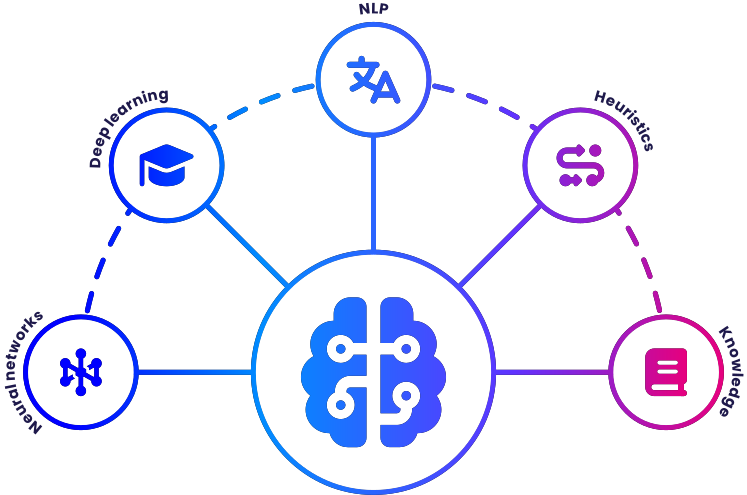
The functioning of artificial intelligence depends not only on the three basic components mentioned above, but also on the approach chosen. Depending on the area of application, there are various approaches to artificial intelligence to choose from, each of which is characterized by different modes of operation:
Neural networks
Inspired by the human brain, artificial neural networks (ANNs) consist of layers of artificial neurons.
- Input layer: This is where the data enters the system.
- Hidden Layers: This is where data is processed and patterns are recognized.
- Output layer: The results are output.
During training, the network learns to weight the connections between the layers in such a way that the results are as accurate as possible. Neural networks are used, for example, in the following areas:
- Image recognition: Neural networks are used, for example, to recognize faces, identify tumors in medical images, or categorize objects in photos.
- Finance: Neural networks help detect fraud patterns in transaction data or predict stock market trends.
- Personalization: Recommendation algorithms, such as those used by Netflix or Amazon, are based on neural networks to tailor content to individual users.
Deep Learning
Deep learning is a special method of machine learning that uses deep neural networks, i.e., networks with many hidden layers, as a basis. This enables feature extraction without human intervention. It is the standard for complex tasks such as autonomous driving or generative AI (e.g., ChatGPT).
Here is an example:
- Using neural networks, an AI system can recognize whether, for example, an image shows a dog or a cat.
- With deep learning, the AI system can solve more complex tasks—for example, recognizing different dog breeds.
As data passes through the individual layers, each layer learns something new. For example, an early layer recognizes simple edges in images, while later layers recognize shapes or entire objects. The system automatically corrects errors and becomes more accurate with each pass.
Deep learning is most commonly used for these areas of application:
- Autonomous vehicles: Self-driving cars use deep learning to analyze road images and make decisions in real time.
- Fraud detection: Financial institutions detect fraudulent patterns in transaction data.
- Generative AI: Systems such as text or image generators (e.g., ChatGPT) use deep learning to generate creative content.
Natural Language Processing
Natural Language Processing (NLP) is a field of artificial intelligence that helps machines understand, analyze, respond to, and even generate human language.
Language is broken down into smaller components—e.g., sentences or individual words. The AI system then analyzes grammar, meaning, and context, for example, in order to understand the content.
NLP is used for these applications, for example:
- Chatbots: e.g., real-time customer service
- Translations: e.g., Google Translate
- Speech recognition: e.g., systems such as Siri or Alexa

Get started with implementation and put your trust in MaibornWolff.
Heuristic methods
Heuristic methods are AI approaches that use simplified solution strategies to solve problems quickly and efficiently. They are based on rules or empirical values – so-called rules of thumb. Instead of performing computationally intensive searches for the perfect solution, the system settles for a sufficiently good solution. This AI approach is particularly useful when time and resources are limited.
Heuristic methods are used in the following areas of application:
- Chess programs: Chess AIs evaluate potential moves based on heuristics, e.g., "protect the queen" or "capture the center of the board."
- Navigation systems: Apps such as Google Maps use heuristics to calculate the best route, e.g., "Avoid traffic jams" or "Take the shortest route."
- Product recommendations: E-commerce platforms such as Amazon suggest products based on simple rules such as "Customers who bought this also bought ...".
Knowledge Representation
Knowledge representation deals with organizing and storing world knowledge in such a way that machines can draw logical conclusions. It is not about statistical probabilities (as in machine learning), but about fixed rules and facts.
Information is stored in logical rules, hierarchies, or networks (ontologies). This enables AI to understand causal relationships.
Examples of knowledge representation include:
- Google Knowledge Graph: This connects facts about people, places, and things to better understand search queries. For example, if you search for Albert Einstein, Google will not only show you links, but also relevant facts such as his date of birth, his most famous theories, or connections to other scientists.
- Chatbots: Chatbots use knowledge representation to store FAQs and generate answers. For example, a customer service bot answers questions such as "How do I change my password?" based on stored information.
- Medical expert systems: Systems such as IBM Watson store medical knowledge in the form of rules and databases to help doctors make diagnoses. For example, a doctor enters symptoms and the system suggests possible diagnoses and treatments.
How does AI not work?
AI is powerful, but not infallible. It has no real understanding of our world, but stubbornly calculates probabilities. And even statistics can be wrong sometimes. Here are the most common causes of failure in AI projects:
- Poor data quality (bias): Incorrect, incomplete, or distorted training data causes AI to learn incorrect patterns.
- Overfitting: If the AI is too tailored to the training data, it may not handle new data well.
- Lack of context: AI often fails when faced with ambiguity, irony, or sarcasm, as it processes language mathematically rather than emotionally.
- Lack of data: If the amount of data is too small, AI cannot deliver reliable results.
- Technical limitations: Insufficient computing power or poor hardware can impair the performance of the AI.
From understanding to implementation: AI with MaibornWolff
You now have an idea of how AI works. The question is: How can we profitably integrate this technology into your IT landscape?
At MaibornWolff, we are not fans of technology for technology's sake. We help you use AI where it brings real business value and streamlines processes instead of bloating them.

Then put your trust in MaibornWolff.
FAQs
How does AI work, explained simply?
AI works through pattern recognition. It is trained using examples (data), derives rules from them (training), and applies these rules to new, unknown situations (inference). Think of it like a child learning to recognize an apple by being shown thousands of pictures of apples.
What does AI need to function?
A functioning AI requires three pillars:
- Data: As training material.
- Algorithm: As a set of rules for learning.
- Computing power: To perform the calculations.
How does machine learning differ from traditional programming?
In classical programming, humans define the rules (if X, then Y). In machine learning, the computer finds the rules independently by analyzing correlations in the data. The output is not hard-coded, but determined statistically.
Kyrill Schmid is Lead AI Engineer in the Data and AI division at MaibornWolff. The machine learning expert, who holds a doctorate, specialises in identifying, developing and harnessing the potential of artificial intelligence at the enterprise level. He guides and supports organisations in developing innovative AI solutions such as agent applications and RAG systems.