

Sovereign cloud explained simply: control, security, and trust in the digital world
Geschätzte Lesezeit: 19 Minuten

The cloud has long been the backbone of many digital business models. But the more sensitive data and critical processes migrate to the cloud, the more pressing the question becomes: Who has control in case of doubt? This is exactly where the sovereign cloud comes in. A sovereign cloud is not a product that you simply buy—it is a target state that companies must actively create. The key is to leverage cloud benefits such as scalability and speed without relinquishing control over data, compliance, and reliable evidence. In this guide, you will learn what constitutes a sovereign cloud and how your company can achieve digital sovereignty step by step.
Sovereign Cloud: The most important facts at a glance
- A sovereign cloud is a cloud environment that verifiably makes data, access, and operations controllable under a defined legal framework and reliably meets compliance requirements.
- Sovereignty in the cloud is becoming increasingly relevant as the cloud becomes the standard for core digital processes and data becomes more valuable and therefore more worthy of protection through digitalization and AI.
- A sovereign cloud combines technological sovereignty (control over infrastructure, keys, access), data and legal sovereignty (data locality, compliance), and operational transparency (auditability, open source, standards).
- The use of a sovereign cloud gives companies back control over their data and access, enables better compliance verification, and makes them less dependent on individual providers.
What is a sovereign cloud?
A sovereign cloud is a cloud computing environment that is specifically tailored to the legal, security-related, and operational requirements of a particular national or regional jurisdiction.
The aim of the sovereign cloud is to enable companies to reliably comply with applicable compliance requirements while retaining verifiable sovereignty over data, access, and protection mechanisms. In this way, the sovereign cloud supports the digital sovereignty of companies, i.e., their ability to remain self-determined and independent in critical digital matters.
The sovereign cloud is not just “another” type of cloud. While public, private, and hybrid clouds primarily describe operating models, “sovereign” stands for a target state and thus for an individual set of requirements. This is derived from your legal situation, your risk profile, and your internal governance requirements.
Although some providers advertise sovereign cloud solutions for purchase, in practice the issue is much more than just a finished product: sovereignty in the cloud is not created by a label, but by designing your cloud environment to meet your individual (legal) requirements. The operating model is secondary. A sovereign cloud environment can be implemented technically as a public, private, or hybrid cloud. What is crucial are verifiable mechanisms for control, transparency, auditability, and legal compliance.
Why the sovereign cloud is gaining importance
The concept of the sovereign cloud is becoming increasingly relevant, as the cloud has already become the standard for data storage and core digital processes in many industries. The more sensitive information is stored there, the more important it becomes to consider how this information is processed and who has control and access to the data. What's more, data is one of a company's most valuable resources today. It determines efficiency, innovation, and, increasingly, the performance of AI applications, which rely on high-quality and reliable data sets. However, data protection is not just about the necessary technological infrastructure, but also about compliance with the legal framework.
If a provider is based in another jurisdiction, this may result in access options that do not comply with European regulations (e.g., GDPR and NIS-2) regarding data protection and data sovereignty. An impressive example of this is the US CLOUD Act: if you use a US cloud provider, they may be required to disclose data to US authorities in exceptional circumstances. This also applies if the data is physically stored in the EU, as long as the provider has control over it. And even if the company in question is not a US company, but maintains a business relationship with the US through subsidiaries, for example.
This is precisely why sovereign cloud approaches are coming into focus: they are designed to ensure that access options are limited and that data protection and compliance requirements can be reliably met. If you create flexibility that makes your company independent of a specific provider, you are also less vulnerable to geopolitical and economic developments, such as trade disputes or sanctions.
This also has a noticeable impact on day-to-day business: if you are not completely tied to a single hyperscaler, you have more leeway in terms of prices, scope of services, and contract terms, and in case of doubt, you can more easily switch to alternatives without disrupting critical processes.

Get your personalized cloud consultation
Get started in the cloud in just four weeks with the right strategy.
Confidently into the digital future: The three pillars of the sovereign cloud
A sovereign cloud combines many mechanisms and measures from different areas. This makes it much more than a single feature. A sovereign cloud is created when you implement the appropriate measures across multiple pillars. It is important to have a suitable basis for this: the architecture and provider setup must fit your legal requirements and framework conditions. Building on this, it is important to consistently implement the measures in the relevant areas. To truly gain control and the ability to act, you must ensure data and legal sovereignty, as well as operational and technical sovereignty.
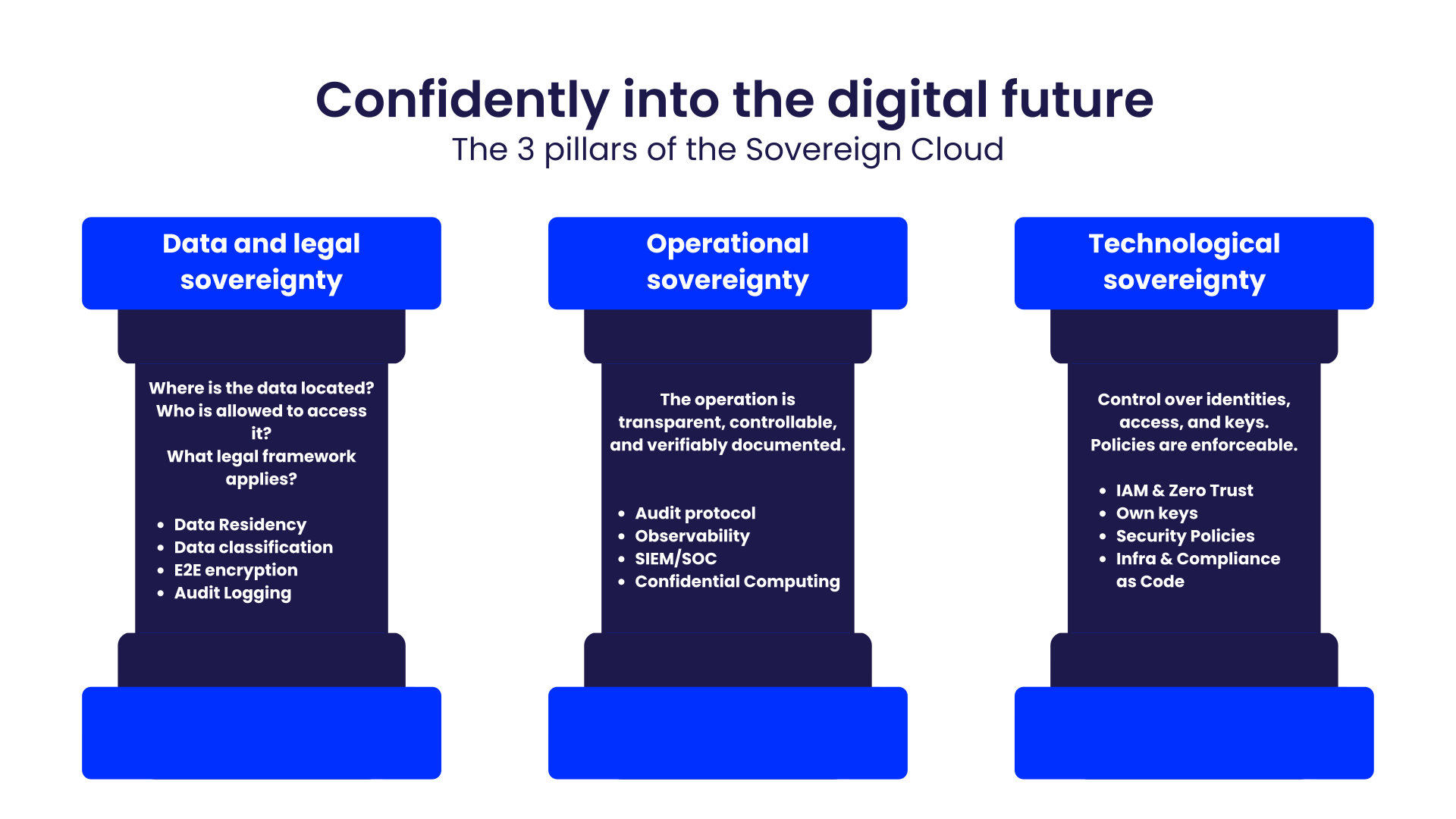
Data and legal sovereignty
Data and legal sovereignty means that you determine where your data is stored, who can access it, and under what legal conditions this happens. Essentially, it is about data locality, compliance, and protection against unauthorized or illegal access. Typical mechanisms and measures:
-
Data classification according to protection requirements:
Basis for appropriate technical and organizational protective measures. This also includes the question: Which data is particularly sensitive or regulated?
-
Set data residency:
Clear guidelines on which countries or regions data may be stored in, for example, exclusively within the EU.
-
Ensuring data sovereignty:
Control over storage locations, access, and encryption, as well as how data is processed and replicated.
-
Build hybrid or multi-cloud models:
Separate sensitive data from hyperscalers or at least store backups in sovereign environments.
-
End-to-end encryption:
Data is encrypted at the sender's end and only decrypted again when it reaches the authorized recipient. It remains unreadable to third parties during transmission and storage.
-
Sovereign Controls:
Technical controls, for example to block or restrict access from outside the EU.
-
Legal sovereignty:
Erfüllung der Anforderungen aus DSGVO, BSI-Vorgaben und EU-Regelwerken und Einführung eines Compliance-Dashboards.
Operational sovereignty
Operational sovereignty means that you make cloud operations transparent, controllable, and auditable. Auditability means that access, changes, and operational processes are documented in such a way that they can be clearly traced retrospectively and reliably verified during internal or external audits. Typical mechanisms and measures:
Tamper-proof audit logs
It records who accessed which systems or data and when, which configurations were changed, and which administrative actions were performed. The logs are protected in such a way that they cannot be changed (unnoticed) retrospectively.
Centralized observability
The three components of monitoring, logging, and tracing enable comprehensive system monitoring. All operating and security data is collected in one place. This allows you to monitor not only technical aspects, but also identify security-related events and potential compliance and data protection violations at an early stage.
SIEM and SOC integration
SIEM (Security Information and Event Management) collects and correlates security logs to identify unusual patterns. A SOC (Security Operations Center) uses this information for monitoring and responds to emergencies according to defined processes.
Confidential Computing
Hardware-based encryption of the compute environment. For example, via a trusted execution environment (TEE) such as Intel SGX or AMD SEV. Many cloud providers already offer Kubernetes or other runtime environments in such an environment as a PaaS service.
Open-source-based technology stacks
For example, CNCF Stack to make workloads between clouds more flexible and reduce dependencies on providers (known as vendor lock-ins).
Kubernetes-based container orchestration
Containerized applications are automatically deployed, scaled, and monitored using the open-source Kubernetes platform. When you set up workloads on Kubernetes, you usually don't have to set up Kubernetes itself: many cloud providers offer it as PaaS. At the same time, this creates a uniform basis that makes switching to another provider much easier.
Use open standards and interfaces
This allows you to avoid proprietary special solutions, i.e., manufacturer-specific interfaces that only work in a specific cloud. This gives you greater flexibility in your choice of tools and reduces your dependence on individual providers.
Technical excellence
Technical sovereignty means that you determine the central technical control points in the cloud yourself. This primarily includes control over access, identities, and keys, as well as the ability to enforce security requirements in a technically binding manner. Typical mechanisms and measures:
Strict and transparent identity and access control
A multi-tenant-capable identity and access management (IAM) system is the central authority for identities and permissions. It clearly separates access between different teams, departments, or customers and makes it possible to track who (or what) is allowed to access what, and who (or what) is not. The basic principle here is “deny by default”: access is not permitted initially and is only granted if an explicit right has been assigned. This is typically done via role-based access control (RBAC) or attribute-based access control (ABAC).
Identity Governance & Administration (IGA)
Centralized, efficient management of digital user identities and access rights across the entire organization. This not only creates transparency about who has which rights, but also enables fast, controlled changes, for example, when roles change or employees leave the company.
Federated identity
Authorized users access different apps and systems with the same login credentials, even across organizational boundaries. This gives you more control and therefore more sovereignty, as you can manage identities centrally and revoke access across the board. At the same time, the administrative effort is reduced. This is implemented using standards such as SAML, OIDC, and OAuth2.
Zero Trust Security
Accesses are checked for every request, regardless of whether they come from the internal network or from outside.
Standardized security policies
Uniformly defined specifications for access, encryption, networks, and workloads. Ideally, these policies are rolled out and enforced automatically, for example via policy engines such as OPA Gatekeeper or Kyverno. Provider-specific landing zones often provide predefined policies that serve as templates and can be expanded. This is particularly important as the amount of software in the cloud grows. New environments can thus only ever operate within the scope of the policies. In addition, automated configuration monitoring ensures continuous control. The systems are continuously checked for deviations from security standards.
Own keys
You manage your cryptographic keys yourself. For example, using customer-managed keys (CMKs) or the Hold Your Own Key (HYOK) security principle, whereby individuals or organizations retain control over their encryption keys. For particularly high levels of protection, keys are stored in a hardware security module (HSM), either as a separate device or as a corresponding cloud service.
Infrastruktur und Compliance als Code
Infrastructure and security and compliance requirements are defined as code, versioned, and rolled out automatically. This can be achieved using tools such as Terraform and Ansible. The advantage lies in the control provided by repeatability and rapid recoverability. By automating your infrastructure, you can often save 60–80% of the migration effort when changing providers.

Digital independence does not happen by chance, but through conscious decisions.
This briefing highlights what matters: where you need confidence, how to avoid losing control, and what can help you become strategically resilient.
More control, more trust: the key benefits of the sovereign cloud
Building a sovereign cloud environment is not just a technical alternative to traditional cloud models. Above all, it is a way to regain more control over critical data and processes. And thus an important building block for securing long-term trust among customers, partners, and regulatory authorities.
-
Control over data and processes
In sovereign cloud environments, you can determine where your data is stored, how it is processed, and who has access to it. This creates clarity about responsibilities and reduces the risk of business-critical workloads becoming dependent on external decisions or platform mechanisms that are difficult to understand.
-
Legal certainty and compliance with EU rules
In regulated industries in particular, compliance is not an “extra” but a prerequisite. A secure cloud helps you to implement requirements such as those of the GDPR, BSI requirements, or other EU regulations cleanly and to better demonstrate compliance. This reduces risks, speeds up audits, and brings more security to procurement and operations.
-
Independence from non-European providers
Those who have alternatives remain capable of acting. Sovereign cloud models reduce dependencies on individual hyperscalers and give you more leeway when prices, conditions, or geopolitical circumstances change. This strengthens your negotiating position and makes your IT strategy more resilient.
-
Improved transparency and security
Sovereignty also means that you can see more clearly what is happening in your environment. Clearer governance, traceable logging, and more tightly controlled access models increase transparency. This strengthens your cloud security because you can usually identify security risks earlier, assess them more accurately, and address them more consistently.

We accompany you on your journey to the sovereign cloud!
Schedule a free initial consultation with our cloud experts.
For whom is the sovereign cloud particularly relevant?
The more sensitive your data and the greater the need for protection, the more important the issue of control and trust becomes. The concept of the sovereign cloud is therefore particularly relevant for organizations that process sensitive data and must meet strict security, data protection, or compliance requirements. This applies above all to areas in which data is particularly sensitive, critical processes are running, or legal requirements are very strict, such as:
- Government agencies/public institutions
- Financial sector
- Healthcare
- Law firms
- Universities
- Research institutions
Challenges on the path to a sovereign cloud
A sovereign cloud does not simply arise from a new platform or a different provider. Often, more than just the technology changes: teams have to work together differently, responsibilities are redrawn, and established processes are restructured. In practice, three areas of obstacles are particularly evident: technological dependencies, organizational implementation problems, and political and regulatory framework conditions.
Technological barriers
This is where it is decided whether your cloud architecture is truly portable, controllable, and secure to operate. Technical dependencies and complex security mechanisms often stand in the way.
Lack of standards and differing definitions
Many sovereignty requirements have not yet been established as clear standards. Initiatives such as GAIA X, which aim to create a common framework for networked, trustworthy data in the EU, are still in the development stage. Providers therefore interpret sovereignty differently. This leads to fragmentation: requirements, labels, and technical implementations vary depending on the provider, which makes comparisons and decisions difficult.
Strong lock-in effects
The use of proprietary APIs, databases, or identity systems from large hyperscalers creates dependencies. This means that you become so tied to one provider that switching later on is only possible at great expense. For greater portability, applications often need to be refactored. This means that code and architecture are specifically rebuilt so that they work with standardized interfaces and can also run in other cloud environments. This costs time and resources.
Complex cryptomanagement and IAM
Key management and encryption concepts such as CMK, HYOK, or HSM are essential for a sovereign cloud, but challenging to operate. The same applies to complex IAM systems and authorization concepts.
shortage of skilled workers
Expertise in cloud security, cryptography, DevSecOps, and zero trust is in short supply. Without these skills, the risk of misconfigurations and project delays increases.
Legacy systems slow down modernization
Older applications often do not support modern security and compliance mechanisms. Replacing legacy systems and migrating to containerized or cloud-native architectures is particularly costly.
Organizational barriers
Sovereignty only works if processes and responsibilities are clearly defined. This often requires established operating models and areas of responsibility to be redesigned.
Resistance to change in existing structures
For a sovereign cloud, processes and responsibilities often need to be fundamentally redesigned. Because this changes established procedures and responsibilities, implementation in existing structures often meets with resistance.
Lack of governance models
Roles, guidelines, and responsibilities must also be redefined. It is often unclear at first who will assume the position of key manager, identity owner, or policy owner.
Costs and budgetary constraints
High-end solutions are often more expensive than standard offerings. EU providers often lack PaaS services (Platform as a Service: ready-made services operated by the provider, such as managed databases or monitoring). As a result, operational expertise must increasingly be built up internally or purchased externally. This increases effort and running costs.
Inadequate know-how management
Sovereign clouds mean greater flexibility, but also greater personal responsibility. To ensure that new tools and operating models run reliably, training, certification, and systematic skills development are required. In practice, this is often underestimated, and the transformation takes longer than planned or knowledge is distributed unevenly.
Integration of external service providers
Many services are outsourced to managed service providers. However, these service providers often do not work independently. This means that the transformation must not only take place internally, but external partners must also be considered and integrated into zero-trust models, for example.
Political and regulatory barriers
In addition to technology, laws, regulations, and documentation requirements also limit the scope for action. At the same time, lengthy procedures and changing conditions can slow down the implementation of the sovereign cloud.
Dynamic legal situation
In addition to technology, laws, regulations, and documentation requirements also limit the scope for action. At the same time, lengthy procedures and changing conditions can slow down the implementation of the sovereign cloud.
International dependencies
Supply chains for hardware, chips, and security components can be affected by geopolitical tensions. This contradicts the goal of reducing dependencies.
Conflicts of interest between stakeholders
In practice, three sets of objectives collide: the state demands maximum sovereignty and verifiability. The economy wants cost and innovation efficiency, while providers want to impose their own cloud platforms.
Lengthy processes
Tenders often take a long time, especially when they are in the public sector. Because sovereign systems are often more expensive and take longer to implement, established providers are often given preference in procurement procedures.
Tough certification procedures
Certification processes are often very lengthy. It can take years to obtain certifications such as C5, ISO, or EUCS. This causes immense delays in innovation.
European fragmentation
Sovereignty is interpreted differently in some European countries. Joint infrastructure projects such as GAIA-X or IPCEI are therefore progressing slowly.
Step by step to the sovereign cloud with MaibornWolff
The path to a sovereign cloud is challenging, but worthwhile and increasingly necessary. As dependencies, security requirements, and compliance pressures increase, it becomes more important to have a cloud environment that you can control permanently and in which your data is demonstrably stored securely.
The key is not to find “the perfect solution,” but rather a cloud strategy that fits your processes, your protection needs, and your risk tolerance. This is exactly where MaibornWolff comes in: We help companies assess their starting point, develop a robust target architecture, and implement it step by step.
We not only provide you with the right technology, but also support you in creating appropriate compliance frameworks and in reliably implementing and adhering to these requirements.
Our range of services includes, among other things:
-
Digital sovereignty assessment: We analyze where your organization is already positioned with sovereignty and where critical dependencies exist. As part of our cloud consulting services, we use this information to develop a realistic roadmap for you.
-
Cloud solutions: Setting up custom cloud platforms based on the CNCF stack, developing sovereign landing zones, and implementing GDPR-compliant reference architectures.
-
Cloud migration of existing solutions to EU cloud providers or sovereign cloud offerings from hyperscalers (AWS ECS, Azure Sovereign Cloud, STACKIT, or Delos).

Achieve digital sovereignty in your company.
Book a free consultation with our experts here.
The present and future of the sovereign cloud in Germany
There are currently several relevant developments in the area of sovereign cloud and data infrastructures in Germany and Europe. The European Gaia-X project, which aims to establish a secure, federated data infrastructure in Europe, plays a central role in this. Gaia-X positions itself as a framework for standards, compliance, interoperability, and governance that connects providers and users and enables sovereign, trustworthy infrastructures and secure data exchange.
The new “Danube” release is a sign of Gaia-X's ongoing development: the updated version of the Trust Framework was presented at the Gaia-X Summit 2025. According to the official announcement, it creates the technical and architectural foundations for operating scalable and trustworthy data spaces across Europe.
At the same time, the topic of digital sovereignty is currently more present than ever at the political level. This was demonstrated, among other things, at the Digital Summit 2025 in Berlin, where Gaia-X was one of the central projects. And implementation is also gaining momentum in practice: in the public sector, in local authorities, and in industries with high protection requirements such as energy, mobility, and smart cities, pilot and practical projects are already emerging that implement Gaia-X data spaces.
In addition to Gaia-X, other initiatives and concepts are emerging that address the issue of digital sovereignty. These include the EuroStack initiative, launched in 2024/25, which aims to provide Europe with the broadest possible, sovereign, open, and collaborative technology base in the long term. And not just for the cloud, but also for data and AI infrastructure, networks, IoT, and chips. This could result in the creation of an entire European tech stack architecture, i.e., a complete ecosystem that reduces technological dependence on non-European big tech.
In addition, projects such as the TrustED project, AI and data protection initiatives, and open-source cloud infrastructures are working to ensure that sovereign clouds no longer remain just a theory, but become practical and usable. This is to be achieved, for example, through identity management, privacy technologies, and interoperable services.
Overall, it can be said that the sovereign cloud is no longer just a vision, but is gradually developing into a practical reality. At the same time, the multitude of frameworks and initiatives shows that a separate ecosystem is forming in Germany and Europe that sets standards and reduces dependencies. In the coming years, it will be crucial to see how quickly these approaches can be scaled up and how consistently they can be transferred into broad practical use.
FAQ: Frequently asked questions about the sovereign cloud
How does a sovereign cloud differ from traditional cloud models?
A sovereign cloud differs from traditional cloud models primarily in its focus on verifiable control over data, access, and operations rather than “just” convenience and scalability. In addition, security and compliance requirements are usually firmly anchored in the architecture and operation, for example through governance, proprietary key management, and technical access controls. Traditional cloud models often offer faster standardization, but can lead to dependencies (vendor lock-in) and give you less influence over data flows and operational details.
Which EU providers are common options for sovereign cloud setups?
Current popular EU providers for sovereign cloud environments include STACKIT, AWS (ECS), Microsoft's sovereign cloud offerings, Delos (a joint venture between Microsoft and SAP), Open Telekom Cloud (Telekom), IONOS, and Nextcloud.
How do I know if my company is operating with digital sovereignty?
To get an initial impression of whether there is still a need for action in terms of digital sovereignty, you can start by asking yourself a series of questions, such as:
-
Which of our systems/workloads are business-critical?
-
Which of our data is particularly sensitive or regulated?
-
Where is our data located, how is it processed, and who has the technical capability to access it?
-
Are there clear rules and responsibilities for security, operation, and compliance?
-
Could we switch providers without central processes coming to a standstill for weeks?
-
What laws/standards do we have to comply with and how do we prove this?
-
Do we have real alternatives and a realistic exit plan for critical applications?
-
Do we have the necessary expertise internally (or reliably externally) to operate and further develop our cloud environment securely?
If you can already answer these questions clearly and reliably, this is a strong sign of digital sovereignty. In practice, however, this is rather the exception. If you discover gaps, you have also identified key areas for action, which you can use as a basis for determining the next steps.
-
What steps are necessary to make an existing IT infrastructure secure?
Making an existing IT infrastructure secure requires a structured transformation process. In this context, security means gaining control over data, operations, dependencies, and security mechanisms. This requires the following steps:
-
Analyze the initial situation
-
Bring key and cryptography management under your own control
-
Convert infrastructure into controllable, portable, and reproducible components
-
Implement data locality and classification
-
Establish transparency and auditability in operational processes
-
Enforce security requirements technically (security and compliance automation)
-
Design applications to be sovereign (independent, auditable, and portable)
-
Christian Leinweber is Head of Department in the DevOps&CloudNative division at MaibornWolff, with many years of experience in distributed system architectures, including the design and integration of application landscapes. His passion is the introduction of cloud native systems into structures where not only applications scale, but also the people who build them.