

RPA: Targeted process automation
Estimated reading time: 9 minutes

As a consultant and software designer, Vadim actively shapes the solutions developed by the Pro-Code AI Solutions delivery unit. With a background in digital design and process usability, he focuses on measurably improving business and production processes. In customer projects, he ensures that new solutions can be easily and intuitively integrated into the existing corporate ecosystem without any friction losses.
Your team is too qualified for “Ctrl+C, Ctrl+VM,” but it is precisely these manual routine tasks that eat up valuable hours every day. With Robotic Process Automation (RPA), you can put an end to this waste of time by having digital assistants take over the tedious typing and data transfer between your systems—across all systems and without any signs of fatigue. This ensures zero typing errors, seamless processes, and finally, free capacity for what really moves your business forward: real value creation instead of digital janitorial work.
The most important information in brief
-
What is robotic process automation? RPA refers to software bots that perform repetitive tasks by interacting with existing applications in the same way a human would.
-
What distinguishes RPA from traditional workflow automation? While workflow tools usually optimize processes within a single system, RPA bridges the gap between different applications. The bot takes care of system hopping – either in the traditional way via the user interface (UI) if interfaces are missing, or in a modern way via API.
-
For which processes is RPA particularly suitable? It is suitable for clearly structured tasks with a high degree of repetition (e.g., collecting information, prequalifying inquiries, forwarding data to downstream systems).
-
What are the limitations of traditional RPA? RPA reaches its limits when processes contain many exceptions, require complex decisions, or are heavily dependent on unstructured data.
-
What role does AI play in modern RPA approaches? AI is not a prerequisite for RPA, but it significantly expands its possible applications. Modern RPA solutions are increasingly evolving into interactive agents.
What is RPA?
Imagine RPA as a digital colleague who never gets tired, never needs a vacation, and only knows about typos from hearsay. The RPA bot simulates a human user on the surface: it sees buttons, reads fields, and types in data. To the outside world, this process node looks as if a colleague were acting.
The key feature is that it uses the existing user interface (UI), making it the ideal partner for systems that do not have a modern digital interface (API).
We differentiate between the automation of objects (e.g., business processes) and automation with tools. Robotic business process automation is the tool (enabler) for efficiently automating business processes—it complements traditional approaches but does not replace them.
More than just a better macro
While traditional scripts often fail due to system limitations, RPA builds bridges. Our bots are not picky: they work across systems, jump back and forth between applications, and use the user interface just like you do.
Modern RPA platforms also offer graphical modeling tools, simplified configuration, and integrated logging—important prerequisites for operating and developing automation in a controlled manner.
From click machines to interactive agents
Originally, RPA was the digital finger that strictly imitated clicks. Today, it's about more than that: we link classic workflows with AI agents that communicate with users and think for themselves.
The goal: to eliminate manual brakes
An efficient business process is like a perfectly timed chain. However, there are often steps in between where data has to be transferred manually or laboriously compared. Imagine an event marketing company that has just been commissioned to organize a trade fair.
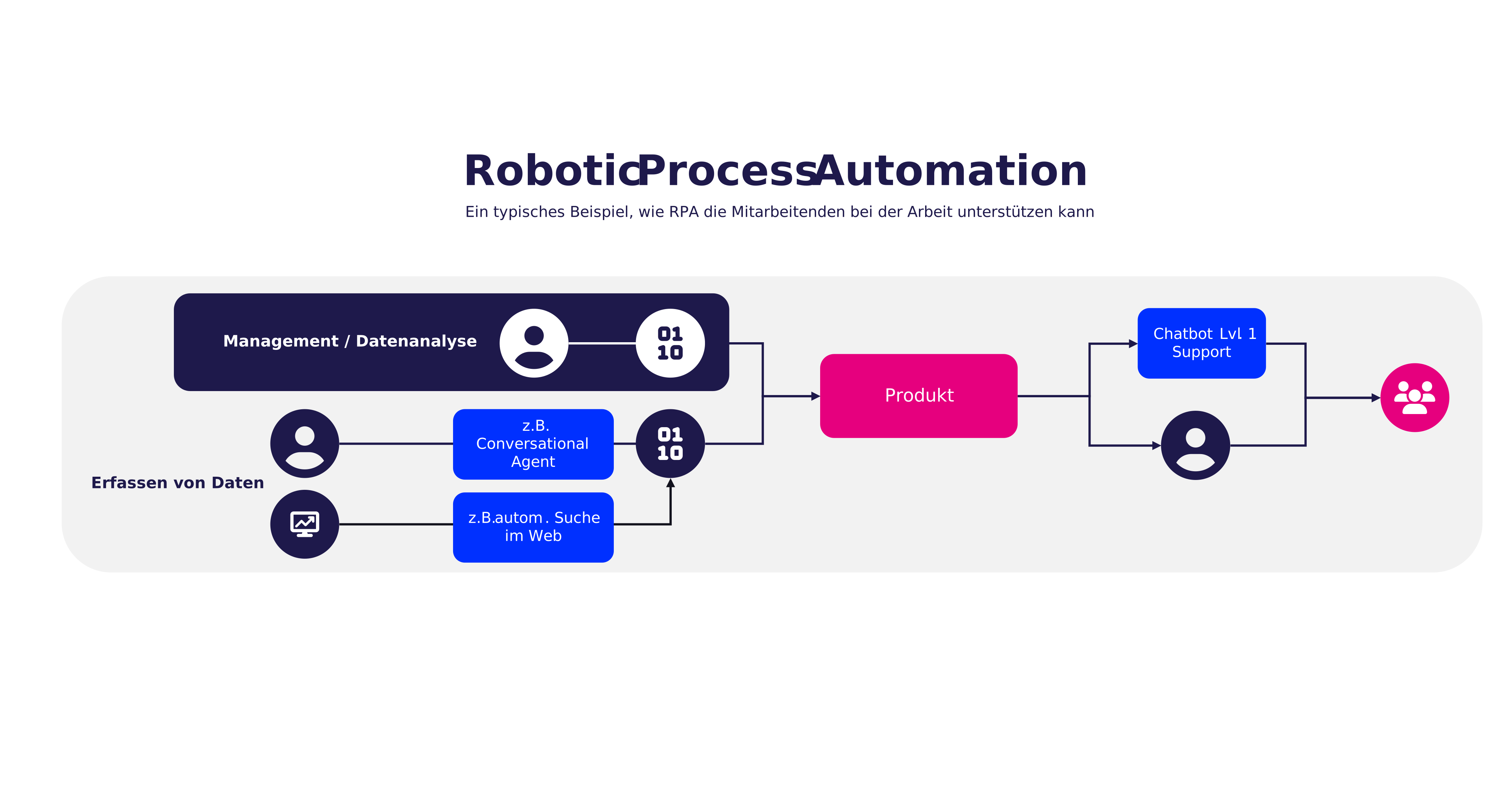
Various technological gears mesh together in this process:
-
Classic workflows: These control the choreography within a step—i.e., who does which task and when, and who approves it.
-
End-to-end process: This is the big picture. RPA automates processes across departmental and system boundaries.
-
UI interaction & APIs: The bot either uses the user interface (UI) when interfaces are missing or communicates directly via APIs.
-
AI components: These make the bot smart so that it can also understand unstructured data.
RPA thus evolves from a pure click machine to a strategic link in your system landscape.
Even though the terms are often confused, it is important to distinguish between them:
-
Digitization is the basis (data becomes digital).
-
Optimization is the goal (processes improve).
-
Automation is the means.
RPA is the tool that builds bridges where traditional IT reaches its limits. And AI? It is the upgrade that transforms the bot from a mere click machine into a thinking partner.
How RPA reduces operational workload and creates business value
RPA is not an end in itself, but rather a tool for bringing order to process chaos. Its use creates structure in three core areas:
-
Interface management: Bots act as a link between heterogeneous systems. They collect data, consolidate it, and transfer it in the correct format to downstream processes, significantly reducing media breaks.
-
Predictability & service quality: Specialists only get involved when real expertise is required. Bots perform routine tasks according to fixed rules, at a stable pace and with consistent quality. This increases the predictability of your processes and ensures that throughput times remain calculable and error rates minimal.
-
Scalability: RPA enables peak loads to be absorbed without organizational restructuring. New use cases can be added in a modular fashion without disrupting the existing IT architecture.
True efficiency isn't just measured in seconds saved. A much more exciting indicator is this: Are your personnel costs for routine tasks going down while quality is going up? If so, you've made the leap from a simple DIY solution to strategic value creation.
Where can RPA be used?
RPA is primarily used where processes are heavily influenced by interaction, handovers, and recurring communication. The technology supports departments in collecting, structuring, and processing information, often as an upstream instance to existing workflows and systems.
| Area | Top use cases | Specific benefits |
|---|---|---|
| Finance & Accounting | Invoice processing, expense reporting, account reconciliation | Reduction in booking errors, faster monthly closings |
| Human Resources (HR) | Onboarding new employees, master data maintenance, payroll accounting | HR teams have more time for employee support instead of data maintenance |
| Customer Service | Pre-qualification of inquiries (chatbots), status updates to customers | 24/7 response time and relief for the hotline with standard questions |
Supply Chain & Purchasing | Order processing, supplier onboarding, inventory monitoring | Transparent supply chains and automatic reordering in case of bottlenecks |
IT-Support | Password resets, ticket categorization, user activations | Faster resolution of standard tickets (first-call resolution) |
Automation shouldn't keep you awake at night. That's why we build regulatory guidelines directly into the bot logic. This ensures that your compliance remains watertight and your employees can focus on more important things:
-
Financial service providers: We take MiFID II, PSD2, and AML/KYC standards into account directly in the process.
-
Healthcare: Bots work according to GMP requirements and use interoperability standards such as FHIR.
-
Retail & e-commerce: Here, the focus is on PCI DSS compliance for payment data and rapidly scalable APIs.
This turns a simple bot into a reliable support for your regulatory obligations.
Guide to successful RPA implementation
Anyone can install software. The trick is to find the processes where it is really worth using. At MaibornWolff, we don't impose a rigid framework on you. Instead, we look at your existing IT landscape and the maturity of your processes. Our goal is to provide honest advice: we only automate what really makes sense.
Phase 1: The reality check
Success begins with selecting stable, suitable processes (proof of concept).
-
Identify processes (high degree of standardization, high volume)
-
Make rules, exceptions, and dependencies transparent
-
Evaluate automation potential using KPIs (e.g., throughput time, error rate)
-
Implement pilot process under realistic conditions
Phase 2: Getting the team on board
Automation changes working methods. Involving all stakeholders at an early stage ensures acceptance and quality of the bots.
-
Integrate specialist departments: Use expert knowledge to correctly map process details and special cases (happy path vs. exceptions).
-
IT partnership: Involve IT at an early stage for operational security, governance, and technical integration.
-
Transparent communication: Disclosure of goals and impacts to reduce reservations.
-
Enablement: Empowering employees (upskilling) to use RPA solutions and recognize potential.
-
Role clarification: Definition of clear responsibilities (e.g., process owner, bot controller) and escalation paths.
Phase 3: Step on the gas and keep going
After the pilot project (proof of concept), the transition to regular operation and controlled expansion takes place.
-
Center of Excellence (CoE): Pooling of RPA expertise and definition of uniform development standards.
-
Pipeline management: Continuous identification and prioritization of new automation candidates based on ROI.
-
Monitoring: Ongoing monitoring of bot performance, stability, and error rates
-
Lifecycle management: Regular adaptation of bots to updates of target applications or changed processes
-
System integration: Ensuring that RPA solutions remain compatible with the overall IT and data strategy
Mastering challenges effectively: Where RPA comes in and where additions are needed
RPA is an excellent assistant, but not a decision-maker: automation ends where human judgment begins. The bot takes care of the tedious data preparation so that your experts can focus their expertise fully on making truly smart decisions.
RPA works particularly reliably in clearly defined, stable processes. If processes are changed frequently or are only implicitly known, the maintenance effort for automation increases. A clear process description and conscious handling of exceptions create the necessary stability and make RPA maintainable in the long term.
Traditional RPA solutions are designed for structured inputs. As soon as free text, speech, or images come into play, pure rule sets reach their limits. Modern RPA approaches therefore combine bots with complementary technologies, such as for text or speech input, and integrate them specifically into the overall process.
One of the biggest challenges arises when RPA is used in isolation. Without integration with existing processes, systems, and data structures, isolated solutions with limited impact are created. However, when RPA is understood as part of a comprehensive automation and data strategy, it makes an important contribution, particularly when it comes to collecting, preparing, and providing information.
RPA is not a substitute for well-thought-out process design or integrated IT architectures. Its strength lies in closing gaps, facilitating transitions, and supporting people in their everyday work. Those who consciously plan for this role avoid typical stumbling blocks and lay the foundation for sustainable automation.
Less routine, more business with MaibornWolff
Don't use RPA as a digital band-aid for poor processes, but as a lever for real freedom. We ensure that the bots fit seamlessly into your world – quietly, stably, and efficiently. Let's work together to find out where we can relieve your team of tedious tasks.
Frequently asked questions about RPA
Is RPA more of a short-term transitional solution or a long-term strategy?
RPA is often used as an entry point into automation, but it is not purely a transitional technology. Used correctly, it remains relevant in the long term. In particular, it serves as a link between existing systems, people, and more advanced automation approaches such as IT automation or AI automation.
How does RPA differ from business process management (BPM)?
BPM (Business Process Management) considers the entire end-to-end process across all departments. A workflow defines the logical sequence of steps within a system. While classic workflow automation handles internal routing, RPA acts as a smart mediator between worlds to close manual gaps in a complex end-to-end process.
What role does the cloud play in RPA projects?
Cloud platforms facilitate the operation, scaling, and orchestration of RPA solutions. They enable centralized management, monitoring, and integration of additional services. However, whether the cloud is a sensible option depends heavily on security requirements, data flows, and existing IT strategy.
Can RPA be used effectively without AI?
Yes. RPA works very effectively even without AI, primarily for clearly structured, rule-based tasks. AI expands the scope of application, but is not a prerequisite for successful RPA projects.
What are the risks of implementing RPA without governance?
Without governance, uncoordinated individual automation projects can arise that are difficult to maintain and do not deliver sustainable benefits. Typical risks include dependence on individuals, lack of transparency, and increasing maintenance costs.
As a consultant and software designer, Vadim actively shapes the solutions developed by the Pro-Code AI Solutions delivery unit. With a background in digital design and process usability, he focuses on measurably improving business and production processes. In customer projects, he ensures that new solutions can be easily and intuitively integrated into the existing corporate ecosystem without any friction losses.