

Process automation in companies: From time-consuming task to self-running process
Estimated reading time: 9 minutes

Process automation offers companies great opportunities: processes become faster, more stable, and easier to control. The decisive factor here is not so much the technology used as the right choice of processes. Automation is most beneficial where volume, repeatability, and clear decision-making logic come together. Those who select processes in a targeted manner and consider automation from the outset create solutions that work in everyday life, can grow with the company, and have a long-term impact.
The most important information in brief
-
What does process automation mean? The term refers to the targeted automation of recurring, rule-based procedures in order to make business processes more efficient, stable, and easier to control.
-
Why is process automation important? It helps companies reduce complexity, lower manual effort, and operate processes reliably.
-
Which processes are suitable for automation? Processes with high volumes, clear rules, and stable workflows, primarily those where error rates or manual effort are high.
-
How do you get started? Through clearly defined pilot projects or proofs of concept that test the benefits and feasibility before scaling up.
-
What are the typical challenges? Established system landscapes, data quality, and organizational issues such as governance, compliance, and change management.
What does process automation mean?
Technically speaking, process automation—or business process automation (BPA)—refers to the automated control of business processes by software, from simple data reconciliation to complex decision-making. In practical terms, it means one thing above all else: freedom from monotony. Your employees are relieved of repetitive “robotic tasks” and can once again devote themselves to value-adding activities.
But beware of the “shiny object syndrome”: many companies make the mistake of falling in love with a technology first and then desperately searching for use cases. We recommend the opposite approach. Make a strict mental distinction between the domain (the technical problem you want to solve) and the tool (the software you use to do so). Successful automation always starts with the process, never with the tool.
Digitization, optimization, automation: Please don't roll the dice
These three terms often end up in the same buzzword pot, but the distinction between them is crucial to your success. Let's take an honest look at them:
-
Digitization is the basis: It turns analog information into processable data. But be careful: if you digitize a poor analog process 1:1, you'll end up with nothing but digital garbage.
-
Optimization is a must: Before we throw technology at it, we clean up. We simplify processes and get rid of ballast. Only a stable process is worth scaling.
-
Automation is the turbo: It can only be ignited once the track is in place. Prematurely automating unstable processes does not create relief, but rather expensive, maintenance-intensive “island solutions.”

Would you like to know how your processes can be automated pragmatically? Together, we will clarify where it makes sense and creates real added value.
Automate – but with a plan!
Automation is a tool: it pays off where it reduces complexity and noticeably lightens your team's daily workload.
Where automation is particularly useful
Not every process needs a digital turbo boost. Indiscriminate automation is a waste of money. Experience has shown that a rule of thumb applies: automation is a game changer when tasks are repetitive, follow clear rules, and involve high volumes.
If you identify processes that tie up valuable skilled workers with monotonous “data shuffling,” you have found the ideal candidate. We currently see the greatest leverage for efficiency and quality in the following areas in particular:
This is less about speed and more about absolute precision and regulatory compliance.
-
The use case: Automation is often the only way to ensure compliance with complex regulations such as MiFID II, PSD2, or AML/KYC (anti-money laundering).
-
The benefit: Systems take over account reconciliation or claims management in an audit-proof and GDPR-compliant manner. This provides peace of mind before the next audit.
The biggest challenge in industry is often the language barrier between the factory floor (operational technology) and business IT.
-
The use case: Modern solutions link MES and SCADA data directly to the planning level.
-
The benefit: This enables true predictive maintenance and automated quality control. It is important here that alarm paths and security (according to ISO 27001) are prioritized so that problems are solved before the conveyor belt stops.
In logistics, the flow of information is just as important as the flow of goods. Outdated Excel lists are fatal here.
-
The use case: Automation takes over tracking via IoT integration (GPS), controls customs processes, and bridges system breaks to ERP via APIs.
-
The benefit: Seamless documentation and smooth processes, even when suppliers and partners use completely different IT systems.
Good service requires empathy—but the algorithm can do the groundwork.
-
The use case: “Ticket triage” automatically classifies customer inquiries and resolves standard issues (such as password resets) immediately without human intervention.
-
The benefit: In retail, this absorbs peak loads (e.g., on Black Friday), for example, in returns processing, while sensitive payment data (PCI DSS) remains protected. The team is relieved and has time for complex customer issues.
Where restraint is advisable
Not every process should be automated. Processes are less suitable if:
-
Exceptions are the norm: The process changes frequently or is difficult to predict.
-
Human judgment is crucial: For example, in complex individual decisions or negotiations.
-
The effort involved outweighs the benefits: If implementation and operation cost more than they save.
In these cases, simplification or better structuring is often the more sensible first step.
Is it worth it? The math behind automation
The short answer is yes. The honest answer is only if you don't make naive calculations. True cost-effectiveness does not come from simply saving a few minutes of work, but from striking a balance between hard savings and technical stability.
The pragmatic ROI check (hard figures)
Don't rely on gut feeling. Whether a process is ripe for automation can be measured using specific key performance indicators (KPIs). In practice, these metrics have proven themselves in demonstrating success in black and white:
-
Cost per transaction: What does manual processing cost compared to automated processing (including license costs)?
-
Error rate & rework: How often does a human have to make corrections? These hidden costs are eliminated with good automation. Throughput time: How much faster is the result delivered?
-
Transformation rate: What percentage of cases run completely in the background (without human intervention)?
Our tip: Start with a clearly defined pilot project. This will provide reliable figures for the projection without immediately triggering huge investments.
Maturity Level: The Pitfall of Brittle Automation
One cost factor that is often overlooked is maintenance. Many companies build quick, makeshift solutions that work today but break down tomorrow with the slightest software update (known as brittle automation).
If you need a developer every week to repair the bot, the ROI is gone. Therefore, pay attention to metrics such as MTTF (Mean Time To Failure) – in other words, how long does the thing run stably? A robust architecture costs a little more initially, but saves expensive firefighting in the long run.
Which technologies are suitable for which processes?
The choice of the right technology depends on the process and its maturity level. The following overview classifies the most important approaches in a compact and practical manner.
| Technology | Suitable for | What it is particularly good for | Typical application |
|---|---|---|---|
| RPA | Rule-based tasks without APIs | Quick start, no system changes | Data transfers between legacy systems |
| BPM | End-to-end processes across multiple systems | Control, transparency, compliance | Approval processes, order-to-cash |
| Low-Code | Simple, customized specialist applications | Fast implementation, high flexibility | Prototypes, internal tools |
| AI | Unstructured data, variable decisions | Pattern recognition, decision support | Document processing, classification |
How to get started? From proof of concept to scaling
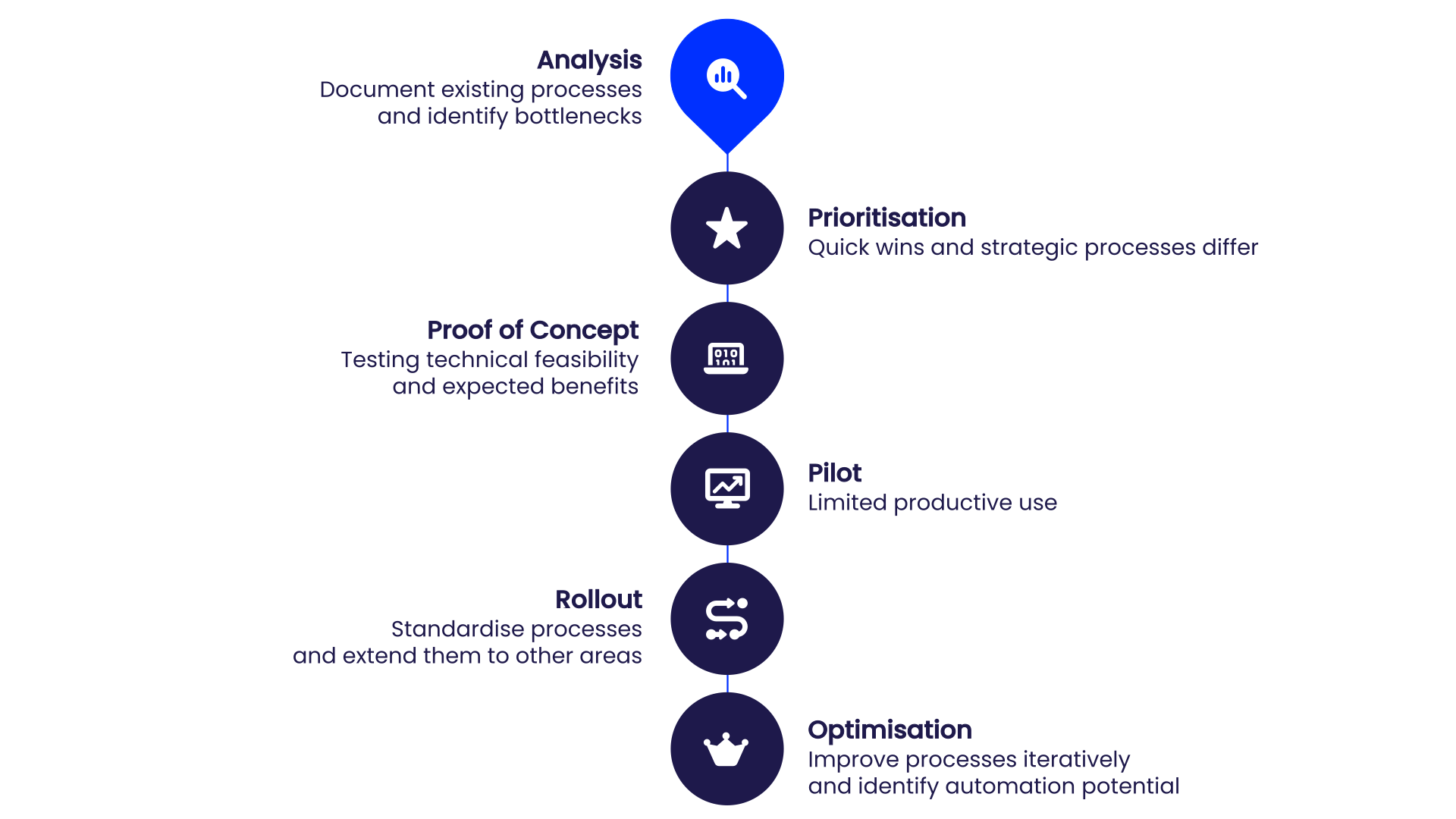
Successful process automation starts small and scales in a targeted manner. A proof of concept (PoC) tests feasibility and benefits. Pilot projects gather experience. Only then does the company-wide rollout follow: agile, iterative, and with clear risk management.
Outlook: Where the journey is headed (more connected, more intelligent, more pragmatic)
The era of isolated island automation is over. In the future, we will no longer view process chains as rigid sequences, but rather as dynamic systems. The biggest trend here is data proceduralization: it is no longer just about the tool, but about allowing data to flow freely—across application boundaries.
The process as software
An exciting paradigm shift for decision-makers: Think of your business processes as software development in the future.
-
Testability: A process must be measurable (KPIs, ROIs) before it goes live.
-
Modularity: Each process step has APIs so that it can be flexibly docked.
-
Agility: Instead of rigid processes, adaptable workflows are created that are centrally orchestrated in the cloud.
Cloud-native as standard, not as an option
Why the cloud? Because it provides the flexibility needed for this kind of networking. Compared to traditional on-premises approaches, cloud-native automations are easier to scale and roll out across locations. They form the backbone of hyperautomation—the coordinated use of RPA, AI, and analytics along an entire value chain.
AI agents: Lots of potential, but keep your feet still
Autonomous AI agents (agentic AI), which plan and execute tasks independently, are showing exciting initial results in customer service and support. But let's be honest: the technology is still in its infancy. Many are testing it, but few are scaling it productively. For you, this means observing the trend, but starting pragmatically. Not every automation needs AI—often, stable rule logic is completely sufficient.
From knowledge to impact: your starting signal with MaibornWolff
Theory is good, but working processes are better. Our experience shows that many automation projects fail not because of the technology, but because of excessive complexity. That's why we apply the principle: as little technology as possible, as much as necessary.
We don't start with an expensive tool battle, but with an honest assessment of the current situation. We help you identify the real time wasters and build solutions that not only look good on paper, but are celebrated by your team in their everyday work.
Do you want processes that provide lasting relief instead of creating new problems? Let's talk about your pain points without obligation – and how we can solve them pragmatically.

Let's talk about your pain points without obligation – and how we can solve them pragmatically.
Frequently asked questions about process automation
How long does it take for process automation to deliver measurable benefits?
Erste Effekte zeigen sich häufig bereits nach wenigen Wochen, etwa durch reduzierte Bearbeitungszeiten oder weniger manuelle Eingriffe. Nachhaltiger Nutzen entsteht meist dann, wenn Automatisierung schrittweise ausgebaut und in den Regelbetrieb integriert wird.
The first effects are often visible after just a few weeks, for example in the form of reduced processing times or fewer manual interventions. Sustainable benefits usually arise when automation is gradually expanded and integrated into regular operations.
What role does IT play in process automation?
IT ensures stability, security, and integration. At the same time, its role is increasingly shifting from pure implementation to enablement: it provides platforms, standards, and guidelines within which specialist departments can automate.
What are the risks associated with business process automation?
Typical risks include unclear process definitions, poor data quality, or a lack of acceptance among employees. Overly complex solutions can also become a problem if maintenance and operation are underestimated. However, these issues can be easily addressed if processes are clearly structured in advance, data quality is taken into account at an early stage, and specialist departments are involved from the outset.
As a consultant and software designer, Vadim actively shapes the solutions developed by the Pro-Code AI Solutions delivery unit. With a background in digital design and process usability, he focuses on measurably improving business and production processes. In customer projects, he ensures that new solutions can be easily and intuitively integrated into the existing corporate ecosystem without any friction losses.